Monday, January 17, 2022

Future Dividend Income is Not Cheap

Last year was a record for dividend payments in the US. This continues the trend of the past 13 years, which wasn't interrupted even in 2020. I obtained data from Standard & Poor's that companies in the S&P 500 paid more than $500 billion in dividends to their shareholders.

Dividend payments on S&P 500 index increased by 3.62% in 2021, from $58.28 to a record of $60.39. That's the 12th consecutive year of annual dividend increases for S&P 500, meaning that the index itself is a dividend achiever.


Over the past sixty years, payments on the S&P 500 index have generally just trended upwards. The only exception was during the Global Financial Crisis, when payments decreased in 2008. Despite the Covid-19 shutdowns however, S&P 500 dividend payments rose from $58.24 to $58.28. This is impressive growth, given the fact that a lot of businesses worldwide were shut down. During the bleakest days in March and April 2020, forecasters were expecting double-digit decreases in dividends in 2020. So we pulled through.


While dividends kept growing, earnings per share grew faster in 2021. 

Share prices also grew faster than dividends in 2021. As a result, the dividend yield on S&P 500 dropped to the lowest level in 20 years. Those are the days of the Dot-Com bubble for reference. The dividend yield on S&P 500 on December 31, 2021 was at 1.27%.


It looks like the price of future income is definitely more expensive, because dividend yields are lower today. Of course, I can see that as I am trying to look for good quality dividend growth stocks. It is definitely getting harder to find those hidden gems and buy them at a good price today. This is where looking for individual companies may pay off today.

On the other hand, while stocks are not very cheap, there is no alternative really today that can generate and grow investor capital for the long-run either. 

While S&P 500 has a P/E of 24 today, that is equivalent to an earnings yield of 4%, which is better than the 30 year Treasury Yields of 2%.Of course, we should not forget that earnings would likely grow at around 6%/year over the long run, while bond coupons would never grow.


One similarly between today and 20 years ago is the fact that almost a quarter of the market capitalization of S&P 500 index is derived from companies that do not pay dividends. Some of them are the so called FANGs - Facebook, Amazon, Netflix and Google's of the world.  However, the major difference is that the companies with no dividend payments in 1999 - 2001 could not afford to pay dividends, and they were wildly overvalued. In contrast, the largest companies like Apple, Microsoft, Facebook and Google are earning good profits, they are not selling for more than 30 times earnings, and they are growing those profits quickly ( well, sans Apple).


The one major difference between today and the period from 20 years ago is that companies tend to spend more money on share buybacks than dividends. In comparison, companies spend roughly equal amounts on dividends and buybacks about 20 years ago.


This brings me to the next point. While future dividend income is more expensive, that doesn't mean that investors should not be investing. Not investing means timing the market. It also means missing out on the power of compounding. I believe that investors should be investing when they have money to invest, in the best values they can find at the time. 

The current environment definitely shows the importance of focusing on items within your control. While I do not know if a company would do well over the long-run, I can focus on factors within my control.

For example, I can require quality from the companies I invest in. I can require growth in earnings per share, and an adequate coverage in the dividend payout ratio. I can also be somewhat choosy about the valuation as well.

Most importantly, it would also mean ensuring that I keep investment costs low.  If I buy a stock yielding 3%, and I pay a 1% fee to a financial advisor or a mutual fund manager, I am effectively losing a third of income. 

In addition, if I pay a 15% tax on those dividends, I lose out on 15% of income. I can reduce that by prioritizing investing through tax-deferred accounts such as a Roth IRA for example.

Another item within my control is my savings rate. When I earn less in dividend income from the same amount of money as I did before, I should try to cut costs and increase income in order to be able to save more money.

I think that there are good companies at attractive valuations today. Investors who screen their universe can find good opportunities to build a diversified portfolio of stocks today. That's what I am trying to do too in my premium newsletter as well.


Relevant Articles:


Friday, January 14, 2022

Blackrock (BLK) Dividend Stock Analysis

Blackrock (BLK) is the largest investment manager in the world, with over $6.5 trillion in assets under management.

Over the past decade, the stock has compounded by 19.57%/year. Future returns will likely be lower, and they will track growth in earnings per share and the initial dividend yield at the time of investment.


The company has managed to grow dividends for thirteen years in a row. The last dividend increase occurred in January 2022, when the company raised quarterly dividends by 18.20% to $4.88/share.
Between 2009 and 2019, Blackrock compounded dividends at an annualized rate of 11.60%/year. The company last raised dividends by 18.20% to $4.88/share in January 2022. 


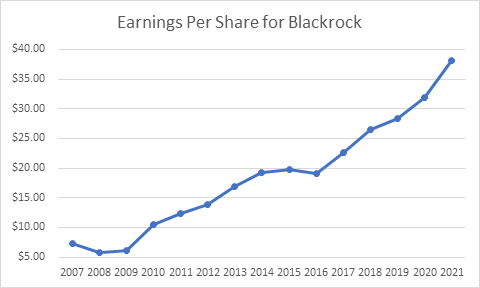
Between 2011 and 2021, Blackrock managed to grow its earnings from $12.37/share to $38.22/share. The company is expected to earn $47.24/share in 2022.


The company is a leader in the asset management industry, with tremendous scale. It also has a diversity of products offered (equity, fixed income etc), geographic diversity ( Americas, Europe, Asia etc) in its products offered and the types of strategies offered ( active, passive, cash management). The company also has diversity in clients served – retail & institutional.
 
The company is a leader in ETFs, with tremendous inflows coming its way as there is a trend to switch from high cost mutual funds to ETFs. Unfortunately, passively managed ETFs provide a lot of assets, but not as much in profits as actively managed funds. The actively managed funds that Blackrock manages tend to be a portion of the assets, but account for almost half of profits. Actively managed products accounts for a quarter of assets and half of revenues. Passively managed assets account for over 2/3rds of AUM, but half of revenues.

Blackrock has managed to grow organically, through new product introductions and through acquisitions. Given it massive scale, it is quite possible that new acquisitions will not have as big of an impact in the long-run. The massive scale does create advantages, since it spreads costs over a larger base, thus ensuring higher profits than smaller competitors. This also offers advantages in distribution as well.

Most asset managers manage to grow the bottom line by attracting new funds from new or existing investors, net of any that sell their holdings. Blackrock has done a great job growing assets organically and through acquisitions over the past decade. If financial markets rise over the next decade, it will also benefit from growing assets under management brought by higher prices. This is a two-edged sword however, because it leaves them exposed in the short-run by market volatility. I do believe that in the long-run, assets will likely go up, bringing a nice tailwind to investment managers such as Blackrock. If we get lower prices in the short run however, we will witness lower earnings per share and lower multiples. This is why I am buying those assets managers on the scale down.

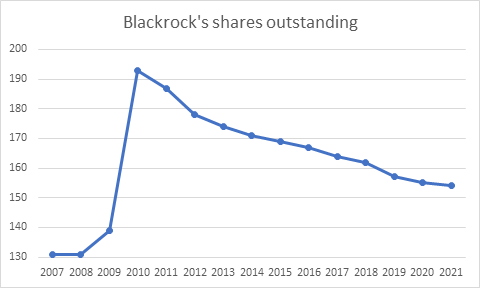
The number of outstanding shares increased between 2009 and 2010, due to acquisitions. That was the acquisition of Barclays Global Investors (BGI), which brought the iShares ETF franchise to Blackrock. Blackrock has been steadily reducing the number of share outstanding since then. Regular share buybacks can increase investors ownership interest in an enterprise, and automatically lift earnings per share. Companies have to be careful however not to overpay for shares they are retiring, otherwise they are wasting shareholder assets.


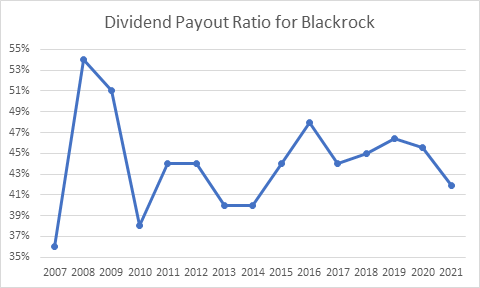
The dividend payout ratio has remained around 45% during the current decade; the only volatility occurred during the 2007 – 2009 financial crisis, when declines in assets under management resulted in lower earnings per share. The company did keep the dividend unchanged in 2009. 


Currently, shares of Blackrock are valued at 22.33 times earnings and spot a dividend yield of 1.90%. 
Relevant Articles:

How to value dividend stocks
- Franklin Resources (BEN) Dividend Stock Analysis
Eaton Vance (EV) Dividend Stock Analysis
The Pareto Principle In Dividend Investing

Wednesday, January 12, 2022

Dividend Champions List for 2022

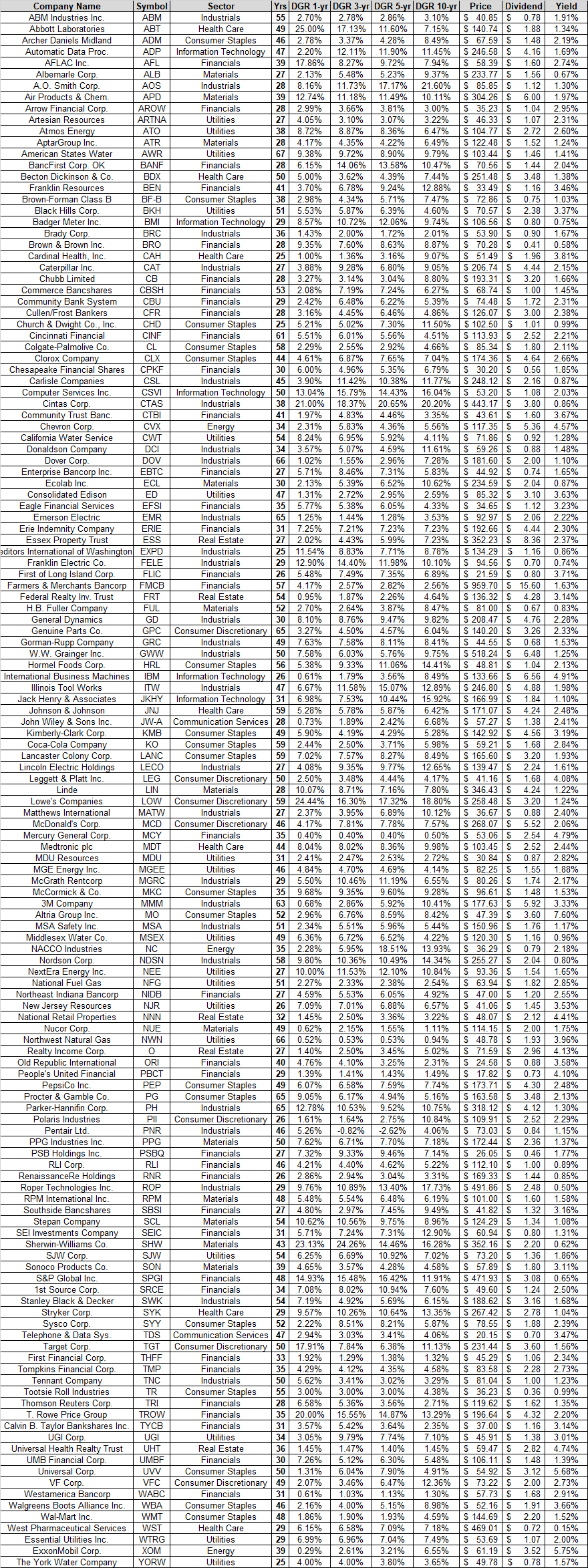
dividend champion is a company which has a 25 year record of annual dividend increases. There are only 137 such companies in the US today. I believe that becoming a dividend champion is no accident, and it is a result of a strong business that has generated earnings growth for a long period of time. These are the types of businesses I like to study, and potentially consider at the right time for my dividend portfolio. I believe that the dividend champions list offers a more complete picture than the dividend aristocrats.

The creator of the Dividend Champions list was David Fish, who unfortunately died in 2018. I decided to do annual updates based on his work.

This year, I decided to keep it simple, and kept the data per each company to a minimum.

As a starting point, there were 138 companies on the dividend champions list at the end of 2020.

There were five companies that ended up leaving the Dividend Champions list in 2021. These companies left for various reasons. The companies that left include:

- Eaton Vance Corp. (EV) - Acquired
- AT&T Inc. (T) - Kept dividends unchanged in 2021
- United Bankshares Inc. (UBSI) - Kept dividends unchanged in 2021
- Weyco Group Inc. (WEYS) - Kept dividends unchanged in 2021
- Raytheon Technologies (RTX) - spin-offs reduced total dividend income in 2020. Should've removed in 2020


The number in brackets is the number of year of consecutive annual dividend increases for each of these five companies.

There were four companies added to the list in 2021. These companies achieved dividend champion status by raising dividends to shareholders for 25 years in a row. The companies include:

- Cardinal Health, Inc. (CAH)

- Church & Dwight Co., Inc. (CHD)

- Expeditors International of Washington, Inc. (EXPD)

- The York Water Company (YORW)


All of this brings the list of dividend champions to 137 companies by the end of 2021. You can download the list from here.


Monday, January 10, 2022

There is no alternative (TINA)

 Interest rates in the United States of America have been on a decline for over 40 years. 

Source: J.P. Morgan Guide to Markets

Over the past 10 – 15 years however, rates have practically reached very low levels. While it was possible to earn 4% - 5% from a short-term Certificate of Deposit or a Savings account before, today rates are more pitiful.


Source: J.P. Morgan Guide to Markets


In addition, rates on long-term US Treasury Bonds, particularly the 10 and the 30 year ones have been decreasing as well. Interest coupons are correlated with returns on bonds. Therefore, if you invest in a 30 year US Treasury bond yielding 2.10% today that you hold for 30 years, you are unlikely to generate more than 2.10%/year.  This means that on a $100,000 investment, you are unlikely to generate more than $2,100/year in interest income. 


Source: Bloomberg

This income is taxed at ordinary tax income rates, and is fixed. It won’t grow to compensate for the loss of purchasing power due to inflation. Treasury Inflation Protection Bonds and iBonds exist, but these don’t yield much. They will likely protect principal at most.

Of course, US bond investors are lucky. The rest of the developed world has long-term bonds which yield practically nothing.

Source: J.P. Morgan Guide to Markets


If you are a saver, the only alternative you have to generate income, and protect principal against inflation is in equities. This means that investors have to take on risk in order to generate an adequate return.

Some may argue that this risk on environment has pushed valuations higher, and therefore future returns lower. It has certainly pushed down yields on US equities, as shown by S&P 500. 


Source: Standard and Poor's

Of course, as investors, we take a DIY approach where we select companies individually, based on our own parameters for our strategies. I believe it is possible to build a portfolio today that would yield around 3% today, whose dividend income would outpace inflation in the long-run, and which would likely grow earnings and share prices in the long-term as well.

It is better to generate some return on investment by investing in equities rather than slowly lose purchasing power to inflation by lending money to the US Government.

To illustrate the dilemma, I compared the yields on US Treasury bonds to the average yield on the 63 Dividend Aristocrats ( They removed AT&T at the end of 2021 and also removed Legett & Platt because it was kicked out of S&P 500).

I believe that the 63 Dividend Aristocrats today offer a better alternative for a long-term investor with a 20 or 30 year timeframe than an investment in US Treasury Bonds over the same time period.


Source: Dividend Growth Investor/Standard and Poor's

The average yield on the dividend aristocrats is 2.22% today. The P/E is at 19 today, according to Morningstar, which is not too high. It brings in some margin of safety in case rates revert back to a more normal 4% - 5%. 

These companies are likely to grow earnings, dividends and share prices over the next 20 – 30 years easily. If a company yields 2% today, but grows dividends at 7%/year, it could double dividends in roughly a decade. This means that the yield on cost would rise to:

  • 4% in 10 years
  • 8% in 20 years
  • 16% in 30 years

If dividends grow above the rate of inflation over the next 20 years, as they have historically, then the purchasing power of that income will be maintained and even increased. If earnings grow as well, this means that the value of the investment would also maintain purchasing power as well. While stock prices fluctuate in the near term, in the long-run they follow the trend in earnings. Therefore, a patient long-term investors would have a chance of the best of both worlds – generating an inflation adjusted stream of income while also growing purchasing power of their capital as well. To add to that, qualified dividends and long-term capital gains are taxed at preferential rates today.  Taxes can be managed of course, by using a retirement account for example. Of course, the risk with Equities is that earnings and dividends do not grow, and share prices do not grow either. Nothing is guaranteed. However, I do believe that taking a risk by investing in equities today is less risky for the long-term investor than not taking a risk at all.

Investors in 30 year US Treasury Bonds are essentially locking in 2.10% for the next 30 years. That coupon will not increase, but is guaranteed by the US Government. However, it is very likely that the purchasing power of that income and the purchasing power of that principal would be much lower in 30 years. Furthermore, this income will be taxed at ordinary income tax rates. However, taxes can be managed too.

What is the point of this article?

It shows me that equities are better investments thant fixed income for someone with a 20 – 30 year horizon. They are likely to generate growth in earnings over time, which would grow dividends and share prices. This would maintain and even increase purchasing power of dividend income and capital invested.  This has been the case for the past decade.

While equities may seem expensive at 20 – 24 times earnings, this is equivalent to an earnings yield of 4% to 5%. This is higher than interest yields of 2%. It also provides margin of safety in case interest rates revert back to 4% - 5%, because it shows that P/E multiples on average would not contract by much.

I believe that a prudent investment method would be to invest in dividend growth stocks, such as the Dividend Aristocrats. That’s because these companies have a proven track record of growing dividend income throughout various economic and business conditions. They also have a track record of growing earnings and are likely to grow share prices too. Of course, not all companies on the Dividend Aristocrats list are buys today. The investor would have to evaluate each company in order to determine if:

- They can grow earnings, in order to grow the dividend
- The payout ratio is adequate and dividends are not in danger of a cut
- Valuation is adequate

In order to keep costs low, I would focus on avoiding ETF charges and stock commissions. I would also focus on investing through tax-deferred accounts, in order to keep taxes low. It does pay to be selective however.

Relevant Articles:


Thursday, January 6, 2022

Bristol-Myers Squibb (BMY) Dividend Stock Analysis

 Bristol-Myers Squibb Company (BMY) discovers, develops, licenses, manufactures, markets, distributes, and sells biopharmaceutical products worldwide. The company is a dividend achiever with a thirteen year track record of annual dividend increases. 

During the past decade, the company has managed to increase dividends at an annualized rate of 3.47%. The last dividend increase was in December 2021, when the company increased its quarterly dividend by 10.20% to 54 cents/share. I believe that future dividend growth will be higher than historical growth, due to the acquisition of Celgene.


Between 2010 and 2020, the company has managed to increase Non-GAAP earnings per share from $2.16 to $6.44. I use non-GAAP EPS because it is cleaner, and takes a look at a lot of one-time items or certain GAAP items that make looking at the business more complicated than it should be. Of course, the downside to this line of thinking is that management may decide to place regular and recurring expenses in the “special items” column, but refer to them as one-time.


Either way, the company is expected to grow Non-GAAP earnings per share to $7.35-$7.55/share by 2021.

Earnings per share will grow from finding new drugs, raising prices on existing ones, selling more, strategic acquisitions, and cutting costs. 

In 2019, Bristol-Myers Squibb acquired Celgene for cash and stock. This diversified its drug portfolio, and provided an additional margin of safety against patent cliffs. 

This deal was accretive to Bristol-Myers due to the fact that the P/E paid for Celgene was lower than the one that BMY stock had; In addition, the part that was financed through debt was accretive, because debt is very cheap today, and is well supported by the company’s strong cash flows. The company is also taking strides to repay it. 

The company has six novel compounds in either early-stages of marketing or late-stages of R&D. These new drugs are mostly in the large market therapeutic areas of oncology and immunology.

While the company has a pipeline of drugs in different stages of approval, there is always the risk of regulatory delays and the risk that they fail to deliver what they were supposed to. Once a drug is approved, it offers its owners the right to be the exclusive seller for a 20-year period of time. This exclusivity comes to an end however, at which point branded drugs lose out market share to cheaper generic drugs. 

It is also projected to generate cost savings or synergies. After all, the company gets to reduce headcount, decrease other expenses in the process, and generate incremental returns due to higher scale of operations. Of course, there is always integration risk, or the risk that the acquisition doesn’t turn out as expected, and the synergies that were expected do not get realized.


The number of shares outstanding decreased from 2 billion in 2008 to 1.637 billion by 2018. The acquisition of Celgene in 2019 has increased the number of shares outstanding to 1.712 billion in 2019 and increased it further to 2.258 billion in 2020.


The payout ratio has decreased over the past decade, from 83% in 2008 to 28% in 2020. A lower payout ratio should provide a better margin of safety from short-term turbulence in earnings per share. It can also provide additional fuel behind future dividend increases. This can result in dividend growth that is faster than earnings growth for a period of time. 


I find the stock to be attractively valued at 8.30 times forward earnings and a dividend yield of 3.47%.

Relevant Articles:


Popular Posts