Thursday, May 30, 2024

Marjorie Bradt - A Hidden Dividend Millionaire

I love reading stories about everyday people, who were able to accumulate wealth with long-term dividend investing.

These stories reiterate how to achieve success with investing:

1. Start early

2. Invest prudently

3. Have patience

4. Give your investments time

5. Let the power of compounding do the heavy lifting

Today's story is from one my favorite books on dividend investing. The book is The Ultimate Dividend Playbook: Income, Insight and Independence for Today's Investor, and it was written by Josh Peters, who was the editor of Morningstar Dividend Investor. 

The story covers Marjorie Bradt, an everyday investor who was gifted some old AT&T stock between 1955 - 1962 from her father. The stock was worth $6,626 then, which was not a small amount of course. But she did not sell it. She signed up for the company's dividend reinvestment plan, and then held on to any spin-offs in the process. 

By 1999, that investment had blossomed into 10 companies, worth more than $1 Million total..

You can read the part about Marjorie Bradt from the book below:

A Role Model

Dividend investors have few heroes, at least as far as you can discover by browsing the bookshelves at Barnes & Noble or reviewing a year's worth of cover stories in Fortune or Business Week. Indeed, dividends may be the most misunderstood aspect of investing in stocks, to the extent people bother to understand dividends at all. Most professionals are indifferent to dividends, and a surprisingly large minority are downright hostile. Even the fans of dividends you might see on TV or read about in a magazine are usually on their way somewhere else, collecting dividends just to kill time while waiting for other opportunities to crop up. True fans, those who understand the critical role of dividends over the long run, are very rare in the professional ranks.

As editor of a monthly newsletter devoted to the topic, Morningstar DividendInvestor, I am one of those rare professionals. And while I admire Warren Buffett, Peter Lynch, Marty Whitman, and many other famously successful and articulate investors as much as anyone, my true hero is—drum roll, please Marjorie Bradt.

Don't spend too much time trying to place her name; she's never been featured on CNBC or mentioned in the Wall Street Journal. She's never written a book about investing or managed a mutual fund. Indeed, the stock market has never even been a hobby of hers. Yet I'm willing to bet that Marjorie's long-term investment record beats the vast majority of investors over the past half century.

I became familiar with Marjorie's remarkable record while working as an assistant to a stockbroker in 1999. Marjorie and her husband, Don, were get- ting their ample estate in order, and they needed cost basis information for their seven-figure portfolio. Given this task, I was handed a folder six inches

thick with old statements, some dating back to the 1950s. The best information I had was their current portfolio, almost all of which consisted of the various corporate descendants of AT&T, the original Ma Bell.

Working backward from what they owned in 1999, I noticed that Marjorie's account was marked by a distinct lack of active management. All she did, it seemed, was reinvest her dividends-quarter after quarter, year after year, decade after decade. When AT&T broke up into a long distance-only carrier and the seven baby Bells, Marjorie held on to all eight stocks. When Southwestern Bell bought Pacific Telesis and Ameritech, she held on. When AT&T went on to spin out Lucent, and US West spun out MediaOne, she held on to those, too.

After more than a day's worth of work, I finally found the root of Marjorie's wealth: a handful of gifts of AT&T stock given to her by her father between 1955 and 1962. Their original value totaled $6,626. Very early on, she signed up for AT&T's dividend reinvestment plan. Instead of getting penny-ante dividend checks every three months, she turned those payments into additional shares, which led to more dividends, and so on. As AT&T prospered and raised its dividend rate, the value of each share rose as well as did the Baby Bells' dividends and share prices. By 1999, this investment had blossomed into a portfolio of ten separate stocks worth more than $1 million—all of them descendants of the original Ma Bell.

I was astounded. Here was all this wealth, but Marjorie hadn't lifted a finger to earn it. She hadn't foreseen the raging inflation of the 1970s, the surge in gold, the run of small caps, then large caps, then small caps again. She didn't predict anything—and she didn't have to. She just held and held, reinvesting every dividend, letting these rising dividend payments do all of the work.

The beauty of Marjorie's experience is its simplicity: Anyone could have done the same, even if virtually no other investors did. No PhD, MBA, or CFA was required; math skills learned in junior high school could suffice. Marjorie didn't have to trouble herself with a market-timing strategy or the pursuit of the next Microsoft. And it isn't as though AT&T was a diamond in the rough in the 1950s; back then the company owned almost every telephone in America. Other companies were growing faster, but millions of investors held stock in Ma Bell, drawn in by the same thing that made AT&T attractive to Marjorie's parents: large, steady, and growing dividends.

Marjorie thus traded the usual investor attempts at prescience for a combination of dividends and patience - and rarely does one find an example of such a richly rewarding investment strategy.


Monday, May 27, 2024

Six Companies Increasing Dividends to Shareholders Last Week

I review the list of dividend increases every week, as part of my monitoring process. I usually focus my attention on the companies with a ten year streak of annual dividend increases, and then review each company using my criteria. I am always on the lookout for new ideas, and to determine if my existing holdings are working. I also want to be ready to act quickly, when the right time arrives.

This exercise helps me to evaluate companies I already own, and see how they are doing. This is a helpful piece of the puzzle, that would be helpful when/if I decide to add to these companies at the right price.


When I review companies, I look at ten year trends in:

1) Earnings per share
2) Dividend payout ratio
3) Dividends per share
4) Valuation

This exercise also helps me identify companies for further research. A large part of the time is spent reviewing companies, screening for companies, and trying to learn more about companies, their business, etc. 

It is not glamorous at all, but dull and boring. 

But it does pay dividends.


During the past week, there were six companies that both raised dividends to shareholders and have a ten year streak of consecutive annual dividend increases. The companies include:

(This of course is just a list, not a recommendation)


Flowers Foods, Inc. (FLO) produces and markets packaged bakery food products in the United States. 

The company increased quarterly dividends by 4.30% to $0.24/share. This is the 22nd consecutive annual dividend increase for this dividend achieverdividend achiever. Over the past decade, the company has managed to raise dividends at an annualized rate of 7.40%

Earnings went from $0.84/share in 2015 to $0.58/share in 2023.

The company is expected to earn $1.22/share in 2024.

The stock sells for 19.20 times forward earnings and yields 4.10%.


Insperity, Inc. (NSP) engages in the provision of human resources (HR) and business solutions to improve business performance for small and medium-sized businesses primarily in the United States.

The company increased quarterly dividends by 5.30% to $0.60/share. This is the 14th consecutive annual dividend increase for this dividend achiever.dividend achiever. Over the past decade, the company has managed to grow dividends at an annualized rate of 20.70%. The pace of dividend growth has been decelerating in the past few years however.

Between 2014 and 2023, Insperity managed to boost earnings from $0.53/share to $4.53/share.

The company is expected to earn $3.65/share in 2024.

The stock sells for 27.47 times forward earnings and yields 2.40%


Lennox International Inc. (LII) designs, manufactures, and markets a range of products for the heating, ventilation, air conditioning, and refrigeration markets in the United States, Canada, and internationally. 

The company raised quarterly dividends by 4.50% to $1.15/share. This is the 15th year of consecutive annual dividend increases for this dividend achiever.dividend achiever. Over the past decade, the company managed to increase dividends at an annualized rate of 17.25%.

Between 2014 and 2023, the company managed to grow earnings from $4.30/share to $16.62/share.

The company is expected to earn $25.25/share in 2024.

The stock sells for 19.90 times forward earnings and yields 0.91%.


LyondellBasell Industries N.V. (LYB) operates as a chemical company in the United States, Germany, Mexico, Italy, Poland, France, Japan, China, the Netherlands, and internationally. The company operates in six segments: Olefins and Polyolefins—Americas; Olefins and Polyolefins—Europe, Asia, International; Intermediates and Derivatives; Advanced Polymer Solutions; Refining; and Technology.

The company raised quarterly dividends by 7.20% to $1.34/share. This is the 13th consecutive annual dividend increase for this dividend achieverdividend achiever. Over the past decade, the company managed to grow dividends at an annualized rate of 9.40%.

Between 2014 and 2023, the company's earnings went from $8.03/share to $6.48/share.

The company is expected to earn $8.27/share in 2024.

The stock sells for 11.90 times forward earnings and yields 5.44%.

Medtronic plc (MDT) develops, manufactures, and sells device-based medical therapies to healthcare systems, physicians, clinicians, and patients worldwide. 

The company eked out a 1.40% increase in its quarterly dividend to $0.70/share. Nevertheless this was the 47th consecutive year of dividend increases for this dividend aristocratdividend aristocrat. The rate of increase was much slower than the ten year annualized dividend growth of 9.75% however.

Earnings went from $2.44/share in 2015 to $2.77/share in 2023.

The company is expected to earn $5.45/share in 2024.

The stock sells for 15.10 times forward earnings and yields 3.40%


Universal Corporation (UVV) processes and supplies leaf tobacco and plant-based ingredients worldwide. The company operates through two segments, Tobacco Operations; and Ingredients Operations. 

The company increased dividends by 1% to $0.81/share. This was the 54th consecutive annual dividend increase for this dividend kingdividend king. Over the past decade, the company managed to increase dividends at an annualized rate of 4.74%.

Between 2015 and 2024, the company managed to slightly boost earnings per share from $4.33 to $4.81.

The company is expected to earn $4.78/share in 2024.

The stock sells for 9.70 times earnings and yields 7.04%.

Wednesday, May 22, 2024

Does timing the market work? If it does, does it pay?

 Does timing the market work? If it does, does it pay?


I tested this concept by creating a simple backtest.


I assumed that four different investors were able to put away $1,000/year at various points in the S&P 500 ETF (SPY) since 1993 through end of 2023. They all use a tax-deferred account, pay no commissions, and reinvest dividends. 


Investor A puts $1,000/year into S&P 500 ETF at the first available close price for the year

Investor B puts $1,000/year into S&P 500 ETF at the highest available close price for the year

Investor C puts $1,000/year into S&P 500 ETF at the lowest available close price for the year

Investor D puts $1,000/year into S&P 500 ETF at the last available close price for the year


As of last month, this is the total worth for each investor:


Investor A is worth $207,000.72

Investor B is worth $177,796.12

Investor C is worth $228,001.77

Investor D is worth $187,997.16


The conclusion that I have is to avoid timing the market. Even if you are consistently able to buy at the low of the year, every single year (which is impossible to do), you are not really that better off than someone who simply bought everything at the beginning of the year

And if you are afraid you will always buy at the top (which is also consistently impossible to do), you are not that far off either.  

If you look at it from a position of each individual year however, there is big variability. But looking at market only on a single year's worth of data is incredibly short term. It's noise.


For example, if you bought $1,000 worth of S&P 500 at the bottom in the year 2022, you returned over 7.50% in that year. You would become famous for timing that one single bottom and making money in a bear market, when everyone else lost money.

If you bought at the beginning of 2022, you would have lost 18.70% for that year on and your clients and everyone else would be laughing at you.

Yet, if you continued investing each year, your overall results won't be as huge, particularly when you get new capital added each year.  Adding that new capital each year smooths out things for you.

When you start averaging out, and stacking those investments year in and year out, brick by brick, you are in effect zooming out. You are taking a longer term approach and building wealth.


After all, in order to make money with market timing, you need to make several correct decisions.

The first one is when to sell.

The second one is when to buy back what you sold.

This sounds complicated, because it is. There are too many variables at play with a market timing strategy.

I believe that a simple strategy of buying right, and sitting tight is superior to a market timing strategy, mostly because it is simpler. When you have less variables, you reduce your chances of error.

To summarize, investing on a regular schedule beats trying to time the markets. For as long as the investor puts money in a diversified portfolio on a regular basis, over a long period of time, it hasn't really mattered if they bought at the top or the bottom.  

Hence, it makes sense to keep investing regularly, and stick to that investment process through thick or thin.


Relevant Articles:

How to accumulate your nest egg

Monday, May 20, 2024

Five Dividend Growth Stocks Rewarding Shareholders With Raises Last Week

I review the list of dividend increases each week, as part of my monitoring process. This exercise helps me to review existing holdings and potentially uncover companies for further research.

This of course is just one aspect in my process. It does provide a helpful look at the way I would quickly evaluate companies, before determining if I want to place them on my list for further research.

Namely I look for:

1) Ten year streak of consecutive annual dividend increases

2) Rate of change in the most recent dividend increase, relative to the ten year historical average

3) Trends in earnings per share, in order to determine sustainability of that dividend income stream

4) Valuation, as well as dividend safety


My review of the weekly dividend increases follows the philosophy outlined in the checklist above.

Over the past week there were five companies that raised dividends and also have a ten year minimum streak of consecutive annual dividend increases. The companies include:


Chubb Limited (CB) provides insurance and reinsurance products worldwide.

Chubb increased quarterly dividends by 5.80% to $0.91/share. This marks the 31st consecutive annual dividend increase for this dividend aristocratdividend aristocrat. Over the past decade, the company has managed to boost dividends at an annualized rate of 5.40%.

The company has managed to grow earnings from $8.50/share in 2014 to $21.97/share in 2023. Chubb is expected to earn $21.67/share in 2024.

The stock sells for 12.65 times forward earnings and yields 1.33%. 

Note, Warren Buffett recently initiated a large position Warren Buffett recently initiated a position in this insurer. 


Northrop Grumman Corporation (NOC) operates as an aerospace and defense technology company in the United States, Asia/Pacific, Europe, and internationally. 

The company increased quarterly dividends by 10.20% to $2.06/share. This is the 21st consecutive annual dividend increase for this dividend achiever. Over the past decade, the company has managed to boost dividends at an annualized rate of 11.90%.

Between 2014 and 2023, the company grew earnings from $9.91/share to $13.57/share. 

The company is expected to earn $24.78/share in 2024.

The stock sells for 18.98 times forward earnings and yields 1.75%.


Realty Income (O) is a real estate investment trust which owns over 15,450 real estate properties. 

Realty Income increased its monthly dividend by 2.14% to $0.2625/share. The new dividend is 2.94% higher than the dividend paid during the same time last year. This dividend aristocrat dividend aristocrat has increased annual dividends several times per year since going public in 1994. Over the past decade, the company has managed to boost dividends at an annualized rate of 3.60%.

Realty Income grew FFO/share from $2.58 in 2014 to $4.08 in 2023.

Realty Income is expected to generate $4.23/share in FFO in 2024.

The stock sells for 13 times forward FFO and yields 5.60%.


Advanced Drainage Systems, Inc. (WMS) designs, manufactures, and markets thermoplastic corrugated pipes and related water management products in North America and internationally. The company operates through Pipe, International, Infiltrator, and Allied Products & Other segments.

The company raised quarterly dividends by 14.30% to $0.16/share. This is the tenth consecutive annual dividend increase for this newly minted dividend achiever. Over the past 5 years, the company has managed to boost dividends at an annualized rate of 11.84%.

Between 2015 and 2024 the company managed to grow earnings per share from  a loss of $0.38/share to a profit of $6.52/share. The company is expected to earn $6.79/share in 2025.

The stock sells for 25.63 times forward earnings and yields 0.37%.


HNI Corporation (HNI)  engages in the manufacture, sale, and marketing of workplace furnishings and residential building products primarily in the United States and Canada. The company operates through two segments, Workplace Furnishings and Residential Building Products.

The company raised quarterly dividends by 3.10% to $0.33/share. This is the 14th year of consecutive annual dividend increases for this dividend achiever. Over the past decade, the company has managed to boost dividends at an annualized rate of 2.90%.

Earnings went from $1.37/share in 2015 to $1.11/share in 2023.

The company is expected to earn $3.05/share in 2024.

The stock sells for 15.10 times forward earnings and yields 2.87%.


Relevant Articles:

- Eight Dividend Growth Stocks Rewarding Shareholders With a Raise

- Fourteen Dividend Growth Stocks Raising Dividends Last Week


Wednesday, May 15, 2024

Is it worth investing at all-time highs?

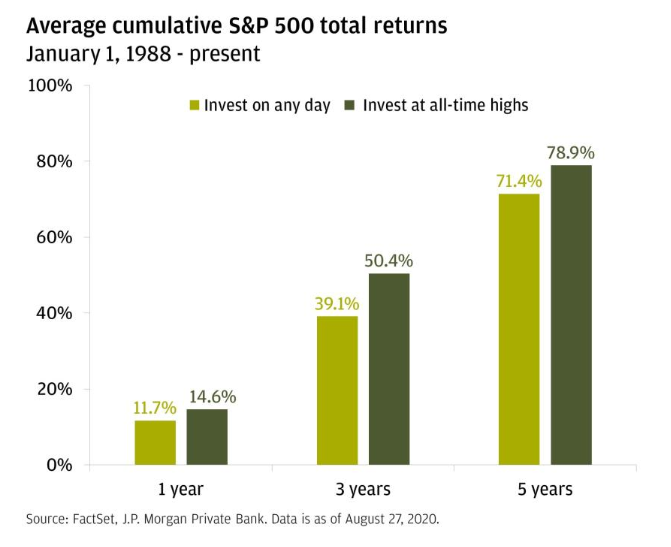
I just recently found a very interesting paper from J.P. Morgan from 2020, which tested whether it is worth it investing at all time highs. This is particularly helpful as US Markets just hit an all-time-high.

The researchers looked at the returns of the US Stock Market Index S&P 500 over a one, three and five year periods on any random day versus on a day that the index hit an all time high. The data in the sample covered the 1988 - 2020 time period. I believe that the results of the study could be relevant today, particularly for investors who may be afraid of the market because "it is too high".

If you invested in the S&P 500 on any random day since the start of 1988 and reinvested all dividends, your investment made money over the course of the next year 83% of the time. On average, your one year total return was +11.7%. 

Now, what do those figures look like if we only consider investments on days when the S&P 500 closed at an all-time high? They’re actually better! Your investment made money over the course of the next year 88% of the time, and your average total return was +14.6%.

And if we look at cumulative total returns three or five years after the original investment, the takeaway is the same. 


Markets can have bad weeks, months, and years, but the value of investments in the S&P 500 has risen over time. Getting invested and staying invested is a simple step an individual can take towards growing their capital and income over time.

The message is simple - do not let all time highs prevent you from investing. The investor who puts money to work on a regular basis could definitely benefit as well, especially from a behavioral perspective. Getting invested and staying invested over long periods of time is how wealth is built in the stock market. Over long periods of time, the US Stock Market has generated great returns partly as a result of earnings growth and reinvested dividends. Over time, those fundamental sources of returns can lead to higher intrinsic values for businesses, and higher dividends, all of which can lead to all-time-highs.


Popular Posts