Wednesday, June 28, 2023

How to find companies for my dividend portfolio

I am a buy and hold dividend growth investor. This means that I build my portfolio patiently. It also means that I rarely sell. I buy stocks to hold for decades, and would do so for as long as the dividend is not cut or for as long as a company is not acquired. This inactivity keeps investment fees and costs low.

It also reduces the impact of behavioral errors. I believe that time in the market beats timing the market. I try to buy companies that I would be comfortable owning even if the stock market closed for a decade. 

To paraphrase Warren Buffett “If you aren't willing to own a stock for ten years, don't even think about owning it for ten minutes.”

I have discussed how I evaluate each company in detail. But I have not discussed how I find companies to research and potentially invest in a more comprehensive way.

Today I will share with you the general process I use to find companies for investment. 

One of the goals of my newsletter is to try and share how I operate as an investor. My goal is to help you become a more rounded investor, so as you can create your own investing process that would help you to achieve your investment goals and objectives. While I would hope that you would stay and follow my journey over the years, I would be happier if you end up as an investor who can follow their own system, and be an independent thinker that would take their financial future in their own hands.

I wanted to share with you the process I follow to identify companies for further research, and potential acquisition. 

My process has evolved over time of course, but there are a few places where I look for investment ideas.

The first place is the good old list of dividend aristocrats. It is a well-known and widely distributed list of S&P 500 companies which have managed to increase dividends for at least 25 years in a row.

Membership is restrictive, but I like the quality and the fact that this list includes great businesses and it is not too exhaustive either. The list has ranged from 40 to 65 members over the past 10 – 15 years. If you managed to learn about each company, you will likely have a list of companies that make sense to you from a business perspective. The next step is either to consider acquiring the ones that are attractively valued, or to wait for the right price for the companies that seem expensive.

I generally screen the list by focusing on growth in earnings per share, dividends per share growth versus valuation, payout ratios etc. 

The second place is the list of dividend champions, contenders and challengers. It is updated monthly, and includes over 800 companies. The number of companies raising dividends for over 25 years is double the Dividend Aristocrats list, because it includes companies that are not part of the S&P 500. It doesn’t have liquidity or market capitalization requirement either.

This list also includes a list of companies that have increased dividends for over 10 years or over 5 years. It has a lot of useful data as well.

The third place I look is the monitoring process, where I review dividend increases every week. I like reviewing the press release for nuance, and try to gauge the management optimism. Sometimes, they read that we are in a situation where it is business as usual. Other times they seem too optimistic. After reading it for a few years, you may get a hang of it too.

A fourth place is through checkups of activity, including press releases, large sudden drops or increases in share price etc. While I review the list of dividend champions, dividend aristocrats and my portfolio holdings, I still learn about major moves in other businesses that I may want to study.

A fifth place is by scuttlebutt. Basically, in my daily life, I look at products, services, ideas, trends etc. You can identify investable opportunities this way. This is also an interesting way to admit that a lot of the missed opportunities I have had have been underneath my nose all those years.

If you like a certain product or service, you should always check and see if there is a company behind it. If that company is publicly traded, you may want to put it on your list for research. This idea is inspired by Peter Lynch.

Sometimes we overcomplicate life. Some of the best investment opportunities are right under our noses. I am reminded about Wal-Mart, Target, Lowe’s, Home Depot, Microsoft, Apple, Starbucks, Hormel, Altria, etc.

I recently saw a video, about a very simple investing process. The eat them, drink them, smoke them and go to the doctor portfolio. You may check it out from here - https://www.youtube.com/watch?v=U23fhx06SUQ&feature=youtu.be

Sometimes, I like a company, and decide to review some of its peers. I may end up owning stakes in all of them.

The sixth place is primary the most dangerous one. I follow a lot of dividend investors and other investors. Sometimes I see a lot of them buying a stock, perhaps because they are blindly following each other. Or perhaps because they are all seeing a good value, possibly because the stock had a catalyst that makes it a value. It is dangerous to be a lemming and blindly follow others, because you may be following them into their bad ideas, lose conviction, and ignore their best ideas. Also, you are not learning much by following others. Groupthink may influence you, which could be bad for your investment returns. 

I believe it is best to have your own process to follow, because you are not at the mercy of others for ideas. Plus, no single investors out there, even Warren Buffett is right 100% of the time. If you follow someone, make sure to follow all of their investment ideas. However, also make sure you have your own process to decide for yourself if a stock is a buy or an avoid.

For example, Buffett received a lot of negative publicity a few years ago, after he sold his airline stocks. In my opinion, that was a bad decision in the first place. After he sold at a loss, everyone out there started saying that he has lost his touch. After Apple went up to $185/share however, everyone started signing praises for him again. Right now, he is sitting on an unrealized gain of over $100 billion, and few are saying that he has lost his touch. And overall, his gains on Apple are higher than his losses on airlines and IBM.

Today, I discussed six places I look for, in my quest for uncovering companies for further research. I believe it is important to have a good population of quality companies, before going to the next stage of screening, evaluating and ultimately buying good companies for my portfolio. 


Thursday, June 22, 2023

Diageo (DEO) Dividend Stock Analysis

 Diageo plc (DEO) produces, distills, brews, bottles, packages, and distributes spirits, beer, wine, and ready to drink beverages. This international dividend company has increased dividends for 25 years in a row. The company’s peer group includes Brown-Forman (BF.B), Suntory, and Constellation Brands (STZ).

The company’s latest dividend increase was announced in January 2023 when the Board of Directors approved an 5% increase in the interim dividend to 30.83 pence /share. The final dividend had been increased by 5% to 46.82 pence/share in October 2022. 

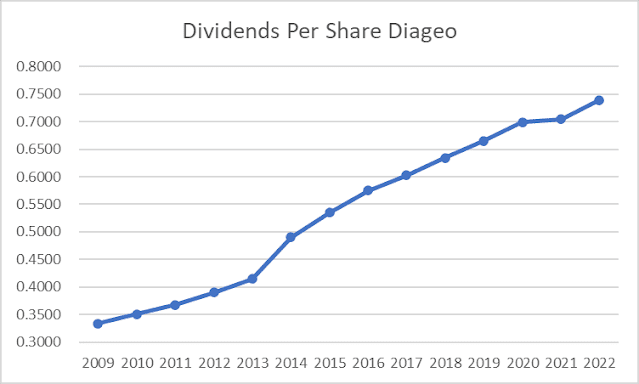
The annual dividend payment has increased by 6.30% per year since 2009, which is in line with the growth in EPS.


A 6% growth in distributions translates into the dividend payment doubling every twelve years on average. Between 1998 and 2008 dividends per share doubled. The next double took about eleven years to achieve, which is not bad.

Dividends on the ordinary shares are normally paid twice a year: an interim dividend in April and a final dividend in October. The approximate split between the two payments is 40:60.

Diageo trades on NYSE as American Depository Receipts. Each receipt is equivalent to 4 shares traded in London. As such, there is a small fee by the custodian bank that issues the ADR’s in the US. Being a British Company, there are no dividend withholdings at the source. You still owe tax to Uncle Sam in a taxable account however.

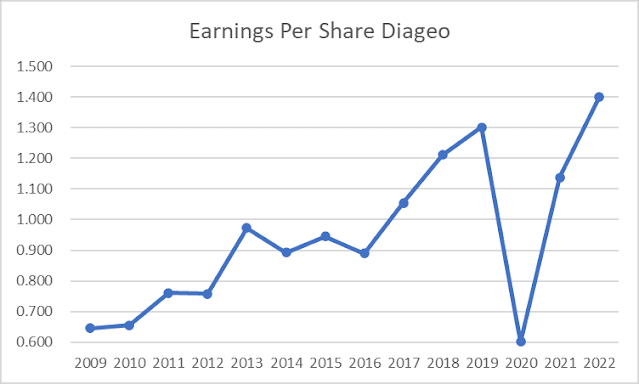
The company has managed to deliver an 6.10% average increase in annual EPS in British Pounds since 2009. Diageo is expected to earn 164 pence per share in 2023In comparison, the company earned the equivalent of 140 pence/share in 2022. Each American Depository Receipt (ADR) that you can purchase on the NYSE is equivalent to four shares that are traded on the London Stock Exchange. 


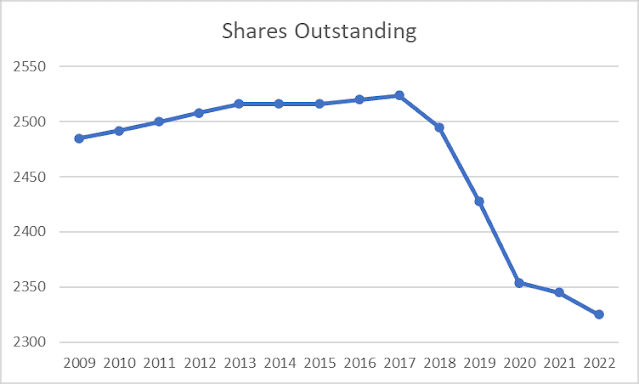
Between 2009 and 2022, the number of shares decreased from 2.485 billion to 2.325 billion.


Diageo owns a portfolio of strong brands, with wide consumer appeal, which are usually number one or two in their respective categories. A few include Smirnoff, Johnnie Walker, Guinness, Baileys, and Captain Morgan. The company also has a wide distribution network on a global scale, which might be difficult for a competitor to replicate. Diageo is the largest spirits company in the world, which provides it with the advantage of scale, relative to its competitors.

Future growth could be driven by organic growth of its premium brands as well as through strategic acquisitions. The company has also focused on its core competencies, by disposing of Pillsbury and Burger King in the early 2000s. North America accounts for one third of sales but over 45% of operating profits. Emerging markets in Asia, Africa and Latin America account for 43% of sales by 29% of operating profits. Europe accounts for 24% of sales and 25% of operating profits. Continued investments in strategic emerging markets could translate into higher sales in the future, particularly as the number of middle class consumers who will be able to afford premium drinks rises significantly.
The company has really high return on equity, which is common for most high quality dividend payers that do not require a lot of equity to operate the business. Rather than focus on absolute values for this indicator, I generally want to see at least a stable return on equity over time.

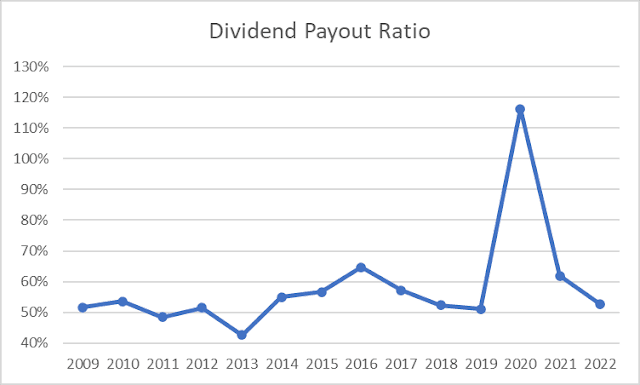
The dividend payout ratio has remained around 50% for most of the time (excepting during the Covid turmoil of 2020). A lower payout is always a plus, since it leaves room for consistent dividend growth minimizing the impact of short-term fluctuations in earnings.


Currently, the stock is fairly valued, as it trades at a forward P/E of roughly 20.85 and yields 2.24%. I am analyzing the company because I believe it is quality dividend growth stock, which is very good addition to my portfolio. I currently find Diageo to be a much better value than Brown-Forman (BF.B), at 36 times forward earnings and yield of 1.20%. 

Sunday, June 18, 2023

Four Companies Increasing Dividends to Shareholders Last Week

I review the list of dividend increases each week, as part of my monitoring process. I follow this process in order to monitor existing investments and to potentially identify companies for further research. I focus on quality companies with consistent cashflows, which can be purchased at attractive valuations, which I can then buy and hold forever. These are the types of long-term investments that can deliver rising dividends for decades, while also delivering dependable returns in the process.

This exercise also shows the data points I use in my quick evaluation of a company. This helps me determine if I want to proceed in analyzing a company for potential investment or not. Typically, a promising fundamental development, such as increasing earnings, a sustainable payout ratio and a track record of consistent dividend increases would place a company on my list for further research. I review the growth in earnings and dividends over the past decade, in order to evaluate the likelihood of them continuing their steady march upwards. I also look at valuation together with fundamental performance. 

If a company is attractively valued, that's definitely great and increases the chances of it becoming a part of my portfolio, if my analysis doesn't raise any red flags. Even if the company seems overvalued today, I would still review it, in order to be ready to act if it ever becomes cheaper.

Over the past week, there were four companies that have managed to increase dividends for at least a decade, AND also increased dividends last week. The companies include: 


National Fuel Gas Company (NFG) operates as a diversified energy company. It operates through four segments: Exploration and Production, Pipeline and Storage, Gathering, and Utility. 

The company increased quarterly dividends by 4.20% to $0.495/share. This dividend king has increased annual dividends for 53 straight years.

Over the past decade, the company has managed to grow dividends at an annualized rate of 2.60%.

The company managed to grow earnings from $3.11/share in 2013 to $6.19/share in 2022. The company is expected to earn $5.18/share in 2023.

The stock is selling for 10 times forward earnings and yields 3.81%.


Realty Income (O) is a real estate investment trust with over 12,400 real estate properties owned under long-term net lease agreements with commercial clients.

The company increased monthly dividends by 0.20% to $0.2555/share. This is a 3.23% increase over the dividend paid during the same time last year. This dividend aristocrat has increased dividends multiple times per year since going public in 1994.

Over the past decade, the company has managed to grow dividends at an annualized rate of 5.30%.

Between 2013 and 2022, the company managed to grow FFO/share from $2.41/share to $4.04/share. Realty Income is expected to generate $4.13/share in FFO in 2023.

The stock is selling for 14.85 times forward FFO and yields 5%.


Target Corporation (TGT) operates as a general merchandise retailer in the United States. 

The company increased quarterly dividends by a paltry 1.90% to $1.10/share. This is the 52nd consecutive year in which Target has increased its annual dividend. 

Over the past decade, the company has managed to grow dividends at an annualized rate of 11.60%.

This dividend king has managed to grow earnings from $3.10/share in 2014 to $6.02/share in 2023. However, earnings are down from the pandemic high of $14.23/share in 2023. The company is expected to earn $8.27/share in 2024.

The stock is selling for 16.19 times forward earnings and yields 3.28%.


W. R. Berkley Corporation (WRB) is an insurance holding company which operates as a commercial lines writer in the United States and internationally. It operates in two segments, Insurance and Reinsurance & Monoline Excess. 

The company increased quarterly dividends by 10% to $0.11/share. This is the 22nd year of consecutive annual dividend increase for this dividend achiever.

Over the past decade, the company has managed to grow dividends at an annualized rate of 9.90%.

The company increased earnings from $1.64/share in 2013 to $4.99/share in 2022. The company is expected to earn $4.68/share.

The stock is selling for 12.66 times forward earnings and yields 0.78%.


Relevant Articles:

- Five Dividend Growth Companies Increasing Distributions to Shareholders

- Eight Companies Rewarding Shareholders With a Raise


Monday, June 12, 2023

Five Dividend Growth Companies Increasing Distributions to Shareholders

I review the list of dividend increases as part of my monitoring process. This exercise helps in monitoring existing positions and potentially identify companies for further research.

Over the past week, there were five companies that both increased dividends and have managed to increase them for at least ten consecutive years. The companies include:

Alexandria Real Estate Equities (NYSE: ARE)
is a life science REIT that owns, operates, and develops of collaborative life science, agtech, and technology campuses in AAA innovation cluster locations, including Greater Boston, the San Francisco Bay Area, New York City, San Diego, Seattle, Maryland, and Research Triangle. 

The REIT hiked quarterly dividends by 2.48% to $1.24/share. The new dividend is 5.08% higher than the distribution paid during the same time last year. This marked the 13th consecutive annual dividend increase for this dividend achiever

Alexandria Real Estate Equities has managed to increase dividends at an annualized rate of 8.72% over the past decade.

It has managed to grow FFO/share from $4.33 in 2013 to $5.44 in 2022. Forward FFO estimates for 2023 are at $8.95/share.

The stock is selling for 13.47 times forward FFO and yields 4.11%.

Casey's General Stores, Inc. (CASY) operates convenience stores under the Casey's and Casey's General Store names. 

The company increased quarterly dividends by 13.16% to $0.43/share. This was the 24th consecutive annual dividend increase for this dividend achiever. Over the past decade the company has managed to increase dividends at an annualized rate of 8.77%.

The company grew earnings per share from $3.19 in 2014 to $9.85 in 2023. The company is expected to earn $10.73/share in 2024.

The stock is selling for 20.44 times forward earnings and yields 0.79%.


Oil-Dri Corporation of America (ODC) develops, manufactures, and markets sorbent products in the United States and internationally. It operates in two segments, Retail and Wholesale Products Group, and Business to Business Products Group. 

The company increased quarterly dividends by 3.57% to $0.29/share. This marked the 21st consecutive annual dividend increase for this dividend achiever. Over the past decade ,it has managed to grow dividends at an annualized rate of 4.62%

Earnings per share fluctuated from a high of $2.09 in 2013 to a low of $0.82/share in 2022. Trailing 12 month earnings are at $3.29,

The stock is selling for 14.30 times trailing earnings and yields 2.46%.


Universal Health Realty Income Trust (UHT) is a real estate investment trust which invests in healthcare and human-service related facilities including acute care hospitals, behavioral health care hospitals, specialty facilities, medical/office buildings, free-standing emergency departments and childcare centers. 

The company increased dividends by 1.41% to $0.72/share. This marked the 38th year of consecutive annual dividend increases for this dividend champion. Over the past decade, the company has managed to increase dividends at an annualized rate of 1.49%.

FFO/share increased from $2.76 in 2013 to $3.54 in 2022. Forward FFO for 2023 is at $3.46/share.

The stock is selling for 14.26 times forward FFO and yields 5.81%.


UnitedHealth Group Incorporated (UNH) operates as a diversified health care company in the United States. It operates through four segments: UnitedHealthcare, Optum Health, Optum Insight, and Optum Rx.

The company hiked quarterly dividends by 13.94% to $1.88/share. This marked the 14th consecutive annual dividend increase for this dividend achiever. Over the past decade, the company has managed to increase dividends at an annualized rate of 23.11%.

UnitedHealth Group managed to grow earnings from $5.50/share in 2013 to $21.18/share in 2022. The company is expected to earn $25/share in 2023.

The stock is selling for 19.61 times forward earnings and yields 1.52%.

Relevant Articles:


Wednesday, June 7, 2023

The importance of investing for retirement as early as possible

At the beginning of the 21st century most young people are told that social security won’t be there for them when they retire from the work force. Thus, in order to be able to completely retire from the workforce, a person has to invest as early as possible in order to take full advantage of the power of compounding.

Let’s follow the story of Erica and John. They both grew up on the same street in the same city. Their mothers gave birth to them at almost the same time. Erica and John went to the same high-school, after which their paths separated. They lost contact with each other for the next 40 years, at which point they found each other on Facebook, and met to reminiscence their childhood and talk about grandkids.

They quickly started talking about their retirement and the amount of money they had each had at the time of their retirement. John, who always saved the extra money he earned from jobs at college and his first job after college, started investing $2000/year in dividend stocks starting at the age of 18 and kept saving and investing the same amount until he was 28. At that point he had so many expenses in order to pay for the needs of his growing family that he couldn’t save anymore. Despite the fact that John couldn’t contribute any more to fund his retirement, he was very good at picking solid dividend growth stocks, and was able to generate annual returns of 10% for the next four decades.

Erica on the other hand had decided that she didn’t want to work in college since she wanted to concentrate on her studies while also enjoying the whole college experience. She then decided to go ahead and get a masters degree after which she was able to get a very good job with one of the largest companies in the USA. She did accumulate a large amount of student debt in the process, which she diligently paid off in a record time after she got her first job. After learning about the importance of saving for your own retirement, she started investing $2000/year in dividend stocks, and was able to also generate 10% in annual returns.

We then fast forward to the age of 65. At age of 65, John's net worth is 1,192,257.81. Erica's networth is $728,086.87 at the age of 65. 

Despite the fact that John had invested only $20,000 in total, versus $76,000 that Erica had invested, he was able to achieve a higher amount of wealth because he had taken a full advantage of the power of compounding by investing his hard earned money as early as his freshman year in college. Even though Erica contributed money for over 37 years her nest egg was $400,000 lower than John’s, because she had ten years less to utilize the power of compounding. You could also access the spreadsheet from here. 

The most important point from this exercise is: start investing for your retirement as early as possible! Ask your kids to invest their first paychecks from high school jobs. And most importantly, let the money compound uninterruptedly for as long as possible. And if you want to take full advantage of compounding, Turbo Charge Your Portfolio With Reinvested Dividends.

Relevant Articles:

- Determining Withdrawal Rates Using Historical Data

- Why do I like Dividend Aristocrats?

- The case for dividend investing in retirement

- When to sell your dividend stocks?

Popular Posts