Monday, December 20, 2021

Twelve Companies Rewarding Shareholders With a Raise

 I am a long-term dividend growth investor. I buy companies with a long streak of annual dividend increases, at the right valuation, and I hold them for as long as they do not cut dividends. I am a very patient buy and hold investor. My goal has always been to achieve a certain level of target dividend income. I invest with the end goal in mind, which is to generate that income to pay bills in retirement, and have it grow above the rate of inflation.

I have discussed before the process I follow to come up with investment ideas. One of the ways I come up with ideas is during my monitoring process. Every week, I compile the list of dividend increases, and focus on those companies with at least a ten year history of annual dividend increases. I want to focus on companies that have managed to raise their dividends through the ups and downs of an economic cycle. This gives me a better feel that these dividends are coming from a sustainable business model, not a company that simply got lucky. I want dividends I can count on, whether we have a recession or a boom.

My monitoring process around dividend increases helps me to see how existing portfolio holdings are doing. It also helps me identify new ideas for further research.

In general, I look at the dividend increase, and compare it to the rate of dividend growth during the past five or ten years. It is helpful to see how sticky the dividend growth rate really is.

Next, I look at trends in earnings per share, in order to determine if the dividend is on solid ground. Without growth in earnings per share, there is a natural limit to future dividend increases. This step is best done when I review trends in the payout ratio as well.

I also look at valuation, but I will have to tell you that valuation is more art than science. You have to look at trends in earnings and dividends, along with the valuation metrics such as P/E ratio and dividend yield. You also have to determine if those trends could last.

During the past week, there were several companies that met the criteria as discussed above. The companies include:


This is a list of companies for further review. Most seem attractive as businesses, but that doesn’t mean that they should be invested in at any price, regardless of valuation.

The next step is to check each business, in order to determine if it is worth further review. I would look at ten year trends in earnings per share, dividends per share, payout ratios, shares outstanding. I would try to understand what the business does, and make an assessment if the good times would continue, so that I can expect higher earnings, dividends and intrinsic values over time. I would look at the valuation relative to earnings and dividend growth, in order to determine if the business is fairly valued, if it looks promising too. For a sample analysis of American Tower (AMT) from a few months ago, check this article

I also wanted to note that the data for American Tower (AMT) is based upon FFO/share, not EPS/share. 


Companies listed in this post include: AMT, BCPC, BEN, BMY, ENSG, FMAO, NWFL, SEIC, TTC, WASH, WDFC


Relevant Articles:


Thursday, December 16, 2021

Just Do It

Investing is simple, but not easy. We all know that we should own great quality companies, which offer great products and services that consumer like. We also know to diversify, not trade too much, and keep investment expenses low. However, we also know that we should not overpay for quality companies as well. In addition, we know that we should not time the markets.

The fascinating part for me is that a lot of investors I speak to seem to agree with the last two statements. They know that we should not time the markets. They also know that we should not overpay for quality companies. While many investors seem to understand the theory, real world application is quite often the tough part.

The first hurdle is that waiting for a company to fall to a certain price and not investing right away is a form of market timing. This is where it is important to understand that a lot of platitudes about the stock market are just that. They are not an objective strategy to guide you through the ups and downs and the changes in the stock markets. Until you develop a strategy to invest, you would be like a blind person. Once you develop even a rudimentary strategy, and you start executing on it, you are on your way to success. This is essentially what I did between 2007 – 2008, as I was developing my screening criteria, my diversification criteria, and overall portfolio management guide.

Once you start following a strategy, the next logical step would be to keep improving on it. Continuous improvement is a management concept from Japan, which has helped a lot of companies do their best. This concept can be applied successfully to the world of investing.

I have done Dividend Growth Investing over the past 10 – 15 years, and documented my evolution on this very site here. As I kept investing, I kept noticing some recurring themes. 

Notably, I would identify great companies which checked on all of the boxes. However, I would not invest either because the yield was lower than some arbitrary measure I had set, or the P/E ratio was higher than an arbitrary measure I had set. In a way, I was timing the market. Even worse, I was not investing in some good quality companies, but buying stock in companies that appeared cheap, but they turned out to be value traps. The companies I skipped on turned out to do very well, and conquer the world. I was lucky to buy into some of them when they had temporary set-backs, like when Visa was selling around 20 times forward earnings in 2015 for example. But I also missed out on others.

This is where I will insert a few quotes from Buffett, to reiterate the point I am trying to make.

"It's far better to buy a wonderful company at a fair price than a fair company at a wonderful price."

“Time is the friend of the wonderful business, the enemy of the mediocre.”

Quite often over the past 10 – 15 years I would see a company selling a little above the top of my valuation range. I would like the company, the business, its prospects, but I would sit there, waiting for a dip that never arrived.

I realized that I had set out some screening criteria which appeared to be an example of discipline and prudence. In reality, I was a little stubborn not to invest in quality companies when presented with the opportunity.

I realized that if I identify a great company, I should just invest in it. I understand that I should not overpay dearly for a great company too. However, valuing companies is more art than science. A company with a low P/E ratio that doesn’t grow earnings is more expensive than a company with a higher P/E ratio that grows earnings. You have to take into consideration the quality of the earnings stream, the possibility for future earnings growth, the possibility for disruption down the road, how long that earnings stream can last for, and how cyclical that stream is.

In general, a lot of companies are priced fairly. You can say that a company may be overvalued by a little or undervalued by a little. It doesn’t matter, because I am not in the business of forecasting short-term fluctuations in share prices. I am in the business of investing for the long-term. So as such, I benefit from along-term trends in the business, that would lift earnings, dividends and intrinsic values. Even if I overpay slightly for a quality business, over the long-run, overpayment would turn out to be a small rounding error. The far bigger problem would be NOT investing in the first place, notably because of something.

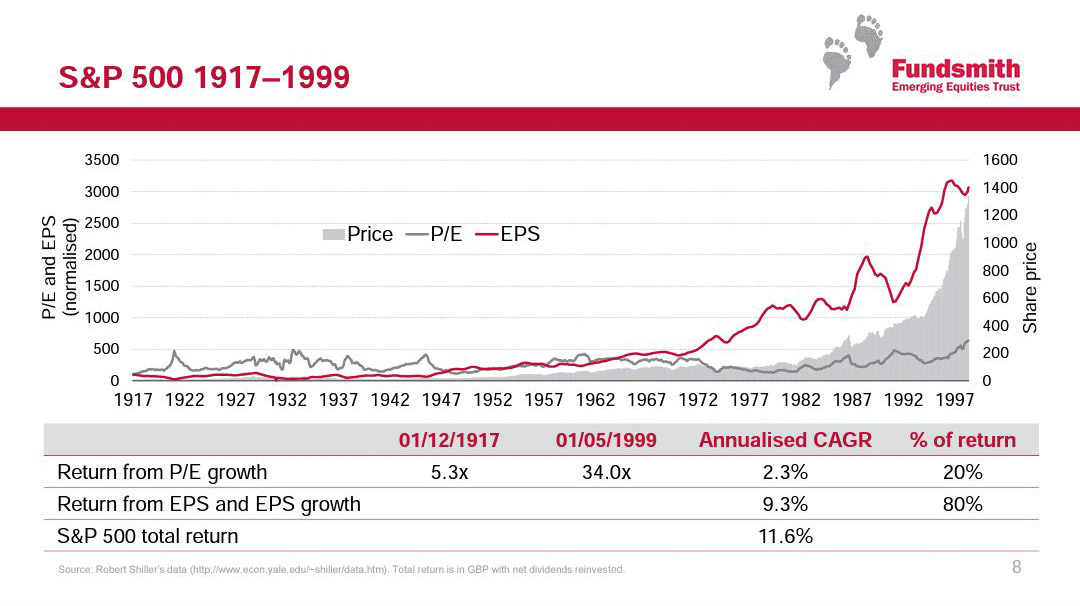
In the long run, growth in earnings contributes more than expansion of price/earnings multiples, as evidenced by this chart from Fundsmith:

(I would add reinvested dividends too however)

All of this works however, if you are going to be a patient long-term investor who will hold through thick or thin. You will not lose hope even if a position takes 5 – 10 years to start working out. You have to understand that not all positions would work, but on the aggregate, the portfolio will work wonders for the patient and persistent investor. This eliminates a large portion of the population however.

This also works great for investors who buy every month. In my opinion, the ability to invest every month is more important than the ability to buy and the bottom and sell at the top. In other words, time in the market beats timing the market. At least that's what my research found out.


I intuitively understood that Regular Investing Beats Buying At The Bottom Every Time, as illustrated by my example with Johnson & Johnson (JNJ). But crunching some numbers above helped solidify my understanding even better.

The exercise that really opened my eyes was when I played some more with some historical data.

I compared a few different scenarios, in order to see if I can optimize my current situation. 

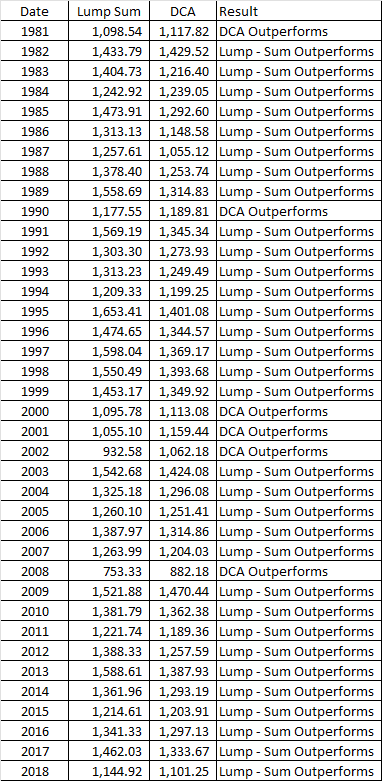
I compared investing a lump sum at the beginning of the year with spreading it over the next 12 months. It turned out that lump-sum investing did better than spreading it over. Check this article on dollar cost averaging versus lump sum investing:

This is successful, because the US market historically goes up. That’s because earnings go up, companies pay dividends that go up and they get reinvested. Earnings that are not distributed are reinvested as well, which further grows business earnings power ( on aggregate). If you look at historical data, US markets are up in 70% of the years. That’s a very strong long-term tailwind. Yes, there will be days, months, years and perhaps even a decade where stocks go nowhere. Example was the 1930s, 1970s and 2000s. But the probability of a higher decade is much higher than for a lower decade. On a random day, there is just a 50% probability that stocks would go up or down. But on an annual or decade basis, it is 70% to 80%.

As you can see, the stock market as a whole tends to exhibit an upward bias over time. It is not all the time of course, and there are always obstacle along the way. There are always clouds on the horizon, and changes. There are always "reasons" to sell or not to invest. Yet, it has built a lot of wealth over the past decades for patient, long-term investors.

Source: Blackrock

I did this on purpose, because a lot of readers have kept asking me if they should wait for a market crash or a decline, before they put money to work.

I also tested whether it makes sense to buy at the top each month, at the bottom each month or jut at the closing price for an index fund. This is a proxy for a stock portfolio. Turns out that being always wrong each month or always right each month is just overrated. The goal is to select good quality companies, and buy them each month whenever you have money to invest. Instead of waiting for a dip, buy when you have money to invest.

This approach works best for someone like me, who is investing every month, and is buying several companies for their portfolio on a regular basis.

For the past several years, whenever I have had money to invest, and quality companies to invest in, I would just invest in it.


What is the point of this article?

Investing is difficult. We do not know exactly how the future would turn out. Nobody really knows for sure if a stock is cheap today or expensive. This is why our valuation techniques should be questioned constantly, because they are prone to error.  A company with a low P/E may turn out to be more expensive than a company with a high P/E, if the latter grows earnings and the former doesn’t.  It’s a balancing act, where we do not want to chase yield or chase growth and overpay for it. Valuation is part art, part science, which is why formulaic investing can fail you, if you do not have enough fail safe mechanisms in place. Selecting quality companies is a good start, as is diversifying across companies, industries, and time. Continuously reviewing investments, and your process, can help identify improvement opportunities.

In my case, I still start my review by looking at growth in earnings per share, dividends per share, dividend payout ratio, buyback history. I also look at trends in P/E ratios over the past decade, in addition to P/E ratios along with dividend growth to make a quick estimate of company quality, profitability and possibility for this future growth to continue. I have realized that having a minimum yield is counter-productive, so I have eliminated that from my process. I have also realized that having a P/E of 20 is overly limiting as well, so I have removed that from my process as well. That doesn’t mean I will be willingly paying 40 times earnings for a company. But I would consider paying up to 30 times forward earnings for a quality company that can grow earnings over the future. Investing is all about finding the right balance in my opinion, and not being too rigid. But not being too complacent either. 

In my case, it is also easy to just invest in a lot of companies every month, through the ups and downs. This is a smoothing mechanism, that takes care of things for me. I have also increasingly started DRIPing my dividends, rather than pool them and allocate them manually.

The goal of this exercise is to overcome my fears, and invest decisively, without paralysis by analysis.

So next time I identify a quality company with good prospects that’s not excessively expensive, I will think of the following right before I click the “buy” button:

“Just do it”


Monday, December 13, 2021

Sixteen Companies Spreading Holiday Cheers To Shareholders

 As part of my review process, I evaluate dividend increases every week. This process helps me to see how my portfolio holdings are doing. It also helps me to uncover and review new candidates for my portfolio.

I look for dependable dividends from companies with a minimum ten-year streak of annual dividend increases, fueled by earnings growth. I look for dependable dividends from companies with dependable earnings, and solid competitive advantages, which I can acquire at attractive valuations.

During the past week, the following companies increased dividends to shareholders. Each company has a ten year streak of annual dividend increases. I review the latest dividend increase relative to the ten year average, and the growth in earnings per share over the past decade. Last but not least, I discuss current valuation. The companies include:


This is a list of companies for further review. Most seem attractive as businesses, but that doesn’t mean that they should be invested in at any price, regardless of valuation.

The next step is to check each business, in order to determine if it is worth further review. I would look at ten year trends in earnings per share, dividends per share, payout ratios, shares outstanding. I would try to understand what the business does, and make an assessment if the good times would continue, so that I can expect higher earnings, dividends and intrinsic values over time. I would look at the valuation relative to earnings and dividend growth, in order to determine if the business is fairly valued, if it looks promising too. For a sample analysis of Union Pacific from 2015, check this article

I wanted to add that while CVS Health (CVS) does not have a ten year streak of annual dividend increases, it did raise quarterly dividends by 10% to 55 cents/share. This was the first dividend raise since 2017. 

I also wanted to note that in Enbridge's case, the dividend amounts are in Canadian Dollars.

Companies listed in this post include: ABT, ARE, AVGO, CHRW, EIX, ENB, MAA, PFE, PNR, SYK, TEL, THG, TRN, WM, ZTS


Relevant Articles:


Sunday, December 12, 2021

Dividend Growth Investor Holiday Sale

Dear Readers,

I have a special deal for you through January 30th, 2022. I would like to offer a subscription to my premium newsletter for a low price of $65/year. You can sign up for a 7 day free trial below:


You can simply sign up online and gain a wealth of knowledge at your finger tips.

As part of this limited time promotion, you will receive the following:

- Dividend Stock Ideas I am investing in for the month
- A list of dividend portfolio holdings
- Valuable Education to help you towards your journey to financial independence

I will also share how I invested a lump-sum at the beginning of 2022, and the reasoning behind that.

The goal of this dividend newsletter is to provide a real-world and real-time educational tool, to help achieve dividend investing goals. I provide a listing of ten companies that I will purchase with my own money, and show you how I build and manage a portfolio from scratch. The newsletter includes detailed analysis of each company, and includes bonus materials on dividend growth investing.

In my investing, I believe in the following principles:

- Buy and hold investing
- Dividend Growth Investing
- Dividend Safety
- Value Investing
- Diversification
- Equal weighting
- Keeping investment costs low

I put all of these concepts together in building and managing the portfolio in the Dividend Growth Investor newsletter.

I believe that this newsletter will provide educational insights to investors in the accumulation phase, as well as those who are at or near retirement. The concepts discussed in the newsletter are the same ones I have used for over a decade to build my dividend growth stock portfolio.

If you subscribe today at the low introductory price of $65/year, your price will never increase. I believe that this newsletter is a bargain at less than 20 cents/day. Sing up for a free trial today:


The newsletter was just published on Saturday, January 22nd. I included the dividend companies I am including in my portfolio this month. After the month is complete, I will be able to send out a list of dividend portfolio holdings on February 5th.

On Monday, January 31st, the price of the newsletter increases to $76/year. I have a limited number of open spots remaining, which is why I may have to turn people away if there is too much interest. This is a one person operation, and will remain that way to preserve quality.


Thursday, December 9, 2021

Skate to where the puck is going

As a dividend growth investor, my goal is to buy stock in a company that fits certain criteria.

In general I look for:

- A streak of consecutive annual dividend increases

- Rising earnings per share over the past decade

- A dividend payout ratio that is not too high 

- An attractive valuation

Once I see this, the goal is to accumulate a position, and sit tight. In a way, I am a long-term investor and will hold on for a long time for as long as the dividend is growing. In a way, I follow long-term trends for as long as they persist. The second they are over however, I exit and look for greener pastures. If the trend resumes, I will get back in.

A lot of investors tend to focus on narratives, which are stories told to defend ideas. Narratives can be helpful, but only if supported by objective data behind them. Otherwise, they are fairy tale stories. As an investor, I am always on the lookout to determine if the story is still ongoing and thesis is still accurate. While I like looking at historical research, I also need to be aware that things may change. If they do, then I need to recognize this and allocate funds elsewhere.

I’ve made some changes over the past 15 years at Dividend Growth Investor, albeit gradually. I started off with a fairly fixed screening criteria. I had been lucky, because my strict criteria helped me find a lot of great companies at attractive valuations in the beginning of my journey. They did well subsequently for the most part. But I've had to adapt over the years, due to many changes.

I have since relaxed the need for a minimum dividend yield. I have also relaxed the need to look for companies with a P/E of less than 20. Now I look at P/E and growth and quality and defensibility of the earnings stream together. This is driven by the changes in the marketplace today, the availability of quality companies at bargain valuations, and the decline in interest rates. Most importantly, it is driven by my research on historical dividend growth success stories, and not wanting to miss out on the next Wal-Mart for example. But change is a given, not just for my strategy, but the world at large.

There are a lot of changes over time, as the world evolves. Some of these changes however are trends within long-term cycles. For example, over the past 40 years, companies in general are not as focused on distributing dividends to shareholders as they once were. I do focus on the companies that still pay and grow dividends however, but I do recognize that things may change in the future. There is a need to be flexible in my approach. In the current version of my approach, I do look for companies that can grow earnings and dividends for decades down the road, while also compounding future net worths. A long streak of consecutive annual dividend increases is the signal I used to identify such companies for research. However, if companies stopped raising dividends, and focused on buybacks instead, I may end up with a much smaller sample size of an investing population from which to source ideas for my portfolio.

For example, in the past 40 years, companies are more prone to pay buybacks than dividends. These days, companies are paying more in buybacks than dividends. 


Source: Standard & Poor's


When share prices are rising, shareholders usually do not care about dividends, as their portion of total returns seems insignificant. This has increasingly been the case in the current bull market. If a stock keeps rising by 15%/year, a shareholder is not going to be impressed by a 2% or a 3% dividend yield. The same thing occurred in the 1990s.


Of course, when share prices refuse to go up, only then do shareholders realize the value of dividends. This happened between 1966 – 1982 


It also happened between 2000 – 2013. 


We know that reinvested dividends account for a large portion of total returns over time. But with investor time horizons shrinking, they are more focused on share price movements. Long term investors are more focused on the longer term. I find a plan focusing on dividends much more robust, because I get to focus on the fundamentals, and the dividend income alone is enough to help pay expenses in retirement after the crossover point is reached. I can afford to avoid worrying about stock prices going nowhere for extended periods of time, as long as the fundamentals as sound, precisely because dividends are more stable, reliable and predictable. 

During those secular bear markets, you see growth companies initiate dividends. This was the case with Wal-Mart stores in 1974, which initiated a dividend after a monstrous 50% decline in the stock in a brutal bear market. This was also the case for Microsoft in 2003, which initiated a dividend after the implosion of the dot-com bubble.

I find dividends to be a decent indicator of valuation, albeit not perfect of course. Lack of dividends definitely makes it harder to evaluate things on my end. Particularly if we are analyzing the broader US markets, where companies have had the proclivity to raise dividends annually for years.

Low yields have historically marked stock market tops. For example, in the 1980s, the Japanese index Nikkei 225 rose from 8,000 to 39,000 points in the span of a decade. Dividend yields, which were historically low for Japanese stocks, were down to 0.50% by 1989. A dividend investor that was close to retirement could have just expected to live off the dividend, but at 0.50% that’s not much. Investors who viewed capital gains as free money however, and expected to live off future gains would have run out of money by the late 1990s as Nikkei fell by 50% - 75%. This is just a reminder that valuations can get out of hand, people would lose their minds in a speculative fervor, but when the clock strikes at midnight the party may end. 

Source: "Japanese Finance in the 1980s: A Survey" by Jeffrey A. Frankel

At present times, we have the so called FANG companies like Facebook/Metaverse, Amazon, Netflix and Google growing share prices, but not really paying dividends. At this pace, only Metaverse and Google are doing some notable share buybacks, but they are not really paying a dividend. Google has always looked like a company that can grow and support dividends, and it is a company I understand and have been really close to buying. However, I never did, mostly to my own detriment.

I have used Google for about 20 years now, so I definitely failed my inner Peter Lynch. I was also one of the first group of users for Facebook since 2005, so I failed Peter Lynch there as well. And I have used Amazon since 2004/2005 as well. I have even generated revenue from Amazon and Google. In fact, one of my mistakes has been that I never invested in them. If I had invested that modest revenues into the stocks, I would have made a pretty dime. I did recognize and invest in other companies within the dividend growth investing universe that did well, so for the time being, the dividend growth investing universe did its work. 

 I have been spoiled in the past 10 - 15 years, because I had the ability to buy quality dividend aristocrats, dividend champions and dividend achievers t attractive valuations, and watch them continue growing earnings and dividends for the most part ( and share prices too). But the future may be different, so I need to understand that if things change, I should be able to recognize it. So while I am fine with the fact that I will miss out on some great companies in my lifetime, I also need to think about risks to my strategy too. If promising companies I understand are out there, but they do not pay and grow dividends, I may be at a disadvantage.

I am pretty confident however, that at some point all of these companies (FAANG types) would initiate a dividend to shareholders. Perhaps that would happen during the next big and pro-longer bear market, just like was the case for Wal-Mart or Microsoft. Of course, I may have to wait for years, before this happens, missing out on potential gains. There are always going to be trade-offs, no matter what I do of course. If I had decided to buy Oracle or Cisco in 1999 for example, it would have been a poor choice. Buying Cisco or Oracle when it initiated a dividend would have been a better choice.

One way that I have somewhat reconciled with the fact that I will miss out on companies is that I own them indirectly through my 401 (k) plan at work. It is basically invested in S&P 500 and an international fund at an 80/20 split. Google, Amazon, Facebook and even Tesla are some of the largest holdings. In a way, this fund portfolio is a good hedge for the companies I will end up missing out on.

But still, it is a good reminder that things can change and evolve over time. The future is never written in stone, and anything could happen really. This helps us stay humble, and open the where things are today, not where we thing they should be.

We need to be cognizant for the potential for change. A decade ago, I believed that companies that do not pay dividends are doing so, because they cannot afford to pay dividends. The success of companies like Google have definitely shown that this is not always the case.

This is why investing is part art, part science. I always keep asking myself if I am being prudent or stubborn.

What is the point of this article?

Notably, trying wrap a few ideas together. Basically we also want to stick to long-term trends, like rising dividends per share, and stick to them for as long as they are present, without second guessing too much.  But, we also need to recognize that things change, so we need to be adaptable. Ultimately, the best idea is to try and improve and focus on quality companies that can grow earnings and cash flows over time and can afford to grow dividends.  That being said, you will miss some companies, as its part of the game. Others that seem like can’t miss investments that you invest will disappoint. Having a fail-safe mechanism, like a 401 (k) retirement fund at work is a good hedge.

Of course in a perfect world, we would have companies like Google, Facebook, Amazon initiating  dividend soon. Microsoft and Apple already did that, so this shouldn't be a foreign concept. But I am actively monitoring the situation.


Popular Posts