Saturday, May 27, 2023

Eight Companies Rewarding Shareholders With a Raise

I review the list of dividend increases every week, as part of my monitoring process. This process helps me identify companies for further research. It's also one of the steps that helps me monitor existing investments.

Dividends offer a strong signaling value. An increased dividend reflects the board's confidence in the company's ability to generate strong earnings and cash flow. It reinforces a company's commitment to a sound capital allocation strategy centered on delivering shareholder value. Increasing the dividend is also indicative of consistent performance and the board's confidence in a company's long-term strategy and growth trajectory..

Over the past week, there were 21 companies that announced dividend increases. Eight of these companies had managed to increase dividends annually for at least ten years in a row. The companies include:


This of course is just a list of dividend increases from the past week, not a recommendation.


When I review companies, I look at ten year trends in:

1) Earnings per share
2) Dividend payout ratio
3) Dividends per share
4) Valuation


Since I have some experience evaluating dividend companies, I also modify my criteria based on the environment we are in and the availability of quality companies. If I see a company with a strong business model and certain characteristics that I like, I may require a dividend streak that is lower than a decade. I have also found success in looking beyond screening criteria by purchasing stocks a little above the borders contained in a screen.

It is important to be flexible, without being too lenient.

You may like this analysis of Lowe's (LOW) as an example of how I review companies.

Relevant Articles:

Wednesday, May 24, 2023

Atmos Energy (ATO) Dividend Stock Analysis

Atmos Energy Corporation (ATO) engages in the regulated natural gas distribution, and pipeline and storage businesses in the United States. It operates in two segments, Distribution, and Pipeline and Storage.

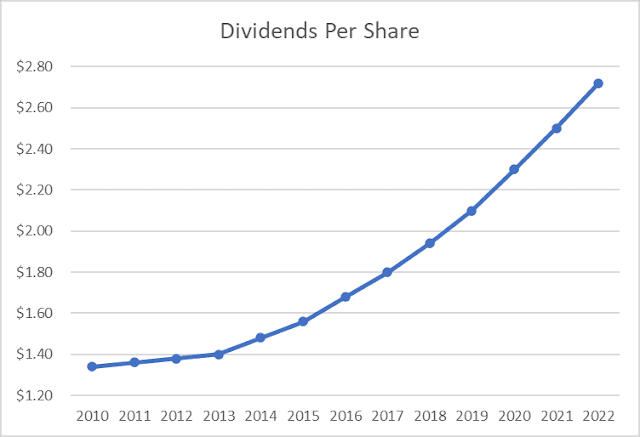
The company is a dividend aristocrat with a 39-year track record of annual dividend increases. The last dividend increase occurred in November 2022, when Atmos raised its quarterly dividend by 8.80% to 74 cents/share.   

During the past decade, Atmos has managed to grow dividends to shareholders at an annualized rate of 7.20%. The five-year annualized dividend growth is at 8.70%.

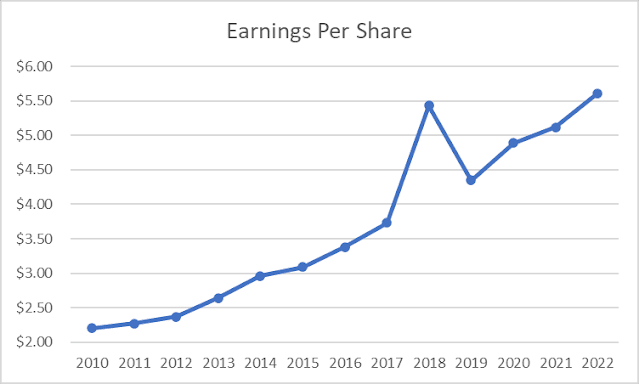
At the same time, the company has managed to boost earnings from $2.37/share in 2012 to $5.61/share in 2022. Atmos Energy is expected to earn $6.03/share in 2023 and $6.42/share in 2024.


Growth will be generated through continued capital investment in the business. The company believes that most of that capex would be immediately accretive within half a year or so. Most of the capex is on increased safety and reliability.

The company’s earnings are generated through regulated gas distribution and natural gas transmission and storage.

Growth in rates over time should compensate for investments. The risk is that states may not be as accommodative to utilities. This risk is somewhat mitigated by the fact that Atmos operates in several states in the US – Texas, Louisiana, Colorado/Kansas, Mississippi, Kentucky.

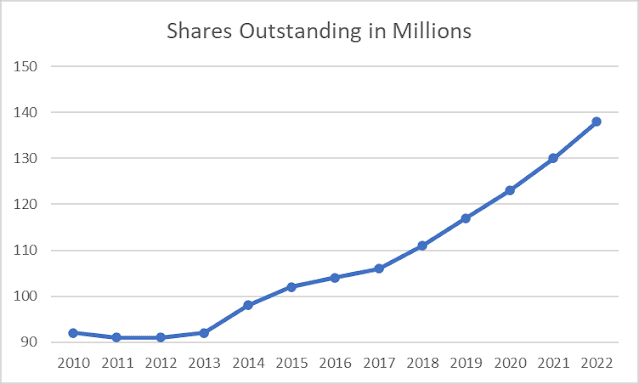
The company obtains capital by selling shares, in order to fund its growth Capex initiatives. As a result, the number of shares outstanding increased from 91 million in 2012 to 138 million in 2022.


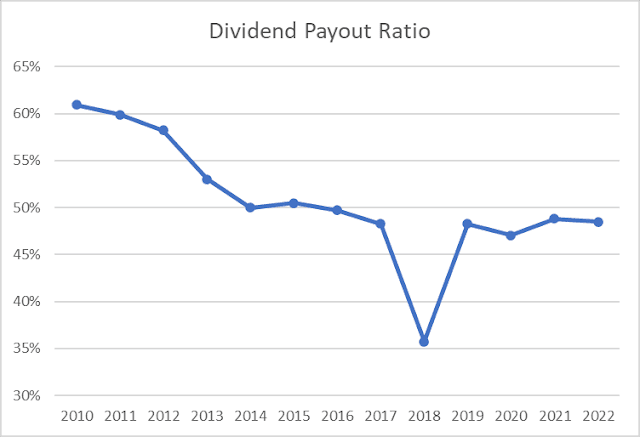
The dividend payout ratio has decreased from 58% in 2012 to 48% in 2022. The lower dividend payout ratio can result in a dividend growth that is higher than earnings growth over the next decade.

I believe that the stock is fairly valued today at 19.30 times forward earnings. The yield is low for a utility at 2.55%, but the dividend payout ratio is lower too.

 Relevant Articles:

- Nine Companies Rewarding Shareholders With Raises


Friday, May 12, 2023

How I Would Invest A Lump Sum Today

One of the most common questions I receive relates about the idea of how to invest a lump-sum amount. I believe that the answer is not a one sized fit all approach. I also believe that the answer for the same person may vary from time to time.

In general, there are pros and cons to each approach. If you look at the historical data, it makes sense to invest money as soon as possible. The stock market usually goes up most of the time, and when you invest, you get to enjoy receiving dividends and the opportunity for capital gains. Of course, this approach assumes that past performance is an indication of future results – this is the warning below each investment that is discussed. The future cannot be forecasted, so in theory, any historical data is not going to be a bulletproof way for future riches. 

Either way, the lump sum investing approach also uses the common-sense theory that since no one can predict the future, it makes sense to invest right away. If you do not invest right away, then you are engaging in timing the market.  

To put more support behind lump-sum investing, if you have the money to buy 100 shares of Johnson & Johnson today, you get to enjoy the right to $404 in future annual dividends from the start. That’s much better than waiting in cash, and earning a lower level of interest income. (taxed at worse rates as well).

The longer you sit in cash, putting off investing in a stock, the more future dividend income you are missing out on. So perhaps, as long as the valuation is not ridiculous, it may make sense to invest as soon as one has the cash. That assumes that this investor will continue buying even during the next bear market or two, and even after securities fall by 20% - 50% or more. It assumes that the investor will not sell in panic, merely because the stock price is lower.

If you are more risk averse, it may make sense to wait before you invest. Some readers spread the money over a certain period of time. They do so in order to avoid the risk of putting everything at the highest point, only to see a 40% - 50% loss, dividend cuts etc. I believe that if that approach works for the risk tolerance of these investors, it is preferable to them trying to wait for a bear market for several years, while they are waiting in cash for a crash. At least with the dollar cost averaging approach, they have a plan in action to conquer their fears. An imperfect plan you can stick to is much better than not having a plan in place. The downside to that plan however is that you may be missing out on dividend income, and the potential for future appreciations, because you are sitting in cash for a decent chunk of time. To put it in other words, if you plan to own 100 shares of Johnson & Johnson that pay $4.04 in dividends, and have the money to do it, you miss out on $404 in annual dividends by sitting in cash. 

Both of those examples are looking at money that is earmarked for long-term investment. If you need money within the next 1 – 3 years for a major expense such as a down payment on a house, a health issue, a car or college, it makes sense to keep the money in cash/fixed income.  If you have a large credit card debt, you are better off paying it off in full, before starting to invest in equities.  

Depending on your risk tolerance, it may make sense to de-risk by paying off your mortgage. The downside of course is that you may miss out on future dividends and appreciation by doing so – just ask anyone who paid off their mortgage between 2010 and 2014. The upside is that you will get a totally different perspective for someone who paid off their mortgage in 1999 - 2000, and missed out on the bear market from 2000 - 2003.

I have thought a lot about the topic, and my opinion has shifted over the years. I went from being risk-averse to slightly less so. But If get a large enough lump-sum amount, I would most likely invest it right away.  If I were a reader of my newsletter, I would likely put the money in an equally weighted portfolio of all companies in the portfolio. I would of course keep costs to the bone, and invest preferably in a tax-advantaged account. Either way, I would continue investing in the companies I identify every month afterwards. The weights may be different, if we for example put $50,000 in the 50 or so companies in the portfolio today, and then put $1,000/month in ten companies for several months. Over the course of the next 5 – 10 years however, things will work themselves out of this initial lopsided situation.

While some companies appear to have stopped growing dividends, others seem to have reduced the rate of dividend growth, while a third group may appear overvalued, I believe that after a long period of time, (e.g. ten years), the investor may be better off investing right away and holding, than sitting in cash waiting for the right pitch. This opinion may have been influenced by the relentless rise of equity prices over the past decade however too. My earlier experiences in 2007 – 2009 showed me that it pays to wait before you invest, despite the data showing me that under most scenarios it has historically paid to invest right away. The issue of course has always been that past performance is not an indication for future results. The other issue is that your personal situation may vary from the averages due to skill or luck. Speaking of personal experiences being different than averages, at the beginning of the decade, I had a colleague who went into a surgery that supposedly had a 98% success rate. Unfortunately, he turned out to be of the unlucky 2% and perishing at the tender age of 27. He was one day older than me. Fate can be a tricky thing.

Alternatively, one could also put the money on an equally weighted scale in the 30 members of the Dow Jones Industrials Average or Dividend Aristocrats or Dividend Champions if they had a lump sum.

If I invest right away, I get to enjoy dividends right away. If share prices decline after my investment, I will just use the dividend cash to acquire more shares that pay more dividends. I have come to believe that timing the markets is a fruitless endeavor. Certain decisions such as waiting to invest are a way of market timing. I invest my money regularly whenever I have cash to invest, so I do not see a reason not to do that with lump sum amounts too. 

Thank you for reading!

Relevant Articles:

Should I buy dividend stocks now, or accumulate cash waiting for lower prices?

Dividend Investors: Stay The Course

- How to invest a lump sum


Tuesday, May 9, 2023

The first $100,000 is the hardest

Charlie Munger is Warren Buffett’s business partner at Berkshire Hathaway. He is a successful lawyer, and investor, who was instrumental in helping Warren expand his investing horizon. Charlie is credited with encouraging Buffett to invest in high quality businesses, which compound over time. Before that, Buffett spent most his attention to statistically cheap stocks.

Charlie Munger is not studied as well as Warren Buffett, which is a shame. It’s a shame because Charlie Munger has shared a lot of insightful lessons on investing, human nature and human biases, which could help many aspiring investors.

There are two good books I have read about Charlie Munger. The first one is “Damn Right: Behind the Scenes with Berkshire Hathaway Billionaire Charlie Munger”, and the second is “Poor Charlie's Almanack: The Wit and Wisdom of Charles T. Munger, Expanded Third Edition”.

There is a passage from “Damn Right”, which really resonates with me:

Charlie Munger has said that accumulating the first $100,000 from a standing start, with no seed money, is the most difficult part of building wealth.

Making the first million was the next big hurdle. To do that a person must consistently underspend his income

Getting wealthy, he explains, is like rolling a snowball.

It helps to start on top of a long hill—start early and try to roll that snowball for a very long time.

It helps to live a long life.

There is another quote from him from a shareholder meeting, saying that

“The first $100,000 is a bitch, but you gotta do it.

I don’t care what you have to do—if it means walking everywhere and not eating anything that wasn’t purchased with a coupon, find a way to get your hands on $100,000.

After that, you can ease off the gas a little bit.”

Just for reference, $100,000 in 1960 has the same purchasing power as $1,026,653 today. Perhaps the modern version of this story is that the first million is the hardest.

In another reference, $100,000 invested in 1960 in the S&P 500 would be worth over $40 million today. This investment would be generating over $640,000 in annual dividend income.

These are some simple, but powerful lessons in these quotes.

The first lesson is that you need to spend less than what you earn, in order to be able to find the savings to make any successful investments. It makes sense that if you live paycheck to paycheck, you will never be able to accumulate any savings to invest for your long-term future.

The second lesson is that once you have savings, you need to invest them intelligently. Once you have a process in place, you stick to it, and keep adding money to your portfolio. You start small, and the efforts from the first few years are not very visible. After saving and investing for 5 – 10 years however, the power of compounding starts showing its true force. Once you accumulate a decent sized nest egg, it will grow net worth and investment income over time, without needing any additional capital from you. At this point, investment income will likely exceed your investment contributions.

I would personally keep adding, for as long as I can, because I enjoy the process of investing for the future. But it is nice to know that once you reach a certain amount of net worth, that is invested intelligently, you know that no matter how hard you mess up in life, you have a third worker quietly working for you, compounding your capital, income and sharing the fruits of its labor with you by working 24/7.

The third lesson is about the power of compounding. It is a small trickle at the beginning. Once you invest for a while, the power of compounding becomes a wonderful force, which keeps accelerating net worth and investment income. You investment capital snowballs into enormous amounts the longer you keep it invested, and do not interrupt the compounding process.

The largest effect of compounding is observed at the end of the financial independence journey. For example, if you invest $1 at 10%/year, you will have $2 in roughly 7 years. However, if you keep that dollar invested at 10%/year for 50 years, you end up with over $117.

For example, Warren Buffett became a billionaire in 1986. He is now worth over $112 billion. More than 99% of his net worth was generated in the past 35 years, long after he turned 56. That's also despite the fact that he has donated almost half of his Berkshire Hathaway shares that he owned in 2006.

If you manage to compound money at a high rate, and do it for a long period of time, you would end up with a very high amount.

Relevant Articles:

How Warren Buffett built his fortune
Charles Munger: A Lesson on Elementary, Worldly Wisdom As It Relates To Investment Management & Business
- Simple Investing Principles to Follow

Sunday, May 7, 2023

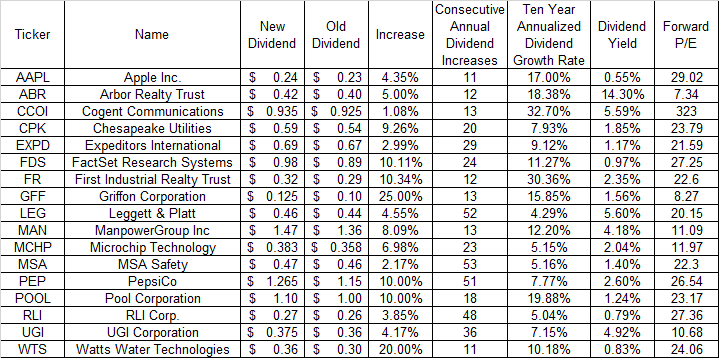
Seventeen Dividend Growth Stocks Raising Dividends Last Week

I review the list of dividend increases every week, as part of my monitoring process. I usually focus my attention on the companies with a ten year streak of annual dividend increases, and then review each company using my criteria. I am always on the lookout for new ideas, and to determine if my existing holdings are working. I also want to be ready to act quickly, when the right time arrives.

This exercise helps me to evaluate companies I already own, and see how they are doing. This is a helpful piece of the puzzle, that would be helpful when/if I decide to add to these companies at the right price.

This exercise also helps me identify companies for further research. A large part of the time is spent reviewing companies, screening for companies, and trying to learn more about companies, their business, etc. 

It is not glamorous at all, but dull and boring. 

But it does pay dividends.

There were 48 companies that announced a dividend increase over the past week. Only 17 of these companies have also managed to increase dividends for at least ten years in a row. The companies include:


This of course is just a list, not a recommendation.


When I review companies, I look at ten year trends in:

1) Earnings per share
2) Dividend payout ratio
3) Dividends per share
4) Valuation


Since I have some experience evaluating dividend companies, I also modify my criteria based on the environment we are in and the availability of quality companies. If I see a company with a strong business model and certain characteristics that I like, I may require a dividend streak that is lower than a decade. I have also found success in looking beyond screening criteria by purchasing stocks a little above the borders contained in a screen.

It is important to be flexible, without being too lenient.

You may like this analysis of PepsiCo (PEP) as an example of how I review companies.

Relevant Articles:


Companies included in this article: AAPL, ABR, CCOI, CPK, EXPD, FDS, FR,GFF, LEG, MAN, MCHP, MSA, PEP, POL, RLI, UGI, WTS,

Popular Posts