Tuesday, April 12, 2022

Four Notable Dividend Increases Expected for April 2022

One of the aspects of Dividend Growth Investing that appeals to me is the predictability of dividend payments and dividend increases. Many of the great dividend growth companies tend to pay dividends on a predictable timetable every three months. In addition, these companies tend to increase dividends during a typical month, and they do that for many years.

I expect a few notable dividend increases for the month of April from the following companies:


Apple (AAPL) designs, manufactures, and markets smartphones, personal computers, tablets, wearables, and accessories worldwide. 

When the company raises dividends this month, this would be the tenth consecutive year of annual dividend increases. This means that Apple will become a dividend achiever.

The company has managed to grow dividends at an annualized rate of 9.20% in the past five years. The current quarterly dividend is $0.22/share.

Apple is not cheap at 26.93 times forward earnings and a dividend yield of 0.53%.

Procter & Gamble (PG) provides branded consumer packaged goods to consumers in North and Latin America, Europe, the Asia Pacific, Greater China, India, the Middle East, and Africa. It operates in five segments: Beauty; Grooming; Health Care; Fabric & Home Care; and Baby, Feminine & Family Care. 

A dividend increase would mark the 66th year of consecutive annual dividend increases for this dividend king.

The company has managed to grow dividends at an annualized rate of 4.90% in the past five years. The current quarterly dividend is $0.8698/share.

The stock does not seem cheap at 27.14 times forward earnings and a dividend yield of 2.18%.

After posting this article, P&G hiked the quarterly dividend by 5% to $0.9133/share. One down, three to go.

Johnson & Johnson (JNJ) researches and develops, manufactures, and sells various products in the healthcare field worldwide. It operates in three segments: Consumer Health, Pharmaceutical, and Medical Devices.

A dividend increase would mark the 60th year of consecutive annual dividend increases for this dividend king

The company has managed to grow dividends at an annualized rate of 5.90% in the past five years. The current quarterly dividend is $1.06/share.

The stock seems fairly valued at 17.09 times forward earnings and a dividend yield of 2.36%.

Costco (COST)  engages in the operation of membership warehouses in the United States, Puerto Rico, Canada, the United Kingdom, Mexico, Japan, Korea, Australia, Spain, France, Iceland, China, and Taiwan.

A dividend increase would mark the 18th consecutive annual dividend increase for this retailer with a loyal customer fan base. That dividend track record is as impressive to me as the $1.50 hot dog, whose price hasn't changed since 1985. It may also be nice to see Costco sending out a special dividend to shareholders.

The company has managed to grow dividends at an annualized rate of 11.90% in the past five years. The current quarterly dividend is $0.79/share.

Costco is not cheap at 44.82 times forward earnings and a dividend yield of 0.54%.


Relevant Articles:

Dividend Kings List for 2022

Dividend Aristocrats List for 2022

- Dividend Champions List for 2022


Sunday, April 10, 2022

The Best Time to Buy US Stocks

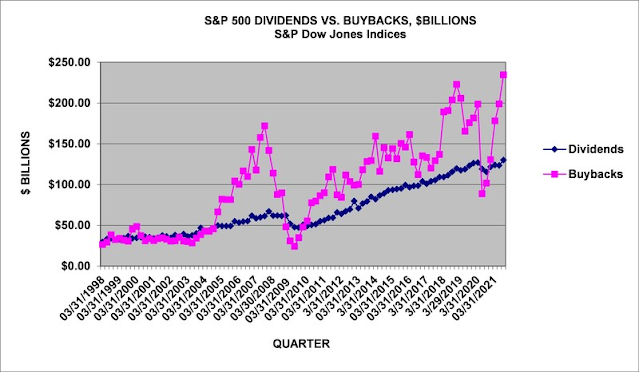
The best buy signal to invest in US stocks has been when companies drastically reduce buying back stock.

That occurred in 2008 - 2009 and in 2020.


Source: S&P Global

Companies tend to initiate share buybacks when share prices are high, and they are flush with cash. Then they end up cancelling them, or not going through with the share buybacks, when share prices are low. This is the opposite of how you should be buying shares in my opinion.

On the other hand, companies tend to maintain or even increase dividends, even during a downturn.

I prefer the relative stability, predictability and dependability of the dividend payments over share buybacks. With dividends, I have the option to reinvest into the stock or put the money to work elsewhere. Once a company declares a dividend, it tends to stick to this schedule. I like this consistency, because it reminds me of successful investing. Successful investing is about consistency.

With buybacks, I don't have this option - company management allocates excess cashflows to their stock, whether or not it is a good value. They do buybacks when they are flush with cash, rather than on a consistent and predictable schedule. Companies seldom care about valuations with share buybacks. They also do buybacks when they feel like it. While I could be taxed on the dividend, there are multiple ways to eliminate or defer paying taxes (for US shareholders). A large portion of investors in US stocks are not taxed (e.g. pension funds, endowments, retirement accounts). Given the short holding periods for US stocks, taxation is a moot point. Share buybacks remind me of the futile attempt to time the market, which are seldom consistent and often disappoint. Consistency in dividend policies beats doing things when you feel like it (like buybacks).

I like the predictable nature of dividends, because I know exactly how much is going to be allocated. It's better to buy stock with dividends regularly, rather than when some executive feels like it (like they do with buybacks). Buybacks are definitely more discretionary than Dividend policies.

Canceling a buyback or not going through with it is rarely noticed or mentioned, because they are treated as a lower priority by company managements. Canceling a dividend is definitely viewed negatively, because it signals problems with the underlying business. A dividend is more visible to the investing community than a buyback, hence dividend announcements get more publicity. 

A track record of annual dividend increases speaks volumes to the stability and dependability of long-term cashflows for a business. This is what causes me to research and potentially invest in a stock, provided the valuation is not too excessive.

In general, I believe that dividends are better than share buybacks. 

That's because dividends can accomplish everything that buybacks can supposedly accomplish, but in a much more efficient, consistent and dependable way.

I like the fact that cash dividends provide the investor with the option to invest back in the company, or invest in the best available opportunity for them. A buyback makes that decision for them. Options have value.

This ends my rant of the day.


Relevant Articles:

- Who owns US stocks?

- Long Term Investors Needed

- Dividends versus Share Buybacks/Stock repurchases

- Share Buybacks and Dividends Are Not The Same Thing


Wednesday, April 6, 2022

99% of Buffett's Wealth Came After Age 56

In a meeting with Warren Buffett, Jeff Bezos asked him: 

"Your investment thesis is so simple. You’re one of the richest guys in the world and it’s so simple. Why doesn’t everyone just copy you?”

Warren Buffett responded by saying:

“Because nobody wants to get rich slowly.”


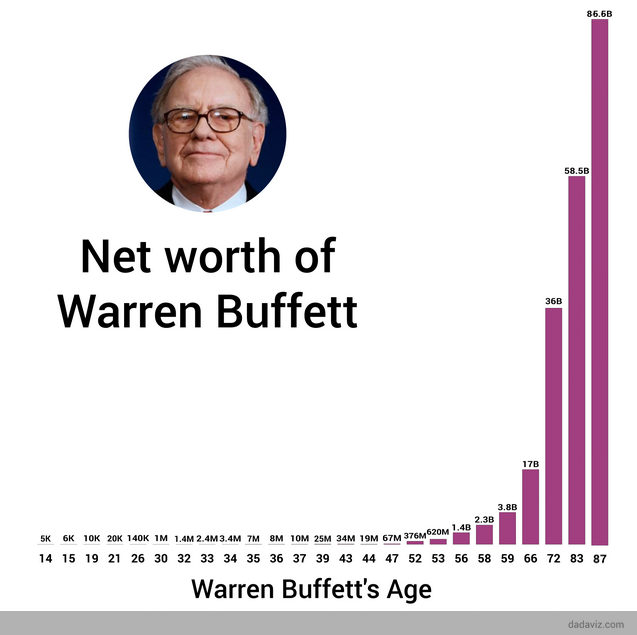
The power of compounding is truly visible with Warren Buffett. He first became a billionaire at the age of 56 in 1986. This reflects his approach of getting rich slowly and enjoying the journey, rather than the destination. In his words, Buffett has been "Tap Dancing to Work" for decades.

Today, his net worth is about $125 billion at the age of 91. And that’s after he donated tens of billions of stock to charity. You can see that due to compounding, over 99% of his net worth was built after the age of 56.


He was able to achieve this by compounding his investments at a high rate of return for a long period of time. This is what makes him the best investor in the world.

We also need to note that since 2006, Buffett has donated shares to charity. While these shares were worth $41 billion at the time of donation, they have appreciated mightily since then. 

In June of 2006, he owned 474,998 “A” shares. Now, he owns 238,624 shares, worth about $100 billion. (source)

If Buffett had not donated any shares, his net worth would have been $250 billion today. Instead, it is about $125 billion.

Most of these shares are destined for philanthropy. Buffett will donate 99% of his net worth to charitable causes. This is admirable, and it is great that he will see some benefit of his donations during his lifetime. However, it is a very high tradeoff between donating money today, versus donating more money in the future.

The power of compound interest is definitely a magnificent force. If we assume a total return of 10%/year, each dollar I put to work today could turn into $117 in 50 years. In reality, due to the power of compounding, the upside is virtually unlimited, while the downside is capped to the amount invested. The investor just needs to be patient, and select investments that have a long runway and can compound at a high rate of return for decades. This is where focusing on companies with wide moats definitely helps. In my opinion, the list of Dividend Aristocrats is a good starting place to identify good long-term investments that can compound wealth for long periods of time.

I like researching different stories and viewpoints, and then trying to take the best lessons that apply in my situation. Ultimately, you are successful if you do something you enjoy and you do it for a long period of time. When you compound at a high rate of return for a long period of time, you end up with massive outcomes in your favor. This concept goes for money, knowledge, relationships, health.

Relevant Articles:


Monday, April 4, 2022

Four Dividend Growth Stocks Rewarding Shareholders With Raises

I review the list of dividend increases each week, as part of my monitoring process. This helps me monitor existing holdings. This step also helps me identify potential ideas for further research. 

For these reviews, I usually focus my attention on companies with at least a ten year track record of annual dividend increases. I ignore the rest, because I want companies with the ability to grow dividends throughout a normal economic cycle.

I also review trends in earnings per share, dividend growth, and valuation, before deciding if I want to spend more of my time researching the company in detail. I also like reviewing the press releases, in order to sense the tone and commitment of company management to furthering shareholder interests.

During the past week, there were four companies that raised dividends, and had an adequately long track record of annual dividend increases. The companies include:


Bank OZK (OZK) provides various retail and commercial banking services. 

The company raised its quarterly dividend by 3.30% to $0.31/share. Bank OZK has increased its quarterly cash dividend on its common stock in each of the last forty-seven quarters. For comparison purposes, the bank paid $0.28/share in April 2021. 

Bank OZK has raised dividends for 26 years in a row and has a ten year annualized dividend growth rate of 19.90%.

Between 2012 and 2021, the bank managed to grow earnings from $1.10/share to $4.47/share. It is expected to earn $3.94/share in 2022.

The stock is selling for 10.86 times forward earnings and yields 2.81%.

Glacier Bancorp, Inc. (GBCI) operates as the bank holding company for Glacier Bank that provides commercial banking services to individuals, small to medium-sized businesses, community organizations, and public entities in the United States.

The company increased its quarterly dividend by 3.10% to $0.33/share. The Company has declared 148 consecutive quarterly dividends and has increased the dividend 49 times. This is the eleventh year of consecutive annual dividend increases. Over the past decade, the company managed to grow dividends at an annualized rate of 9.30%.

Between 2012 and 2021, the bank managed to grow earnings from $1.05/share to $2.86/share. The company expects to earn $2.79/share in 2022.

The stock is selling for 18.05 times forward earnings and yields 2.63%.

The PNC Financial Services Group, Inc. (PNC) operates as a diversified financial services company in the United States. 

The company raised its quarterly dividend by 20% to $1.50/share. This is the twelfth consecutive year of annual dividend increases for this dividend achiever. Over the past decade, the bank has managed to boost dividends at an annualized rate of 16.30%. 

"The significant increase in our dividend is reflective of PNC's financial performance, strong capital levels and our board's confidence in our business model and strategies," said William S. Demchak, PNC chairman, president and chief executive officer.

PNC earned $5.28/share in 2012 and managed to grow earnings to $12.70/share in 2021. The bank is expected to earn $14.13/share in 2022.

The stock is selling at a forward P/E of 12.97 and yields 3.30%.

Watsco, Inc. (WSO) distributes air conditioning, heating, refrigeration equipment, and related parts and supplies. 

The company increased its quarterly dividend by 12.80% to $2.20/share. This is the ninth year of dividend increases for Watsco. They lost their track record in 2012, when they distributed a large special dividend, in anticipation of the increased taxes on dividends in 2013. That never happened, to they resumed growing the dividend from a lower base. 

Watsco has paid dividends to shareholders for 48 consecutive years. The Company’s philosophy is to share increasing amounts of cash flow through higher dividends while maintaining a conservative balance sheet with continued capacity to build its distribution network. Future changes in dividends are considered in light of investment opportunities, cash flow, general economic conditions and Watsco’s overall financial condition. 

Watsco grew earnings from $2.70/share in 2012 to $10.78/share in 2021. The company is expected to further grow earnings per share to $11.99 in 2022.

The stock is selling at 25.41 times forward earnings and yields 2.89%.

Relevant Articles:

- Thirteen Dividend Growth Stocks Rewarding Shareholders With A Raise

- Five Dividend Stocks Rewarding Shareholders With Raises


Friday, April 1, 2022

Help! I have a serious spending addiction

I have a serious spending addiction – any time I find myself with some extra cash on hand, I end up spending it. This is particularly troublesome, as I tend to salivate when I see an item that I really want.

Anytime there is a big sale, especially one with large markdowns, my spending problem comes out on the surface and I sometimes go through all of my cash on hand and sometimes even borrow money to spend. The exhilarating feeling of spending my cash is similar to probably what a drug addict feels when they get their daily dose. I look at the list of items I spent my money on, and it provides me with an internal sense of happiness and accomplishment. Sometimes, I even look for ways to save money from recurring expenses in order to have more money to spend. I am often scrambling to find enough cash, as I always have at least 15 – 20 deals on my radar, just waiting to be purchased.

I spend a large portion of my monthly income on dividend paying stocks. I willingly spend my money on dividend stocks because I know that I am contributing towards my retirement goals. I view every dollar that I can invest in a quality dividend stock at attractive valuation such as PepsiCo (PEP), Altria (MO) or Johnson & Johnson (JNJ), will work hard for me and produce several more dollars over their lifetime for me.

Over the past two months however, my spending addiction went out of control. There are a lot more bargains to be found. If we enter a bear market, we will have even more sales to take advantage of.  My fingers are itching on my trigger, as I see so many quality firms which are selling at promising entry prices.

Unfortunately, I would have to train myself to resist future sales in the future. This is because once I start living off our investments, I will have less money to invest every month. The month of April is usually a reminder of this future event for me. The reason why I will purchase a limited amount of stock in April is due to taxes. Once your income from non-salary sources becomes noticeable, you end up having to pay estimated quarterly taxes. Fortunately or unfortunately, my estimated payments were not sufficient to cover the remainder of taxes due. This is fortunate, because I had been able to deploy the funds at prices that were much lower than prices today. I would much rather invest the funds and get the chance of earning a return on them, rather than provide a zero interest loan to the government.

Luckily, by the end of April, I should be able to redirect my cash flows toward growing my dividend positions. Hopefully, the market is not going to increase too much by that time.

Relevant Articles:


Your future retirement income is on sale
Three stages of dividend growth
S&P 8000 – The power of reinvested dividends in action
Dividend Investors Should Focus on Valuation, not just Yield
39 Dividend Champions To Consider

Popular Posts