Wednesday, August 12, 2020

Investing Beliefs, Weakly Held

I wanted to touch base with you, and see if I can learn from your experiences.

I recently asked folks on Twitter the following question:

"What is something you used to believe about investing, but do not believe anymore?"


I received some interesting responses. You can check some of them here.

I also reached out to readers in my investing newsletter, and they offered some great ideas as well.

I wanted to reach out to you and see if you would be willing to share any investing beliefs you had, which you no longer have. If you are willing to do so, I would also appreciate hearing more about the reasoning behind the decision.

You can feel free to post your comment below.

I will likely use those in an article that may appear some time in the future. Obviously, your names/profile names would not be used.

Thank you for reading!


Monday, August 10, 2020

Six Companies Demonstrating A Commitment to Shareholder Returns

My portfolio monitoring process can be best summarized by these two major activities:

1) I screen the dividend growth investing universe, using a few parameters for entry.
2) I look at major announcements, such as earnings releases and dividend increases or cuts

The second process revolves around reviewing press releases for earnings and dividend announcements for the past week. I usually focus my attention on companies that have increased dividends for at least a decade. My analysis has discovered that companies that get to grow dividends for a decade are more likely to continue raising them.

A long history of annual dividend increases is an indication of a strong business that generates more in excess cashflows each year. I am interested in companies whose business model can generate excess cashflows for long periods of time after my investments. My requirement to look for a ten year history of annual dividend increases eliminates a lot of companies who simply got lucky in the right place of the cycle. This requirement also reduces the number of cyclical companies, which generally have poor long-term dividend growth prospects.

I review the trends in earnings per share, dividend payout ratios and growth in dividends, in order to determine the likelihood of further dividend growth in the future. I look at the interplay between all factors, rather than focus on one item over the others. No two companies are the same.

Last but not least, I also look at valuation. Valuation is part art, part science. In general, companies with low multiples tend to have slow growth, while companies with high multiples have higher expected growth. Finding the right balance between these two, coupled with the trade-off between dividend yield and dividend growth, is the secret sauce.

Now that I have spilled all my secrets with you, I wanted to share the companies that raised dividends over the past week. Just as I discussed above, I focused on the companies that have raised dividends for at least a decade, and have also managed to boost dividends last week. The companies include:

Dover Corporation (DOV) provides equipment and components, consumable supplies, aftermarket parts, software and digital solutions, and support services worldwide.

The company increased its quarterly dividend by 1% to 49.50 cents/share. This was the 65th consecutive year in which the Company has increased its annual cash dividend, demonstrating Dovers long standing commitment to returning capital to shareholders. Over the past decade, this dividend king has managed to increase distributions at an annualized rate of 8.60%.

The company earned $3.12/share in 2008, $1.91/share in 2009 and managed to grow profits to $4.61/share in 2019. The company is expected to earn $5.20/share in 2020.

The stock is selling for 20.80 times forward earnings and offers a dividend yield of 1.85%.

Essential Utilities, Inc., (WTRG) operates regulated utilities that provide water or wastewater services in the United States. It offers water services through operating and maintenance contracts with municipal authorities and other parties.

The company increased its quarterly dividend by 7% to 25.10 cents/share. This marked the 28th consecutive year of annual dividend increases for this dividend champion.

Over the past decade, this dividend champion has managed to grow dividends at an annualized rate of 7.50%/year.

Between 2009 and 2019, the company grew earnings from $0.62/share to $1.04/share.
The company is expected to generate $1.48/share in 2020.

The stock is not cheap at 31.90 times forward earnings. It does offer a low yield for a utility of 2.10%, but that is the price to pay for future growth.

STERIS plc (STE) provides infection prevention and other procedural products and services worldwide. It operates in four segments: Healthcare Products, Healthcare Specialty Services, Life Sciences, and Applied Sterilization Technologies.

The company raised its quarterly dividend by 8.10% to 40 cents/share. This marked the 16th year of annual dividend increases for Steris. Over the past decade, this dividend achiever has managed to boost distributions at an annualized rate of 13.20%.

Steris managed to grow earnings from $2.16/share in 2010 to $4.76/share in 2020.

The company is expected to generate $5.49/share in 2021.

The stock is not cheap at 28.10 times forward earnings. It yields 1.05%.

Microchip Technology Incorporated (MCHP) develops, manufactures, and sells semiconductor products for various embedded control applications in the Americas, Europe, and Asia.
The company raised its quarterly dividend by 0.15% to 0.368 cents/share. Microchip Technology has been increasing dividends by a trickle every quarter for some time now, but has a 19 year track record of consecutive annual dividend increases. During the past decade, this dividend achiever managed to boost dividends at an annualized rate of 0.75%.

Between 2010 and 2020, the company grew earnings from $1.16/share to $2.23/share.
The company is expected to generate $5.86/share in 2021.

The stock looks optically cheap at 16.90 times forward earnings, but yields only 1.50% with a slow rate of growth.

Illinois Tool Works Inc. (ITW) manufactures and sells industrial products and equipment worldwide. It operates through seven segments: Automotive OEM; Food Equipment; Test & Measurement and Electronics; Welding; Polymers & Fluids; Construction Products; and Specialty Products.

Illinois Tool Works raised its quarterly dividend by 6.50% to $1.14/share. This marked the 46th consecutive annual dividend increase for this dividend champion.

The company managed to grow earnings from $1.89/share in 2009 to $7.74/share in 2019.
The company is expected to generate $5.76/share in 2020.

The stock is not cheap at 33.10 times forward earnings. It offers a dividend yield of 2.40%.

Badger Meter, Inc. (BMI) manufactures and markets flow measurement, control, and communication solutions in the United States, Asia, Canada, Europe, Mexico, the Middle East, and internationally. It offers mechanical or static water meters, and related radio and software technologies and services to municipal water utilities.

The company increased its quarterly dividend by 5.90% to 18 cents/share. This marked the 28th consecutive annual dividend increase for this dividend champion. Over the past decade, this dividend champion has managed to boost distributions at an annualized rate of 10.80%.

Between 2009 and 2019, the company managed to grow earnings from $1.14/share to $1.61/share.
Badger Meter is expected to generate $1.49/share in 2020.

The stock is expensive at 45.30 times forward earnings. Badger Meter yields close to 1.10%.

Relevant Articles:

- Nine Dividend Paying Companies Raising Dividends Last Week
- Two Sweet Dividend Increases For Long-Term Shareholders
- Five Dividend Growth Stocks Rewarding Shareholders With Raises
- Two Cheap Dividend Stocks Raising Dividends Last Week

Thursday, August 6, 2020

Warren Buffett: America's Youngest Early Retiree

In 1954, Warren Buffett got a job at Graham-Newman, which was a value investing company with an impressive track record. The company was managed by Benjamin Graham, the author of Security Analysis and The Intelligent Investor. Benjamin Graham is said to be the father of value investing, and one of the original security analysts to put security analysis on the maps. His annual salary was $12,000.

Buffett had sold securities prior to that, managed his own portfolio and participated in numerous business ventures, including placing pinball machines in barber shops. Between 1950 and 1955, his net worth increased from $9,800 to $127,000.

This was his dream job. Buffett had been rejected by Harvard, and went to school in Columbia, where Ben Graham taught a course on value investing. Buffett wanted to go work for Graham after graduating. He even offered to work for free, but Graham rejected him at the time as “overvalued”.

After selling securities for his father’s firm between 1951 and 1954, Buffett received an offer from Ben Graham, which he accepted on the spot. This was his dream job to work for his mentor.

In 1955, Buffett learned that Ben Graham was going to retire and close his investing company.

Warren declined the opportunity to become a partner in Graham-Newman. Instead, he chose to retire. He shares this story in this great article.

He was 25 at the time, married with a kid. However, he was not worried at all. These are his words, as discussed in a Forbes article from a few years ago:

The thing is, when I got out of college, I had $9,800, but by the end of 1955, I was up to $127,000. I thought, I’ll go back to Omaha, take some college classes, and read a lot—I was going to retire! I figured we could live on $12,000 a year, and off my $127,000 asset base, I could easily make that. I told my wife, “Compound interest guarantees I’m going to get rich.”

Warren Buffett decided to become a private investor in 1955, and live off his capital base. He retired at the age of 25. He expected that his investment skill would be sufficient to generate as much money as his old day job at Graham-Newman.

Retiring early to pursue your passions is a concept that many Financial Independence Retire Early (FIRE) Blogs focus on. Living on your capital, rather than employment is the goal for many of these folks. We do get inspired by folks like Mr Money Mustache who retired at the age of 30 after a decade of investing or Derek Foster, who retired at the age of 34.

Here we have Warren Buffett, who retired at the age of 25 however. He retired to live life on his own terms, and do what made him excited to get out of bed every morning and "tap dance to "work"". Similar to every early retiree, he focused his attention on pursuing his passions and focus on what's important for him in life. And he succeeded beyond his wildest dreams most probably.

To put things in perspective, the average salary for a full-time employee in the 1950s was roughly $5,500/year. So Buffett was earning above average income, and he was expecting to earn an above average income from his investing.

It looks like he expected to generate 10%/year and live off these proceeds. That’s a pretty high annual return needed, but this is the Oracle of Omaha we are talking about. He has been able to compound money at Berkshire Hathaway and the Berkshire Partnerships at 20%/year for decades. Which means that even if he remained a private investor, he would have likely continued to compound his money at more than 10%/year, even after paying for his living expenses.

The most fascinating thought process for me is that if he had managed to compound his capital, net of living and investment expenses, at 10%/year between 1955 and 2019, he would have a net worth of $56.6 million today. That would have been an impressive track record, and he would have been wealthier than most investors today. But it is very likely that we would have never heard about him. It is very likely that if he really retired to do his own thing in the 1950s, there wouldn’t have been several books about him, the annual shareholder meetings, and the fame.

In 1955, it would have been quite easy to construct a portfolio of blue-chip companies that yielded 5%. Security prices had just exceeded their pre-Depression highs from 1929, even as earnings and dividend payments had increased substantially.

His lifestyle does not seem very frugal however. Each dollar in 1955 has the same purchasing power as $9.60 in 2019. In other words, an item that used to cost $1 in 1955 can be purchased at $9.60 today. This means that spending $12,000/year was equivalent to spending $115,200/year today. That’s a pretty nice lifestyle to have in Omaha, Nebraska.

For reference, his net worth was quite impressive for a 25-year-old, since his $127,000 in 1955 is equivalent to having $1.20 million today.

It is fascinating to read his opinion on housing from that time.

In Omaha, I rented a house at 5202 Underwood for $175 a month. I told my wife, “I’d be glad to buy a house, but that’s like a carpenter selling his toolkit.” I didn’t want to use up my capital.

However, three years later he did buy a house for a reported $31,500 in 1958. Although I do not know his networth in 1958, I do know that he became a millionaire in 1960, at the tender age of 30.
The nice thing is that he was able to focus his attention to investing full time. The really nice thing is that he had wealthy relatives and friends, who put up money to start his investment partnership in 1956. Later on, money came pouring in through word of mouth. Several of Graham-Newman’s clients invested with Warren Buffett. You can read more about the Buffett Partnership and read his 1956 - 1969 letters here.

He managed to compound that money at high rates of return, beating his benchmarks in the process. As a result, the assets under management for the Buffett partnership compounded to $100 million by 1969. Warren Buffett was worth $20 million by 1969.

This is when he decided to retire for a second time. This time he retired at the age of 39. By 1970, his sole occupation was being a CEO of Berkshire Hathaway.

If he had really just managed to earn 10%/year off that $20 million by retiring and focusing on charity work for example, Buffett would have been worth roughly $2.3 billion. It would still be very impressive, but nowhere close to being one of the ten richest people in the world. Very few would even bother studying his investment record. Just as few are studying the investment records of other investors on the Forbes list worth less than $10 billion today.

It is fascinating that Buffett retired at the age of 25, and decided to live off investment income. He has been fascinated with the power of compound interest since he read the book “1000 ways to earn $1000” as an impressionable teenager. He knew that even a modest rate of return, compounded over long periods of time could lead to impressive results. For example, a dollar you waste in your 20s, could have grown to $117 in 50 years, provided that you invested it at a 10% annualized total return.

While you may not be alive in 50 years, there is a very high chance that a family member or a charitable cause could be there in 50 years, and benefiting from your foresight.

It is also fascinating to think about opportunity costs. If Buffett had decided to just work an ordinary job, and not focus on investments full time, he would still end up rich but not rich enough to have biographies written about him, and world leaders reaching out to him on the phone in times of crisis. He retired twice, at the ages of 25 and 39. However, he retired to do something better than before.

It is even more fascinating to look at mistakes made, opportunities missed and calculate their impact, decades down the road. Doing so really makes you understand how a simple decision can have a type of butterfly effect that reverberates over the decades.

For example, back in 1951, Buffett lost 20% of his networth on a Sinclair station that he tried to manage. That was approximately $2,000, as he was worth $10,000 at the time. In a 1998 speech he mentioned that the opportunity cost of those $2,000 was something like $6 billion. It is triple that amount now.

I am pretty sure that he would have been wealthier if he had not bought his house in 1958. But at some point, you need to use the money to create the sort of life you need, not be a slave to the power of compounding either.

He made a smart decision at the age of 25 to retire early, and create a life that is true to his values.  The money was merely a scorecard, a byproduct of his passion for investing. Investing is something he did when he was a teenager worth a few hundred dollars and it is something he still does, by managing a corporation worth hundreds of billions of dollars.

"Although I had no idea, age 25 was a turning point. I was changing my life, setting up something that would turn into a fairly good-size partnership called Berkshire Hathaway. I wasn’t scared. I was doing something I liked, and I’m still doing it."

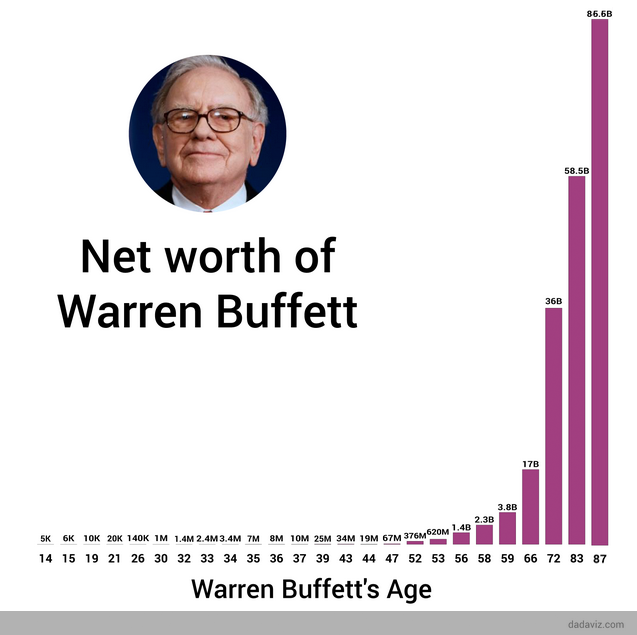
You can see his networth by age in the chart below:

Image for post

Relevant Articles:

- Buffett Partnership Letters
- The one lesson about Warren Buffett's success that no one wants to hear
- What would happen to Berkshire Hathaway after Warren Buffett is gone?
- The Pareto Principle In Dividend Investing
- Warren Buffett Investing Resource Page
- Warren Buffett’s Dividend Stock Strategy

Tuesday, August 4, 2020

BP Cuts Dividends by 50%

British based energy giant BP PLC (BP) cut dividends by 50% to 31.50 cents/share for each American Depository Receipt ( minus any ADR fees). This was the first dividend cut for BP since 2010, when it had a costly oil spill in the Gulf of Mexico.

This is the second oil major to cut dividends, after Royal Dutch Shell (RDS.B) cut dividends at the end of April 2020.

The turbulent global economy, the pandemic, and the low energy prices are the reasons for this move.  This move would provide the company with more flexibility and strengthen its balance sheet. They are expecting to focus excess cashflows to share buybacks, which are easier and less newsworthy to scrap when things go sour. When you are not making enough profit to support a high dividend, that was set when the times were better, cutting it may be a logical step.

As is the case for each dividend cut, I automatically sell after the news is posted.

If a company later reinstates its dividend, and starts raising it again, I may reconsider it. I did this for BP in 2013 and 2014, but I don't think it was a wise move in hindsight. The same strategy was not a smart move for General Electric (GE) either. While I may need a few more data points, so far it looks like buying back after a dividend is reinstated may not be a good strategy. On the other hand, buying Pfizer after it cut dividends in 2009 would have worked very well ( I didn't buy it).

The oil and gas sector is unable to earn its dividends from earnings right now, based on low energy prices. As a result, there are few bargains to be found in the space.

The interesting fact is that when BP suspended dividends in June 2010, the stock fell as low at $26.75/share. The company resumed paying a dividend in March 2011, and it has distributed $21.53/share so far. By February 2011, the stock was selling at $46 - $48/share.

It definitely looks like for cyclical companies, the time to buy may be when things are gloomiest, rather than when they are on top of the world. That being said, you have to have a good timing twice- first to buy low and second to sell high. I am not good at timing the market, and I doubt many of you are either. Hence, it makes sense to invest in companies that do ok throughout the ups and downs of the economic cycle. This means that exposure to commodity companies may have to be kept low.

Exxon Mobil (XOM) is probably at a high risk to cut dividends over the foreseeable future, because it has been unable to cover the current distribution out of earnings per share. This is from their latest conference call:

Finally, we have a long history of providing a reliable and growing dividend. A large portion of our shareholder base has come to view that dividend as a source of stability in their income, and we take that very seriously. While we manage our capital allocation priorities over the long term, we also recognize the need to balance in the near term to respond to market conditions. In response to the unprecedented environment that we find ourselves in, we've taken decisive action in 2020.

To recap what we've done so far this year. We've reduced short-term capital spending by more than 30%. We're on pace to reduce cash operating expenses by more than 15%. We've increased debt to a level we feel as appropriate to provide liquidity, given market uncertainties, and we will hold it at that level. And we're continuing to pay a reliable dividend.

While it sounds reassuring, this is usually how management teams try to cheer shareholders up, before a dividend is cut.

To me it is fascinating that the oil crash began in 2014. Yet, we didn't really get the oil and gas majors to cut dividends until it intensified in 2020. Energy investors have lived through a brutal 6 year period of negative returns, which is in stark contrast with the situation in 2014, when energy was touted as the next big thing, valuations looked cheap, and energy was one of the best performing sectors over the preceding decade.

Relevant Articles:

- Is BP’s dividend safe?
- Dividend Growth: The Risk of Being Cocky
- Royal Dutch Shell Cuts Dividends For The First Time Since World War II
- Are Energy Stock Values Today a Once in a Lifetime Opportunity?

Monday, August 3, 2020

Nine Dividend Paying Companies Raising Dividends Last Week

As part of my monitoring process, I review the list of dividend increases every week. This exercise helps me to monitor existing portfolio holdings, and to identify promising companies for further research.

I tend to focus my attention on companies with at least ten years of annual dividend increases. This activity helps me to focus on companies with a higher chance of delivering sustainable dividends, and lets me identify the companies with a long runway for future dividend increases.

I review each company, in order to determine if it can continue raising its dividends for the foreseeable future. I believe that rising earnings per share are the fuel behind future dividend increases.

I look at rising earnings per share, in conjunction with trends in the dividend payout ratio. A high payout ratio is generally a warning sign, unless the business model is highly predictable or earnings are growing faster than dividends. I generally prefer if earnings and dividends grow at roughly the same long-term rate. Sometimes there are changes, and reasons for why that’s not the case, especially if a company just recently started growing dividends from a low base.

I like to review trends in dividend growth too, and check if it is accelerating, decelerating or just keeping pace at a constant rate.

I also like to review the valuation in terms of P/E and yield. While these are viewed as old-fashioned today, I have found them to be useful yardsticks to follow, along with dividend growth, payout ratio and earnings growth. Valuation is part art, part science.

American States Water Company (AWR) provides water and electric services to residential, industrial, and other customers in the United States. It operates through three segments: Water, Electric, and Contracted Services.

The company raised its quarterly dividend by 9.80% to 33.50 cents/share. This marked the 66th consecutive year of annual dividend increases for this dividend king. During the past decade, this dividend king has managed to grow distributions at an annualized rate of 8.70%.

Between 2009 and 2019, the company grew earnings from 81 cents/share to $2.28/share.
The company is expected to earn $2.29/share in 2020.

The stock is overvalued at 33.60 times forward earnings. The stock yields 1.75%.

Community Trust Bancorp, Inc. (CTBI) operates as the bank holding company for Community Trust Bank, Inc. that provides commercial and personal banking services to small and mid-sized communities.

The company raised its quarterly dividend by 1.30% to 38.50 cents/share. This marked the 40th consecutive year of annual dividend increases for this dividend champion. During the past decade, this dividend champion has managed to grow distributions at an annualized rate of 3.10%.

Between 2009 and 2019, the bank grew earnings from $1.50/share to $3.64/share. The company is expected to earn $3.10/share in 2020.

The stock is attractively valued at 9.90 times forward earnings and yields 5%.

McKesson Corporation (MCK) provides pharmaceuticals and medical supplies in the United States and internationally. It operates through four segments: U.S. Pharmaceutical, Prescription Technology Solutions, International, and Medical-Surgical Solutions.

The company raised its quarterly dividend by 2.45% to 42 cents/share. This marked the 13th consecutive year of annual dividend increases for this dividend achiever. During the past decade, this dividend achiever has managed to grow distributions at an annualized rate of 12.65%.
The company has managed to grow earnings from $2.95/share in 2009 to $4.95/share in 2019. The company is expected to earn $14.40/share in 2020.

McKesson sells for 10.40 times forward earnings. The stock yields 1.10%.

Portland General Electric Company (POR) is an integrated electric utility company, engages in the generation, wholesale purchase, transmission, distribution, and retail sale of electricity in the state of Oregon. The company operates seven thermal plants; seven hydroelectric plants; and two wind farms.

The company raised its quarterly dividend by 5.85% to 40.75 cents/share. This marked the 15th consecutive year of annual dividend increases for this dividend achiever. During the past decade, this dividend achiever has managed to grow distributions at an annualized rate of 4.10%.

This utility managed to grow earnings from $1.31/share in 2009 to $2.39/share in 2019.
The company is expected to earn $2.39/share in 2020.

The company sells for 18.50 times forward earnings. The stock offers a dividend yield of 3.70%.

Republic Services, Inc. (RSG) provides non-hazardous solid waste collection, transfer, disposal, recycling, and environmental services in the United States.

The company raised its quarterly dividend by 4.95% to 42.50 cents/share. This marked the 18th consecutive year of annual dividend increases for this dividend achiever. During the past decade, this dividend achiever has managed to grow distributions at an annualized rate of 7.25%.

Republic Services managed to grow earnings from $1.30/share in 2009 to $3.33/share in 2019.
The company is expected to earn $2.85/share in 2020.

The stock is not cheap at 30.60 times forward earnings. Republic Services yields 1.95%.

The Scotts Miracle-Gro Company (SMG) manufactures, markets, and sells consumer lawn and garden products in the United States and internationally. The company operates through three segments: U.S. Consumer, Hawthorne, and Other.

The company raised its quarterly dividend by 6.90% to 62 cents/share. This marked the 11th consecutive year of annual dividend increases for this dividend achiever. During the past decade, this dividend achiever has managed to grow distributions at an annualized rate of 16.30%.

The company managed to grow earnings from $2.32/share in 2009 to $8.18/share in 2019.
The company is expected to earn $6.37/share in 2020.

The stock sells for 24.90 times forward earnings. The stock offers a dividend yield of 1.55%.

W.W. Grainger, Inc. (GWW) distributes maintenance, repair, and operating (MRO) products and services in the United States, Canada, and internationally.

The company raised its quarterly dividend by 6.25% to $1.53/share. This marked the 49th consecutive year of annual dividend increases for this dividend champion. During the past decade, this dividend achiever has managed to grow distributions at an annualized rate of 12.30%.

Between 2009 and 2019, W.W. Grainger managed to increase earnings from $5.62/share to $15.32/share. The company is expected to earn $15.94/share in 2020.

The stock sells for 21.40 times forward earnings and yields 1.80%.

Altria Group, Inc. (MO) manufactures and sells cigarettes, smokeless products, and wine in the United States.

The company raised its quarterly dividend by 2.40% to 86 cents/share. This marked the 51st consecutive year of annual dividend increases for this dividend king. During the past decade, this dividend king has managed to grow distributions at an annualized rate of 9.70%.

Altria earned $1.87/share in 2010 and is expected to earn $4.31/share in 2020.

The stock is cheap at 9.50 times forward earnings. The stock yields 8.35%.

Eagle Bancorp Montana, Inc. (EBMT) operates as the bank holding company for Opportunity Bank of Montana that provides various retail banking products and services to small businesses and individuals in Montana.

The company raised its quarterly dividend by 2.60% to 9.75 cents/share. This marked the 21st consecutive year of annual dividend increases for this dividend achiever. During the past decade, this dividend achiever has managed to grow distributions at an annualized rate of 3.30%.

The bank grew earnings from 52 cents/share in 2009 to $1.69/share in 2019. The company is expected to earn $2.36/share in 2020

The stock sells for 6.55 times forward earnings and yields 2.50%.

Relevant Articles:

- My Favorite Exercise As A Dividend Growth Investor
- Three Dividend Stocks in the News
- Two Sweet Dividend Increases For Long-Term Shareholders
- Dividends are a fact, share prices are an opinion

Popular Posts