In the past couple of weeks, there were two high yielding dividend growth stocks, which announced dividend hikes. I typically look for sustainable dividend payments, which can also grow over time. The companies I am about to mention, pay a large portion of earnings per share to shareholders in the form of distributions, which is why future expected growth is not going to be very high. However, for those who need high current income today, companies like those could be decent holdings in a diversified income portfolio. I hold stakes in both companies, and enjoy getting paid to own those shares. It is a very nice feeling to be paid cash dividends that grow faster than my salary, even if I decide to stay in bed and watch soap operas all day long. With dividend investing, the big money is made by sitting, or sleeping, rather than through frenetic investment activity.
The companies raising distributions include:
Verizon Communications Inc. (VZ) provides communications, information, and entertainment products and services to consumers, businesses, and governmental agencies worldwide. The company raised its quarterly dividends by 3.80% to 55 cents/share. Verizon has managed to boost dividends for 10 years in a row. Over the past decade, Verizon has managed to increase dividends by 3%/year. Currently, this dividend achiever is attractively priced at 14.10 times forward earnings and yields 4.40%. I would expect that Verizon manages to grow dividends per share by about 3% - 4%/year in the foreseeable future. Check my analysis of Verizon.
Altria Group, Inc. (MO), through its subsidiaries, manufactures and sells cigarettes, smokeless products, and wine in the United States. The company raised its quarterly dividends by 8.30% to 52 cents/share. Altria has managed to boost dividends for 45 years in a row. Over the past five years, Altria has managed to increase dividends by 9.20%/year. Currently, this dividend champion is attractively priced at 16.90 times forward earnings and yields 4.80%. I would expect that Altria manages to grow dividends per share by about 6%/year in the foreseeable future, driven by its pricing power, strong position in the domestic tobacco market, as well as its 27% interest in SAB Miller. I will reinvest those dividends from Altria into more Altria shares. Check my analysis of Altria.
Both companies are valued properly right now for patient long-term investors, who also need income right now. For example, if we assume a 30 year investment period, and 3% annual growth in earnings per share, and require a 10% annual return, the discounted valued for Verizon is approximately $45.20/share. Using the same parameters for Altria, the discounted value comes out to $32.60/share. Those are of course very conservative expectations, although those fair values represent the value of the business to a private owner. Of course, in the case of Verizon, the future growth would likely be around 3%/year, whereas for Altria I expect that earnings per share to be closer to 5% – 6%/year for the next 30 years. The majority of growth in earnings will likely occur in the first 15 years or so, after which growth will probably get lower.Of course, I don't really do much in terms of discounted analysis, but based on what I know from analyzing both businesses, I prefer Altria to Verizon. Let's circle back in 20 years, and see if I was right.
Full Disclosure: Long VZ and MO
Relevant Articles:
- Altria Group (MO): A Smoking Hot Dividend Champion
- Should I invest in AT&T and Verizon for high dividend income?
- Let dividends do the heavy lifting for your retirement
- Why I don’t do discounted cash flow analysis on dividend paying stocks
- Should I buy more high yielding stocks in order to retire early?
Monday, September 8, 2014
Friday, September 5, 2014
McDonald’s (MCD) Dividend Stock Analysis 2014
McDonald’s Corporation (MCD) franchises and operates McDonald's
restaurants in the United States, Europe, the Asia/Pacific, the Middle East,
Africa, Canada, and Latin America. As of December 31, 2013, it operated 35,429
restaurants, including 28,691 franchised and 6,738 company-operated
restaurants. McDonald’s is a dividend champion which has increased distributions for
38 years in a row.
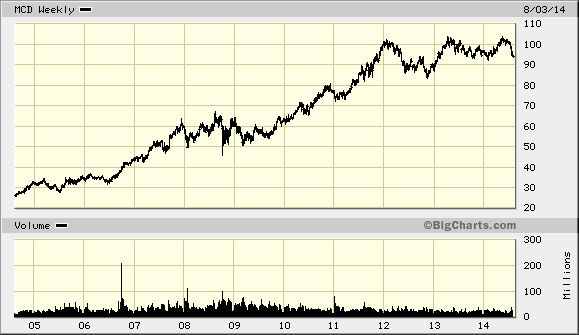
The most recent dividend increase was in September 2013, when the Board of Directors approved a 5.20% increase in the quarterly dividend to 81 cents/share. The largest competitors for McDonald's include Burger King (BKW), YUM! Brands (YUM) and Starbucks (SBUX).
Over the past decade this dividend growth stock has delivered an annualized total
return of 17.90% to its shareholders. Future returns will be dependent on growth in earnings and dividend yields obtained by shareholders.


Tuesday, September 2, 2014
Should I have a minimum yield requirement?
In my entry criteria, dividend yield is the last factor used to select dividend stocks. After I screen the list of dividend champions or dividend achievers, I look at each company in detail.
First I look for growing earnings per share, and attractive entry P/E ratios. Then I check if the dividend is going up above the rate of inflation. Finally, I check if entry yield is above 2.50%.
Using my screen parameters, I sometimes end up missing companies which have low yields but high dividend growth. However, by doing so, I am somewhat protected in the case I purchase a low yield but high growth stock, which subsequently lowers distributions growth or stalls it. I want to avoid at all costs getting carried away chasing dividend growth. Chasing growth could result in overpaying for a low yielding asset that grows earnings and dividends, and my total return ends up being limited to the modest initial yield for several years. My investment philosophy is to avoid losing money, and as a result I am fine missing out on potential gains if that reduces dividend income risk. Winning dividend positions typically take care of themselves, while losing positions are typically the higher risk ones that could make you lose sleep at night.
For example, investors who purchased stock in some great blue-chip dividend payers such as Coca-Cola (KO) or Wal-Mart Stores (WMT) during the 1999 – 2000 period, saw their share prices go nowhere for over a decade. The only return they received was in the form of dividends, which were initially very low. At the same time, both companies managed to significantly increase revenues, earnings and dividends during that time period. The reason behind the lackluster performance was the fact that these stocks were very overvalued in the late 1990’s and early 2000’s. The lesson from this exercise is that even the best dividend paying stocks in the world are not worth overpaying for.
Furthermore, while I may miss out on some companies like Raven Industries (RAVN) or Franklin Resources (BEN), I am going to still be able to select stocks in the sweet spot, which generate best returns for the risk i am taking. A company like Phillip Morris International (PM) or Kinder Morgan (KMI) that provides a good starting yield of 4% which grows at 8%-10% per year, is a much better candidate that a company yielding 1 - 2%, that grows dividends at 12%. The higher initial yield provides a margin of safety for the time in the future when dividend growth stalls. This could be tomorrow, or it could be 20 years from now. The issue with high growth is that it cannot continue forever. At some point, the growth will come down to a more reasonable and sustainable level.
The negative of what I am doing is that I will surely miss out on the next McDonald's (MCD) or Johnson & Johnson (JNJ) dividend growth success story. This is because companies in the early stage of dividend growth typically have low current yields, but manage to grow distributions at a very high clip. Those are the types of companies which will generate outstanding total returns, and double-digit yields on cost for anyone fortunate enough to believe in the company, and put their money there. This is one of the reasons why I purchased Visa (V) in 2011 and recently in 2014, despite the low current yield. I also purchased Casey's (CASY) in 2011 and YUM! Brands (YUM) in 2010 and 2013, when their yields were less than 2.50%. I was betting that above average dividend growth will continue, and I also wanted to beef up my portfolio exposure to the low yield and high dividend growth investments.
In the grand scheme of things, I am starting to believe more and more that initial attractive valuation of less than 20 times earnings is helpful. If this valuation is even lower, that could be very helpful for total returns and future yields on cost as well. The other equally important thing to consider is growth of earnings per share. After all, a quality business that keeps growing over time will eventually bail out the investor who might have slightly overpaid in the beginning. However, if I overpaid for a business that pays a high yield today, but fails to grow earnings per share, chances are that the dividend will not increase above the rate of inflation, and I will end up downgrading my standard of living quite regularly. Therefore, a business which has the potential to earn more in 15 - 20 years, coupled with an attractive valuation, is the type that will deliver investment success to its shareholders. Whether this business pays a 2.50% yield or a 1.50% yield at the time of investment might not be as relevant. However, if I am wrong about my assessment of the business, I will end up losing more under the lower yield scenario, since earnings will not grow by much leading the the price to stagnate, In addition, the business will only pay a paltry yield, that does not grow by much either. Since I use my dividends from companies to buy shares in other companies, this could mean less money to be put to work in the next great dividend growth success story.
This is why evaluating each business one at a time is so important. The investor has to take into consideration valuation, growth prospects, changes in industry or competitive landscape and evaluate that against their unique set of investment opportunities and expectations. Unfortunately, investing is not as black and white as most would make you believe.
Full Disclosure: Long KMI, PM, KO, WMT, YUM, V, CASY
Relevant Articles:
- The importance of yield on cost
- How to be a successful dividend investor
- Types of dividend growth stocks
- How to retire in 10 years with dividend stocks
- Should Dividend Investors Worry About Rising Interest Rates?
First I look for growing earnings per share, and attractive entry P/E ratios. Then I check if the dividend is going up above the rate of inflation. Finally, I check if entry yield is above 2.50%.
Using my screen parameters, I sometimes end up missing companies which have low yields but high dividend growth. However, by doing so, I am somewhat protected in the case I purchase a low yield but high growth stock, which subsequently lowers distributions growth or stalls it. I want to avoid at all costs getting carried away chasing dividend growth. Chasing growth could result in overpaying for a low yielding asset that grows earnings and dividends, and my total return ends up being limited to the modest initial yield for several years. My investment philosophy is to avoid losing money, and as a result I am fine missing out on potential gains if that reduces dividend income risk. Winning dividend positions typically take care of themselves, while losing positions are typically the higher risk ones that could make you lose sleep at night.
For example, investors who purchased stock in some great blue-chip dividend payers such as Coca-Cola (KO) or Wal-Mart Stores (WMT) during the 1999 – 2000 period, saw their share prices go nowhere for over a decade. The only return they received was in the form of dividends, which were initially very low. At the same time, both companies managed to significantly increase revenues, earnings and dividends during that time period. The reason behind the lackluster performance was the fact that these stocks were very overvalued in the late 1990’s and early 2000’s. The lesson from this exercise is that even the best dividend paying stocks in the world are not worth overpaying for.
Furthermore, while I may miss out on some companies like Raven Industries (RAVN) or Franklin Resources (BEN), I am going to still be able to select stocks in the sweet spot, which generate best returns for the risk i am taking. A company like Phillip Morris International (PM) or Kinder Morgan (KMI) that provides a good starting yield of 4% which grows at 8%-10% per year, is a much better candidate that a company yielding 1 - 2%, that grows dividends at 12%. The higher initial yield provides a margin of safety for the time in the future when dividend growth stalls. This could be tomorrow, or it could be 20 years from now. The issue with high growth is that it cannot continue forever. At some point, the growth will come down to a more reasonable and sustainable level.
The negative of what I am doing is that I will surely miss out on the next McDonald's (MCD) or Johnson & Johnson (JNJ) dividend growth success story. This is because companies in the early stage of dividend growth typically have low current yields, but manage to grow distributions at a very high clip. Those are the types of companies which will generate outstanding total returns, and double-digit yields on cost for anyone fortunate enough to believe in the company, and put their money there. This is one of the reasons why I purchased Visa (V) in 2011 and recently in 2014, despite the low current yield. I also purchased Casey's (CASY) in 2011 and YUM! Brands (YUM) in 2010 and 2013, when their yields were less than 2.50%. I was betting that above average dividend growth will continue, and I also wanted to beef up my portfolio exposure to the low yield and high dividend growth investments.
In the grand scheme of things, I am starting to believe more and more that initial attractive valuation of less than 20 times earnings is helpful. If this valuation is even lower, that could be very helpful for total returns and future yields on cost as well. The other equally important thing to consider is growth of earnings per share. After all, a quality business that keeps growing over time will eventually bail out the investor who might have slightly overpaid in the beginning. However, if I overpaid for a business that pays a high yield today, but fails to grow earnings per share, chances are that the dividend will not increase above the rate of inflation, and I will end up downgrading my standard of living quite regularly. Therefore, a business which has the potential to earn more in 15 - 20 years, coupled with an attractive valuation, is the type that will deliver investment success to its shareholders. Whether this business pays a 2.50% yield or a 1.50% yield at the time of investment might not be as relevant. However, if I am wrong about my assessment of the business, I will end up losing more under the lower yield scenario, since earnings will not grow by much leading the the price to stagnate, In addition, the business will only pay a paltry yield, that does not grow by much either. Since I use my dividends from companies to buy shares in other companies, this could mean less money to be put to work in the next great dividend growth success story.
This is why evaluating each business one at a time is so important. The investor has to take into consideration valuation, growth prospects, changes in industry or competitive landscape and evaluate that against their unique set of investment opportunities and expectations. Unfortunately, investing is not as black and white as most would make you believe.
Full Disclosure: Long KMI, PM, KO, WMT, YUM, V, CASY
Relevant Articles:
- The importance of yield on cost
- How to be a successful dividend investor
- Types of dividend growth stocks
- How to retire in 10 years with dividend stocks
- Should Dividend Investors Worry About Rising Interest Rates?
Sunday, August 31, 2014
Best Dividend Investing Articles for August 2014
For your weekend reading enjoyment, I have highlighted a few interesting articles from the archives, which I find to be relevant today. The first five articles have been written and posted on this site, while the last four have been selected from other authors. I tend to post anywhere between three to four articles to my site every week. I usually try to write at least one or two articles that contain timeless information concerning dividend investing. This could include information about my strategy, or other pieces of information, which could be useful to dividend investors.
Below, I have highlighted a few articles posted on this site, which many readers have found interesting:
1) 14 Dividend Growth Stocks I Bought On the Dip Last Week
As some companies started declining in price at the beginning of August, I was able to initiate or add to positions in those securities. As I continuously screen a group of companies I am interested in based on price, it is very helpful when those get into the value territory. Overall, August was a busy month for purchases and sales of puts. Unfortunately, I won't be able to allocate more cash to stocks until some time in October. Of course, January's Roth and SEP contributions are just a few months away from there, followed by tax day. Hence, a little bit of cash accumulation might be helpful.
2) Dividend Investing for Financial Independence
I plan on living off dividends in retirement. In this article I discuss numerically, how to reach target monthly dividend income levels. For example if an investor puts $1000/month companies yielding 4% today and achieving a 6% annual dividend growth,and reinvests dividends, their portfolio will generate over $7,900 in annual dividend income in ten years. However, if our investor put away $2000/month in income stocks with the same characteristics as above, they would be achieving $7,900 in annual dividend income only after 72 months.
3) Kinder Morgan to Merge Partnerships into One Company
Kinder Morgan is simplifying its structure, by merging all limited partner interests into the parent company Kinder Morgan Inc (KMI). This move will create an energy powerhouse, which will be able to enjoy benefits of scale, unique geographic position, simplified structure, lower cost of capital and a ready currency for further acquisitions. The combined company is forecasting an increase in the annual dividend to $2/share by 2015 and then a 10% annual dividend growth through 2020. As a shareholder of KMI, I am happy. As a shareholder of KMR, I am happy as well. The unitholders of KMP and EPB will face some immediate tax hits, once the transaction closes. However, I believe that for those who buy and hold, they will do pretty well for themselves if they do not do anything for at least a decade. Now all shareholders and former partners will have the same interests as Richard Kinder, who I believe to be the Warren Buffett of Energy.
4) How to Invest Like Warren Buffett
Buffett has become a billionaire by continuously keeping an open mind for opportunities which will keep paying him for decades to come. All he has done is look for those situations where he can find a quality business, which will earn more in 15 - 20 years, has a low risk of change that will impact profitability, is managed by quality management team and is available at a good price. Of course, Buffett has also been helped immensely by the insurance float generated for Berkshire Hathaway, as well the hedge fund fees he earned in his days of the Buffett Partnership in the 1950s and 1960s. However, as an ordinary investor, I keep most of my energy focused on how I can select companies that generate a lot of cashflows to me, that I can use to then buy more stock in companies that generate more dividends for me.
5) Why Warren Buffett likes Investing in Bank Stocks
I wrote another article on Warren Buffett and why he likes investing in bank stocks. I believe that he likes their deposit float, which is essentially a very low cost of capital, which is pretty stable over time, and could be deployed by able and honest managers into lucrative projects such as mortgage or business loans. Of course, management quality is of utmost importance, which is why he has been adding to shares of Wells Fargo (WFC) in the past couple of decades.
I read a lot about companies, and also read a lot of interesting articles from all over the web. A few that I really enjoyed over the past months include:
1) Warren Buffett's $50 Billion Decision
I often get asked why do I want to "retire" early, given the fact that my "idol" Warren Buffett is 84, and is not even thinking about "retirement". The truth of the matter is that Buffett has been "retired" since 1956. This article from Forbes describes the decision that the Oracle of Omaha did for himself when he was 26 years old. Surprisingly, his retirement gave him the time to pursue his passion of learning and investing. The billions he made as a result of Buffett Partnerships and Berkshire Hathaway were a pretty nice side-gig. Retirement is about being in control of your time, and doing what you love, not about watching soap operas.
2) Weekend Reading – August 29, 2014
Dividend Mantra has compiled several interesting articles on dividend investing, in his weekly review. In addition, his "retirement" seems to be going really well, as he is making thousands of dollars writing about dividends, and he has recently been interviewed by Mint.
3) Weekly Links: August 31, 2014
My friend Dividends4Life has also compiled a list of pretty good articles on dividend investing on his website. I am surprised that not a lot of other readers know about him, given that he has written about dividend investing for over 7 - 8 years and has tracked his dividend numbers for the same period of time. He is a baby boomer who is dilligently working his way towards retirement.
4) Weekly Roundup - August 31, 2014
The Passive Income Earner also has a list of several articles on Dividend Investing. This is another site I read regularly, given that the writer is someone who has been saving and investing huge amounts to kick-start his dividend machine. I also have used his site to find other sites related to dividend investing.
Thank you for reading Dividend Growth Investor site. I am also on Twitter, if you are interested in following me on another platform, where I post about recent trades I have made.
Full Disclosure: Long KMI, KMR, WFC, BRK.B
1) 14 Dividend Growth Stocks I Bought On the Dip Last Week
As some companies started declining in price at the beginning of August, I was able to initiate or add to positions in those securities. As I continuously screen a group of companies I am interested in based on price, it is very helpful when those get into the value territory. Overall, August was a busy month for purchases and sales of puts. Unfortunately, I won't be able to allocate more cash to stocks until some time in October. Of course, January's Roth and SEP contributions are just a few months away from there, followed by tax day. Hence, a little bit of cash accumulation might be helpful.
2) Dividend Investing for Financial Independence
I plan on living off dividends in retirement. In this article I discuss numerically, how to reach target monthly dividend income levels. For example if an investor puts $1000/month companies yielding 4% today and achieving a 6% annual dividend growth,and reinvests dividends, their portfolio will generate over $7,900 in annual dividend income in ten years. However, if our investor put away $2000/month in income stocks with the same characteristics as above, they would be achieving $7,900 in annual dividend income only after 72 months.
3) Kinder Morgan to Merge Partnerships into One Company
Kinder Morgan is simplifying its structure, by merging all limited partner interests into the parent company Kinder Morgan Inc (KMI). This move will create an energy powerhouse, which will be able to enjoy benefits of scale, unique geographic position, simplified structure, lower cost of capital and a ready currency for further acquisitions. The combined company is forecasting an increase in the annual dividend to $2/share by 2015 and then a 10% annual dividend growth through 2020. As a shareholder of KMI, I am happy. As a shareholder of KMR, I am happy as well. The unitholders of KMP and EPB will face some immediate tax hits, once the transaction closes. However, I believe that for those who buy and hold, they will do pretty well for themselves if they do not do anything for at least a decade. Now all shareholders and former partners will have the same interests as Richard Kinder, who I believe to be the Warren Buffett of Energy.
4) How to Invest Like Warren Buffett
Buffett has become a billionaire by continuously keeping an open mind for opportunities which will keep paying him for decades to come. All he has done is look for those situations where he can find a quality business, which will earn more in 15 - 20 years, has a low risk of change that will impact profitability, is managed by quality management team and is available at a good price. Of course, Buffett has also been helped immensely by the insurance float generated for Berkshire Hathaway, as well the hedge fund fees he earned in his days of the Buffett Partnership in the 1950s and 1960s. However, as an ordinary investor, I keep most of my energy focused on how I can select companies that generate a lot of cashflows to me, that I can use to then buy more stock in companies that generate more dividends for me.
5) Why Warren Buffett likes Investing in Bank Stocks
I wrote another article on Warren Buffett and why he likes investing in bank stocks. I believe that he likes their deposit float, which is essentially a very low cost of capital, which is pretty stable over time, and could be deployed by able and honest managers into lucrative projects such as mortgage or business loans. Of course, management quality is of utmost importance, which is why he has been adding to shares of Wells Fargo (WFC) in the past couple of decades.
I read a lot about companies, and also read a lot of interesting articles from all over the web. A few that I really enjoyed over the past months include:
1) Warren Buffett's $50 Billion Decision
I often get asked why do I want to "retire" early, given the fact that my "idol" Warren Buffett is 84, and is not even thinking about "retirement". The truth of the matter is that Buffett has been "retired" since 1956. This article from Forbes describes the decision that the Oracle of Omaha did for himself when he was 26 years old. Surprisingly, his retirement gave him the time to pursue his passion of learning and investing. The billions he made as a result of Buffett Partnerships and Berkshire Hathaway were a pretty nice side-gig. Retirement is about being in control of your time, and doing what you love, not about watching soap operas.
2) Weekend Reading – August 29, 2014
Dividend Mantra has compiled several interesting articles on dividend investing, in his weekly review. In addition, his "retirement" seems to be going really well, as he is making thousands of dollars writing about dividends, and he has recently been interviewed by Mint.
3) Weekly Links: August 31, 2014
My friend Dividends4Life has also compiled a list of pretty good articles on dividend investing on his website. I am surprised that not a lot of other readers know about him, given that he has written about dividend investing for over 7 - 8 years and has tracked his dividend numbers for the same period of time. He is a baby boomer who is dilligently working his way towards retirement.
4) Weekly Roundup - August 31, 2014
The Passive Income Earner also has a list of several articles on Dividend Investing. This is another site I read regularly, given that the writer is someone who has been saving and investing huge amounts to kick-start his dividend machine. I also have used his site to find other sites related to dividend investing.
Thank you for reading Dividend Growth Investor site. I am also on Twitter, if you are interested in following me on another platform, where I post about recent trades I have made.
Full Disclosure: Long KMI, KMR, WFC, BRK.B
Friday, August 29, 2014
Starbucks: The Next Dividend Growth Success Story
Starbucks Corporation (SBUX) operates as a roaster, marketer, and retailer of specialty coffee worldwide. The company initiated its dividend in 2010, and has been growing distributions rapidly since then. While the company has only managed to increase dividends for four years in a row, I believe that it has the potential to reach dividend achiever status, and have the growth story to become as successful for its dividend growth investors.
The most recent dividend increase was in October 2013, when the Board of Directors approved a 23.80% increase in the quarterly dividend to 26 cents/share. The company's main competitors include McDonald's (NYSE:MCD), Nestle (OTCPK:NSRGY) and Dunkin Brands (NASDAQ:DNKN).
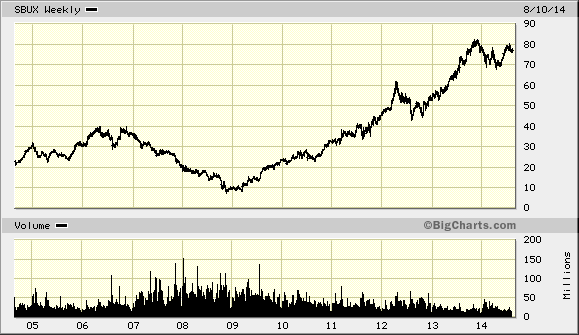
Since the company initiated a dividend payment in 2010, the stock has returned 225%. Future returns will be dependent on growth in earnings and dividend yields obtained by shareholders, as well as the initial valuation locked in at the time of investment.
The most recent dividend increase was in October 2013, when the Board of Directors approved a 23.80% increase in the quarterly dividend to 26 cents/share. The company's main competitors include McDonald's (NYSE:MCD), Nestle (OTCPK:NSRGY) and Dunkin Brands (NASDAQ:DNKN).
Since the company initiated a dividend payment in 2010, the stock has returned 225%. Future returns will be dependent on growth in earnings and dividend yields obtained by shareholders, as well as the initial valuation locked in at the time of investment.
Subscribe to:
Posts (Atom)
