Wednesday, April 20, 2022

Dividend Stock Analysis of Johnson & Johnson (JNJ)

Johnson & Johnson (JNJ), together with its subsidiaries, is engaged in the research and development, manufacture, and sale of various products in the health care field worldwide. The company operates in three segments: Consumer, Pharmaceutical, and Medical Devices & Diagnostics. This dividend king has paid dividends since 1944 and has managed to increase them for 60 years in a row. Dividend increases have been like clockwork every year for decades.

Johnson & Johnson earned $3.49/share in 2011 and managed to grow earnings to $7.81/share in 2021. The company expected to earn between $10.53/share in 2022.


Johnson & Johnson has a diversified product line across medical devices, consumer products and drugs, which should serve it well in the future. This makes the company somewhat immune from economic cycles. Investors looking for a safe and dependable earnings can look no further than Johnson & Johnson. In addition, the company has strong competitive advantages due to its scale, leadership role in various diverse healthcare segments, breadth of product offerings in its global distribution channels, continued investment in R&D, high switching costs to users of its medical devices, as well as its stable financial position.

Future profits growth could come from new product offerings, which are the result of continued investment in research and development, and through strategic acquisitions.

Johnson & Johnson has managed to reduce number of shares outstanding over the past decade, which helped earnings per share growth. Between 2011 and 2021, the number of shares went from 2,775 million to 2,877 million and then declined to 2,674 million. The short bumps up were related to acquisitions.  


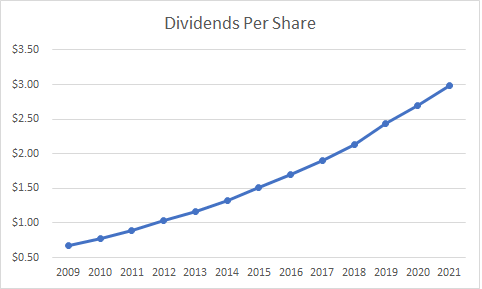
The company managed to grow its dividends by 7.40%/year over the past decade. The company's latest dividend increase was announced in April 2022 when the Board of Directors approved a 6.60% increase in the quarterly dividend to $1.13/share.


The dividend payout ratio has decreased from 64% in 2007 to 54% in 2021. The ability to generate strong cash flows, have enabled Johnson & Johnson to reward shareholders with higher dividends for 60 consecutive years. I believe that the dividend is safe today, but will likely be limited to future growth in earnings per share of 5% - 6%/year over the next decade. A lower payout is always a plus, since it leaves room for consistent dividend growth and minimize the impact of short-term fluctuations in earnings.


Currently, the stock is attractively valued at 16.90 times forward earnings, yields 2.45% and has a forward dividend payout ratio of 43%.

Relevant Articles:

Eleven Dividend Focused Companies For Further Research
Dividend Growth Investor Newsletter Turns One
Dividend Kings List For 2019
How to value dividend stocks

Tuesday, April 19, 2022

Johnson & Johnson (JNJ) Raises Dividends by 6.60%

Johnson & Johnson (JNJ), together with its subsidiaries, is engaged in the research and development, manufacture, and sale of various products in the health care field worldwide. The company operates in three segments: Consumer, Pharmaceutical, and Medical Devices & Diagnostics. This dividend king has paid dividends since 1944. Dividend increases have been like clockwork every year for decades. Check my analysis of Johnson & Johnson (JNJ) for more information about the company.

I just read that Johnson & Johnson (JNJ) has hiked dividends by 6.60% to $1.13/share. This marked the 60th consecutive annual dividend increase for this dividend king. There are only 38 companies in the US which have managed to increase dividends annually for at least 50 years in a row.

Over the past decade, Johnson & Johnson has managed to grow dividends at an annualized rate of 6.40%/year.

When reviewing press releases that discuss dividend increases, I always find it helpful to see the tone from top management. I especially liked what the CEO had to say (Source: Press Release):


"In recognition of our 2021 results, strong financial position, and confidence in the future of Johnson & Johnson, the Board of Directors has voted to increase the quarterly dividend for the 60th consecutive year," said Joaquin Duato, Chief Executive Officer of the company.

This dividend increase is a testament to the stability of the business model. Johnson & Johnson was one of the first companies to raise dividends in April 2020, amidst the uncertainty of the Covid-19 pandemic. It has also delivered during the last few crises, such as during the Global Financial Crisis of 2007 - 2009. When other companies cite current conditions as unprecedented,  Johnson & Johnson actually can provide guidance on revenues and earnings. It is always reassuring to understand that long term fundamentals remain intact, no matter what life throws at this business.

The company expects to earn somewhere between $10.15 and $10.35/share in 2022. 

The valuation seems fine today at 16.90 times forward earnings, albeit it would always be better if the stock is available at a lower price. The stock yields 2.45%.

Relevant Articles:


Monday, April 18, 2022

Five Companies Delivering Dependable Dividend Raises

As part of my weekly review process, I monitor the list of dividend increases and focus on the companies with at least a ten year history of dividend increases. This process helps me to monitor existing positions, but also to identify companies for further research. 

It is also a good reminder about the companies that I never pulled the trigger on, despite understanding them. As an investor, I get to learn from mistakes I make, and hopefully improve over time. 

Over the past week, there were several companies that raised dividends. The companies with at least a ten year track record of annual dividend increases include:

The Procter & Gamble Company (PG) provides branded consumer packaged goods to consumers in North and Latin America, Europe, the Asia Pacific, Greater China, India, the Middle East, and Africa. It operates in five segments: Beauty; Grooming; Health Care; Fabric & Home Care; and Baby, Feminine & Family Care. 

Procter & Gamble raised its quarterly dividend by 5% to $0.9133/share. This was the 66th consecutive annual dividend increase for this dividend king. I liked this part from the press release:

This dividend increase marked the 66th consecutive year that P&G has increased its dividend and the 132nd consecutive year that P&G has paid a dividend since its incorporation in 1890. It reinforces our commitment to return cash to shareholders, many of whom rely on the steady, reliable income earned with their investment in P&G.

Over the past decade, the company has managed to grow dividends at an annualized rate of 5.20%.

Between 2012 and 2021, the company managed to grow earnings from $3.66/share to $5.50/share.

P&G is expected to earn $5.86/share in 2022.

The stock is selling for 27.05 times forward earnings and yields 2.30%. Check my review for more information about the company.

Costco Wholesale Corporation (COST) engages in the operation of membership warehouses in the United States, Puerto Rico, Canada, the United Kingdom, Mexico, Japan, Korea, Australia, Spain, France, Iceland, China, and Taiwan. 

Costco raised its quarterly dividend by 13.90% to $0.90/share. This was the 18th consecutive annual dividend increase for this dividend achiever. Over the past decade, the company has managed to grow dividends at an annualized rate of 12.70%.

Between 2012 and 2021, the company managed to grow earnings from $3.89/share to $11.27/share.

The company is expected to earn $13.04/share in 2022.

The stock is selling for 45.26 times forward earnings and yields 0.61%. Check my review for more information about the company.

Aon plc, (AON) is a professional services firm, provides advice and solutions to clients focused on risk, retirement, and health worldwide. 

AON increased its quarterly dividend by 9.80% to $0.56/share. This is the eleventh year of consecutive annual dividend increases for this dividend achiever.

During the past decade, the company has managed to increase dividends at an annualized rate of 12.70%.

Between 2012 and 2021, the company managed to grow earnings from $2.99/share to $5.55/share.

The company is estimated to earn $13.27/share in 2022.

The company is selling for 24.74 times forward earnings and yields 0.68%.

First Republic Bank (FRC) provides private banking, private business banking, and private wealth management services to clients in metropolitan areas in the United States. It operates in two segments, Commercial Banking and Wealth Management. 

First Republic Bank raised its quarterly dividend by 22.70% to $0.27/share. 

This is the banks 11th consecutive year of dividend increases. The company has raised dividends by 6.40%/year over the past decade.

Between 2012 and 2021, the bank managed to increase earnings from $2.75/share to $7.68/share.

The company is expected to earn $8.44/share in 2022.

The stock is selling for 19.05 times forward earnings and yields 0.67%. 

Quaint Oak Bancorp, Inc., (QNTO) operates as a chartered stock savings bank. The company operates in two segments, Banking and Mortgage BankingQuaint Oak Bancorp increased its quarterly dividend by 18.20% to $0.13/share. This was the 14th consecutive annul dividend increase for this bank.

Between 2012 and 2021, the company managed to grow earnings from $0.55/share to $3.06/share.

The company is selling for 7.60 times earnings and yields 2.24%.


Relevant Articles:

- Costco (COST) Hikes Dividends by 13.90%

- Procter & Gamble (PG) Raises Dividends For 66th Consecutive Year


Thursday, April 14, 2022

Costco (COST) Hikes Dividends by 13.90%

Costco Wholesale Corporation (COST) operates membership warehouses in the United States, Puerto Rico, Canada, the United Kingdom, Mexico, Japan, Korea, Australia, Spain, France, Iceland, China, and Taiwan. You may have seen its stores mentioned in news stories, where long-lines of shoppers are waiting to get in the store. You may have also seen Costco material on empty shelves that used to have toilet paper before.

That company managed to increase its quarterly dividend by 13.90% to $0.90/share. (Press Release) This marked the 18th consecutive annual dividend increase for this dividend achiever. Over the past decade, the company has managed to increase dividends at an annualized rate of 12.70%.


Costco has paid special dividends on three separate occasions over the past decade. The company paid $7/share in 2012, when taxes on dividends were supposed to increase ( they didn't). Costco also distributed $5/share in 2015, and $7/share in 2017. The last special dividend was $10/share in 2020.

Costco is a great company that cares about its employees, customers and shareholders, and has created a unique business model that benefits all stakeholders. The ability to distribute special dividends shows this to me. The company is a rarity today, since it has largely kept the number of shares outstanding stagnant. It favors special dividends to share buybacks, so it is a company after my own heart.


The dividend growth was supported by strong earnings growth. Earnings per share increased from $2.47/share in 2009 to $11.27/share in 2021. 

Prior to the financial crisis, the peak earnings for Costco were in 2008 at $2.98/share. This makes the decrease to $2.47/share not that bad. Otherwise, earnings per share have been trending upwards. The company is expected to generate $13.04/share in 2022. 

The company tends to offer a large quantity of limited variety products at competitive prices. Costco buys directly from vendors in bulk. It also has a quick inventory turnover. This results in generating cash from a sale before having to pay the supplier invoices. Shoppers are loyal to Costco, and employees love working there. Employees are paid very competitively, which is why they stick around, reducing costly turnover. Most of the profits are coming from recurring membership fees, as Costco largely sells its merchandise at a price to cover its expenses.

Charlie Munger, the investing partner of Warren Buffett is a director at Costco since 1997. He has seen the inner workings of the retail giant closely for over two decades. This statement of his is insightful about the inner workings of Costco:

"It has a frantic desire to serve customers a little better every year. When other companies find ways to save money, they turn it into profit. Sinegal passes it on to customers. It's almost a religious duty. He's sacrificing short-term profits for long-term success."

Costco has also maintained a relatively stable dividend payout ratio. It has largely remained between 25% in 2013 to a high of 32% in 2016. This is a fairly tight range, and shows that dividend growth was entirely driven by growth in earnings per share.


I have liked Costco's business model, and have also been a member for several years. I believe that this is a business built to last, which will be successful in the long-term. However, the valuation has always stopped me from initiating a position in the stock, which seems like a mistake in hindsight.


2021

2020

2019

2018

2017

2016

2015

2014

2013

2012

2011

2010

High Price

460.62

349.06

   299.95

   233.52

   183.18

   169.73

   156.85

   126.12

   120.20

   99.28

   83.95

   62.12

Low Price

307

271.28

   189.51

   154.11

   142.11

   137.50

   117.03

   109.50

     93.51

   76.59

   55.74

   49.95

P/E High

40.9

38.7

36.3

32.9

30.1

31.8

29.2

27.1

26

25.5

25.4

21.2

P/E Low

27.2

30.1

22.9

21.7

23.4

25.8

21.8

23.5

20.2

19.7

16.9

17.1


The stock has not sold at less than 20 times earnings since 2011 - 2012. This is fascinating.

Currently, Costco is selling for 44.57 times forward earnings and pays a dividend yield of 0.90%. While it has a high valuation and a low yield, we can expect a higher dividend growth. At the right balance of yield and growth may come the right opportunity for the enterprising dividend investor.

Relevant Articles:


Wednesday, April 13, 2022

Procter & Gamble (PG) Raises Dividends For 66th Consecutive Year

The Procter & Gamble Company (PG) provides branded consumer packaged goods to consumers in North and Latin America, Europe, the Asia Pacific, Greater China, India, the Middle East, and Africa. It operates in five segments: Beauty; Grooming; Health Care; Fabric & Home Care; and Baby, Feminine & Family Care.

The company increased its quarterly dividend by 5% to $0.9133/share. This dividend increase will mark the 66th consecutive year that this dividend king has increased its dividend. The new quarterly dividend of $0.9133/share is almost exactly 5% higher from the prior dividend of $0.8698/share. Fractions make it possible to get even dividend raises on a percentage basis. 

This dividend increase will mark the 66th consecutive year that P&G has increased its dividend and the 132nd consecutive year that P&G has paid a dividend since its incorporation in 1890. It reinforces our commitment to return cash to shareholders, many of whom rely on the steady, reliable income earned with their investment in P&G.

There are only 38 dividend kings in the US. Those are companies that have managed to increase their annual dividends every year for at least 50 years in a row.

Source: Press Release

During the past decade, the company has managed to increase dividends at an annualized rate of 5.20%.


The company is expected to generate $5.88/share in earnings in 2022. That being said, the core business is very stable, which means that long-term earnings power should not be affected. Based on forward earnings, it appears that the forward dividend payout ratio is at 62%, which means that the dividend is sustainable.


Earnings per share have increased from $3.66 in 2012 to $5.50 in 2021.


In the past decade, the dividend payout ratio increased from 58% in 2012 to 59% in 2021. A lower payout is always a plus, since it leaves room for consistent dividend growth minimizing the impact of short-term fluctuations in earnings.


The number of shares outstanding has been decreasing gradually over the past decade too.


It is interesting to look at the company's performance over the past decade for perspective. The stock sold for approximately $66/share a decade ago, and paid a quarterly dividend of 52.50 cents/share, for an annual dividend yield of 3.20%. 

Fast forward to today, and the company is paying a quarterly dividend of almost 91 cents/share, for a total yield on cost of 5.53%. If we take dividend reinvestment into consideration, a $1,000 investment ten years ago would be generating $74.60 in annual dividend income today.


At the current price of $159.01/share, the stock seems overvalued at 27.14 times forward earnings. The stock yields 2.30%. P&G may be worth a second look on dips below $120/share.

Relevant Articles:


Popular Posts