Friday, September 12, 2014

Walgreen: A High Dividend Growth Champion To Consider

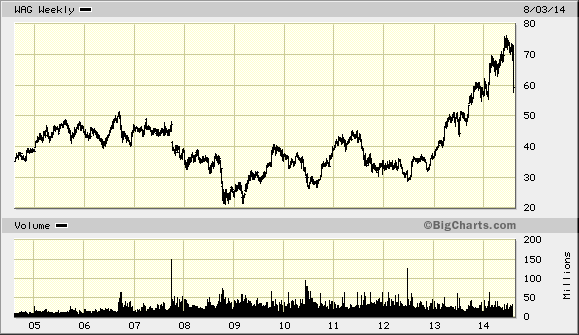
Walgreen Co. (WAG), together with its subsidiaries, operates a network of drugstores in the United States. This dividend champion company has paid a dividend since 1933 and increased it for 39 years in a row.

The most recent dividend increase was in August 2014, when the Board of Directors approved a 7.10 increase in the annual dividend to 33.75 cents/share. The largest competitors for Walgreen include CVS (CVS), Wal-Mart (WMT) and Rite-Aid (RAD).

Over the past decade this dividend growth stock has delivered an annualized total return of 9.10% to its shareholders.
The company has managed to deliver an 8.40% average increase in annual EPS over the past decade. Walgreen is expected to earn $3.32 per share in 2014 and $3.87 per share in 2015. In comparison, the company earned $2.56/share in 2013. In the press release from Walgreen from yesterday, the company mentioned that it expects earnings per share to hit $4.25 - $4.60 by 2016.

Tuesday, September 9, 2014

Selling Puts: Pros and Cons for Dividend Investors

Last week, I sold some puts on British Petroleum (BP), right after the judgment that opened the door for a potential $18 more billion in liabilities stemming from that Gulf of Mexico oil spill from 2010. The stock price sold off sharply on those news, and I decided that this was an opportunity to add to my existing position. Since I am low on investable funds, I decided to sell some puts on British Petroleum. I posted this over the internet, and had a reader ask me exactly what that means. As a result of this question, I am going to try and respond to this request.

A put is an options contract, that allows the options buyer to sell a number of shares at a given price at a given date in the future. The number of shares per each options contract is 100. People buy put options in order to protect themselves from a decline in prices, and thus they want to limit their losses. Those who purchase put options are therefore either hedging their exposure, or outright trying to place a bet that prices are going to decrease. For the right to sell a number of shares at a given price into the future, the options buyer pays the options seller a premium. This is essentially the cost of the bet behind the option. The premium is essentially the price that the put options buyer pays to the put options seller.

The put options seller receives the premium, and has a few potential outcomes for him. In my case, I sold a put option on BP at a strike of $44, which expires in April 2015. I received an options premium of about $2.25/option. This means that the options buyer ( the person I sold the option to) paid $225 for the right, but not the obligation, to sell me 100 shares of British Petroleum at $44/share in April 2015.

I essentially have two potential outcomes from this transaction:

The first outcome is that shares of British Petroleum sell for more than $44/share by the time the options I sold expire in April 2015. As a result, those options contracts expire worthless, and I end up with the $225 in premium in my account. The downside in this outcome is that I missed out on all potential gains above $44/share, if the put is never exercised.

The second outcome is that shares of British Petroleum sell for less than $44/share by the time the options expire in April 2015. As a result, I would have to purchase 100 shares of BP for every options contract I sold to the buyer of the put option. If shares of British Petroleum sell for $40/share in April 2015, I would knowingly buy shares at around $4 lower than then present prices. All is not bad however since I received $2.25 per each share, which essentially lowers the cost to about $41.75/share. In addition, buying at $41.75 sure beats buying at $44 or $45/share outright. The share was selling around $45 immediately after the unfavorable court ruling.

In both first and second outcomes, I am not eligible to receive any dividends on British Petroleum, since the buyer of the put option holds those shares in their own brokerage account. If exercised under the second scenario, I would own some shares in the British oil giant, and receive those fat dividends ( assuming they are not cut or suspended). Astute readers can see that as long as the stock price is flat or up, I get to keep the premium. If the stock price is down, I get to buy shares in a company I am interested in, but at a lower price. It is a win-win for me, that slightly tilts the odds of success in my favor.

However, I used the premiums from the puts I sold to purchase shares in British Petroleum. This means that for every put contract I sold, I was able to buy 5 shares in British Petroleum. I will be earning a nice dividend check on those shares for years to come, since I rarely sell those companies that at least maintain their dividend payment. If shares sell for more than $44 in April 2015, I will have essentially earned 5 shares for every options contract I sold on BP. The nice part is that I would have earned those shares only because I have good credit with my brokerage. Even if I have to buy BP at $44, my entry price would be much better compared to buying the stock outright today. Hence, I view selling puts on stocks I want to buy either way as a type of “heads I am better off than before, tails I am even as before” strategy.

Here comes the danger in selling puts however – the possibility for wipeout risk due to overleveraging. Let’s assume that my portfolio was valued at $10,000, and I sold a put on BP with a strike of $44. If the value of BP stock decreased by 50% in April 2015, and I needed $4,400 to buy BP stock, while the value of my overall portfolio dropped by 50% through April 2015, I would be almost wiped out (assuming other shares in my portfolio also decrease by 50%). This is why it is important to be very careful when playing with leverage, which is akin to playing with fire.

I only sell puts sporadically, and only do it on companies I would like to buy outright, but whose prices are little too rich for my taste today. In addition, I make sure that the potential outlay if all puts are exercised does not exceed 25% of the account value on the stock account through which I do that options trading. Long-time readers also know that I have more than one stock brokerage account, which further reduces wipeout risk.

Full Disclosure: Long BP and short BP puts

Relevant Articles:

My mini-Berkshire strategy for selling insurance through puts and calls
The pros and cons of selling covered calls on dividend paying stocks
An alternative strategy to covered calls
Dividend Paying Companies I recently added to my income portfolio
Check the Complete Article Archive

Monday, September 8, 2014

Two High Yield Companies Raising Dividends in the past month

In the past couple of weeks, there were two high yielding dividend growth stocks, which announced dividend hikes. I typically look for sustainable dividend payments, which can also grow over time. The companies I am about to mention, pay a large portion of earnings per share to shareholders in the form of distributions, which is why future expected growth is not going to be very high. However, for those who need high current income today, companies like those could be decent holdings in a diversified income portfolio. I hold stakes in both companies, and enjoy getting paid to own those shares. It is a very nice feeling to be paid cash dividends that grow faster than my salary, even if I decide to stay in bed and watch soap operas all day long.  With dividend investing, the big money is made by sitting, or sleeping, rather than through frenetic investment activity.

The companies raising distributions include:

Verizon Communications Inc. (VZ) provides communications, information, and entertainment products and services to consumers, businesses, and governmental agencies worldwide. The company raised its quarterly dividends by 3.80% to 55 cents/share. Verizon has managed to boost dividends for 10 years in a row. Over the past decade, Verizon has managed to increase dividends by 3%/year. Currently, this dividend achiever is attractively priced at 14.10 times forward earnings and yields 4.40%. I would expect that Verizon manages to grow dividends per share by about 3% - 4%/year in the foreseeable future. Check my analysis of Verizon.

Altria Group, Inc. (MO), through its subsidiaries, manufactures and sells cigarettes, smokeless products, and wine in the United States. The company raised its quarterly dividends by 8.30% to 52 cents/share. Altria has managed to boost dividends for 45 years in a row. Over the past five years, Altria has managed to increase dividends by 9.20%/year. Currently, this dividend champion is attractively priced at 16.90 times forward earnings and yields 4.80%. I would expect that Altria manages to grow dividends per share by about 6%/year in the foreseeable future, driven by its pricing power, strong position in the domestic tobacco market, as well as its 27% interest in SAB Miller. I will reinvest those dividends from Altria into more Altria shares. Check my analysis of Altria.

Both companies are valued properly right now for patient long-term investors, who also need income right now. For example, if we assume a 30 year investment period, and 3% annual growth in earnings per share, and require a 10% annual return, the discounted valued for Verizon is approximately $45.20/share. Using the same parameters for Altria, the discounted value comes out to $32.60/share. Those are of course very conservative expectations, although those fair values represent the value of the business to a private owner. Of course, in the case of Verizon, the future growth would likely be around 3%/year, whereas for Altria I expect that earnings per share to be closer to 5% – 6%/year for the next 30 years. The majority of growth in earnings will likely occur in the first 15 years or so, after which growth will probably get lower.Of course, I don't really do much in terms of discounted analysis, but based on what I know from analyzing both businesses, I prefer Altria to Verizon. Let's circle back in 20 years, and see if I was right.

Full Disclosure: Long VZ and MO

Relevant Articles:

Altria Group (MO): A Smoking Hot Dividend Champion
Should I invest in AT&T and Verizon for high dividend income?
Let dividends do the heavy lifting for your retirement
Why I don’t do discounted cash flow analysis on dividend paying stocks
Should I buy more high yielding stocks in order to retire early?

Friday, September 5, 2014

McDonald’s (MCD) Dividend Stock Analysis 2014

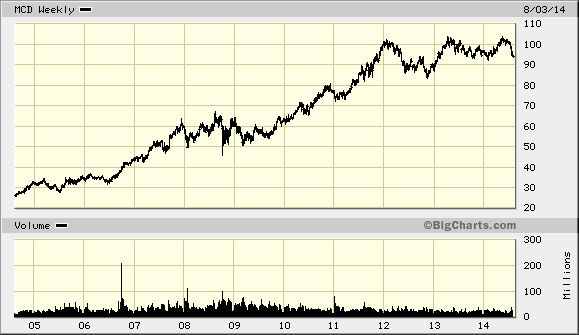
McDonald’s Corporation (MCD) franchises and operates McDonald's restaurants in the United States, Europe, the Asia/Pacific, the Middle East, Africa, Canada, and Latin America. As of December 31, 2013, it operated 35,429 restaurants, including 28,691 franchised and 6,738 company-operated restaurants. McDonald’s is a dividend champion which has increased distributions for 38 years in a row.

The most recent dividend increase was in September 2013, when the Board of Directors approved a 5.20% increase in the quarterly dividend to 81 cents/share. The largest competitors for McDonald's include Burger King (BKW), YUM! Brands (YUM) and Starbucks (SBUX).


Over the past decade this dividend growth stock has delivered an annualized total return of 17.90% to its shareholders. Future returns will be dependent on growth in earnings and dividend yields obtained by shareholders.

Tuesday, September 2, 2014

Should I have a minimum yield requirement?

In my entry criteria, dividend yield is the last factor used to select dividend stocks. After I screen the list of dividend champions or dividend achievers, I look at each company in detail.

First I look for growing earnings per share, and attractive entry P/E ratios. Then I check if the dividend is going up above the rate of inflation. Finally, I check if entry yield is above 2.50%.

Using my screen parameters, I sometimes end up missing companies which have low yields but high dividend growth. However, by doing so, I am somewhat protected in the case I purchase a low yield but high growth stock, which subsequently lowers distributions growth or stalls it. I want to avoid at all costs getting carried away chasing dividend growth. Chasing growth could result in overpaying for a low yielding asset that grows earnings and dividends, and my total return ends up being limited to the modest initial yield for several years. My investment philosophy is to avoid losing money, and as a result I am fine missing out on potential gains if that reduces dividend income risk. Winning dividend positions typically take care of themselves, while losing positions are typically the higher risk ones that could make you lose sleep at night.

For example, investors who purchased stock in some great blue-chip dividend payers such as Coca-Cola (KO) or Wal-Mart Stores (WMT) during the 1999 – 2000 period, saw their share prices go nowhere for over a decade. The only return they received was in the form of dividends, which were initially very low. At the same time, both companies managed to significantly increase revenues, earnings and dividends during that time period. The reason behind the lackluster performance was the fact that these stocks were very overvalued in the late 1990’s and early 2000’s. The lesson from this exercise is that even the best dividend paying stocks in the world are not worth overpaying for.

Furthermore, while I may miss out on some companies like Raven Industries (RAVN) or Franklin Resources (BEN), I am going to still be able to select stocks in the sweet spot, which generate best returns for the risk i am taking. A company like Phillip Morris International (PM) or Kinder Morgan (KMI) that provides a good starting yield of 4% which grows at 8%-10% per year, is a much better candidate that a company yielding 1 - 2%, that grows dividends at 12%. The higher initial yield provides a margin of safety for the time in the future when dividend growth stalls. This could be tomorrow, or it could be 20 years from now. The issue with high growth is that it cannot continue forever. At some point, the growth will come down to a more reasonable and sustainable level.

The negative of what I am doing is that I will surely miss out on the next McDonald's (MCD) or Johnson & Johnson (JNJ) dividend growth success story. This is because companies in the early stage of dividend growth typically have low current yields, but manage to grow distributions at a very high clip. Those are the types of companies which will generate outstanding total returns, and double-digit yields on cost for anyone fortunate enough to believe in the company, and put their money there. This is one of the reasons why I purchased Visa (V) in 2011 and recently in 2014, despite the low current yield. I also purchased Casey's (CASY) in 2011 and YUM! Brands (YUM) in 2010 and 2013, when their yields were less than 2.50%. I was betting that above average dividend growth will continue, and I also wanted to beef up my portfolio exposure to the low yield and high dividend growth investments.

In the grand scheme of things, I am starting to believe more and more that initial attractive valuation of less than 20 times earnings is helpful. If this valuation is even lower, that could be very helpful for total returns and future yields on cost as well. The other equally important thing to consider is growth of earnings per share. After all, a quality business that keeps growing over time will eventually bail out the investor who might have slightly overpaid in the beginning. However, if I overpaid for a business that pays a high yield today, but fails to grow earnings per share, chances are that the dividend will not increase above the rate of inflation, and I will end up downgrading my standard of living quite regularly. Therefore, a business which has the potential to earn more in 15 - 20 years, coupled with an attractive valuation, is the type that will deliver investment success to its shareholders. Whether this business pays a 2.50% yield or a 1.50% yield at the time of investment might not be as relevant. However, if I am wrong about my assessment of the business, I will end up losing more under the lower yield scenario, since earnings will not grow by much leading the the price to stagnate, In addition, the business will only pay a paltry yield, that does not grow by much either. Since I use my dividends from companies to buy shares in other companies, this could mean less money to be put to work in the next great dividend growth success story.

This is why evaluating each business one at a time is so important. The investor has to take into consideration valuation, growth prospects, changes in industry or competitive landscape and evaluate that against their unique set of investment opportunities and expectations. Unfortunately, investing is not as black and white as most would make you believe.

Full Disclosure: Long KMI, PM, KO, WMT, YUM, V, CASY

Relevant Articles:

The importance of yield on cost
How to be a successful dividend investor
Types of dividend growth stocks
How to retire in 10 years with dividend stocks
Should Dividend Investors Worry About Rising Interest Rates?
Popular Posts