The Kinder Morgan group of companies issued a press release today, which discussed some interesting new developments. Basically, the general partner being Kinder Morgan Inc (KMI) will be acquiring the master limited partner structures such as Kinder Morgan Energy Partners (KMP), Kinder Morgan Management LLC (KMR) and El Paso Pipeline Partners (EPB). There will no longer be any master limited partnerships involved with the Kinder Morgan name, which would simplify things and roll all assets under one corporation. For a brief overview of the current structure, please check this article.
The limited partners in Kinder Morgan Energy Partners (KMP) will receive 2.1931 KMI shares and $10.77 in cash for each unit they hold. The limited partners of El Paso Pipeline Partners (EPB) will receive .9451 KMI shares and $4.65 in cash for each unit they hold. While I doubt that the KMI shares received would be taxable, because of the like-kind nature of this exchange, I believe that the cash will be a taxable event for some unitholders.
The shareholders in Kinder Morgan Management LLC (KMR) will receive 2.4849 KMI shares for each share of KMR. This would essentially eliminate the gap between KMR and KMP, which has existed for the past several years. This was one of the reasons why I initially purchased KMR over KMP – lower prices, plus possibility for tax-free compounding of distributions, without the added complexity of K-1 tax forms that partnerships generate around tax time.
Before the deal was announced, I was actually expecting that the limited partnerships will take over the general partner, or that the general partner Kinder Morgan Inc would merge into them, thus creating a one giant MLP. Instead, Kinder Morgan Inc will be subject to double taxation as a result of this deal, and also would no longer be enjoying the sweet incentive-distribution rights as a general partner. Those IDR’s will be eliminated, thus lowering cost of capital. However, the company would be enjoying some nice depreciation benefits, which would shelter a portion of income. The drawback is that now most of distributions would no longer pass-through directly to unitholders of limited partner units. On the contrary, the corporation would have to pay taxes on corporate income level, and then when it sends those dividend checks to shareholders, they would also be liable for any taxes.
The other drawback for other investors could be that the yields they will generate will be lower. This is because KMP yields 6.90% while EPB yields 7.50%.Even at the higher dividend of $2/share, KMI yields 5.50% at best.
One positive behind the deal is that there won’t be the need to constantly issue new shares as much as with the MLP structure. Therefore, existing shareholders would not be diluted as much as with other MLPs. In addition, it would be much easier for the company to operate as one, rather than four complicated structures. This would make it easier to move aggressively on acquisitions, which would further boost growth.
The other competitive advantage for the new structure would be that it won’t have to distribute all cash flow to unitholders for distributions, but could actually choose to reinvest a portion in the business. That should reduce need for debt, although it won’t eliminate it. The main attraction of course is that the elimination of the IDR's will make cost of capital lower.
However, the company now expects annual dividends to hit $2/share in 2015, and then grow by 10%/year through 2020. I don’t know about you, but this sounds like a pretty sweet deal, if it could be realized. Based on my calculations, Kinder Morgan Inc could end up paying $3.22/share by 2020, which is an yield on cost of roughly 9%. I believe this is a doable target, because the new company will be retaining more cash to invest in the business, and it will be able to better focus on finding acquisitions for further growth.
After this deal is closed, Kinder Morgan will be the largest position in my dividend portfolio. Kinder Morgan Inc (KMI) was already one of my largest four positions. Kinder Morgan Management LLC (KMR) has also been a decent size position. This is why I haven’t added to Kinder Morgan Inc for over an year and a half. Because this position will account for much more than any other position in my portfolio, and because its high current yield is higher than the yield on my portfolio as a whole, I doubt I would buy more shares for at least one or two years from now. The only exception is one of my IRA accounts, where dividends are reinvested automatically. As I have explained earlier, it makes sense to do so given the fact that this account is not going to get any future cash contributions in the future.
Full Disclosure: Long KMI, KMR
Relevant Articles:
- Kinder Morgan Partners – One Company three ways to invest in it
- Richard Kinder: The Warren Buffett of Energy
- I admire Investors with Skin in the Game
- Master Limited Partnerships (MLPs) – an island of opportunity for dividend investors
- General vs Limited Partners in MLP's
- MLPs for tax-deferred accounts
Sunday, August 10, 2014
Friday, August 8, 2014
Why Warren Buffett Likes Investing in Bank Stocks
Warren Buffett is the second richest person in the world, a self-made billionaire investor that has a very large following. He is well known for turning struggling textile manufacturer Berkshire Hathaway (BRK.B) into a 300 billion dollar conglomerate, through investing in sound companies like Coca-Cola (KO), American Express (AXP), Geico etc. One of his largest holdings is the bank Wells Fargo (WFC). Warren Buffett has been holding on to Wells Fargo for a little under 2 decades. When I first analyzed the company in 2013, I was not overly impressed. I was more impressed with the big five Canadian Banks. However, as I did some thinking and pondering, I realized my original thesis might have missed out on a lot of other concepts, which is why I initiated a small position in the bank a few months later.
Buffett has claimed that investing in Berkshire Hathaway was a big mistake, because the business was destined for poor profits and required constantly new capital in order to keep up and stay competitive. He has mentioned that had he purchased insurance companies outright, he would have been much richer today. His knowledge of insurance business had started accumulating in the 1950s, after purchasing GEICO, and Western Insurance Company that was selling at less 1 times earnings. Back in the late 1960s, Buffett acquired the National Indemnity company through Berkshire Hathaway. He has been investing in insurance companies for the next five decades.
The reason why he liked insurance companies is due to their float. Per Warren Buffett's words, "Insurers receive premiums upfront and pay claims later. ... This collect-now, pay-later model leaves us holding large sums — money we call "float" — that will eventually go to others. Meanwhile, we get to invest this float for Berkshire's benefit. ..."
Insurance companies usually use proceeds acquired through float, and invest it in safe instruments like government or corporate bonds. If an insurance company ends up paying out less in claims than the premiums it receives, it turns an underwriting profit. In other words, it used those premiums paid by policyholders and earned interest income on it, while also earning a profit on the insurance process. In other words, the premium amounts from policy holders serve as a sort of margin loan, which does not cost anything to the insurance company that at least manages to break even. If that insurance company can at least maintain a break-even point on insurance proceeds, and can at least maintain a stable level of premium amounts, it can end up in a pretty nice position for itself. It is a really nice situation to be when you get almost free cost of capital, that you can then deploy at higher rates of return.
Most other insurance companies tend to keep selling insurance, even if they are no longer compensated well for the risk. Berkshire Hathaway however only does this when they expect to at least earn some money on the policies. This is because if you take on a future potential liability, without being properly compensated, you will lose money. In an industry, where you receive money today in order to pay for claims at an unknown time in the future, taking unprofitable business could have devastating effects on shareholder equity in the business. This is where the concept of having able and honest management comes into play.
As I was looking over the annual reports of Wells Fargo, I realized the reason why Buffett really likes the bank so much. It essentially receives cash from depositors, who are not really getting paid that much. In effect then those banks use those almost free capital to make loans to creditworthy borrowers, and profit from the spread, minus their operating costs.
Of course in either bank or insurance operations, you don’t want management that takes reckless risks,
The other factors that help in Buffett’s investments in Wells Fargo (WFC) and Bank of America (BAC) is the nature of customer relationships. If you bank with your Wells Fargo, you are more likely to consider them when you need a loan for a new car, house, or to start a business. In addition, you are exposed to their cross-selling of investment services, credit card services etc.
Results from insurance operations can be lumpy, and so are earnings from bank operations. Financial crises do happen, which results in dividend cuts in many institutions every so often. However, for the long-term patient accumulator of capital, the holding period of forever should work to their advantage.
Unfortunately, Berkshire Hathaway cannot acquire a bank outright, due to current US regulations. Hence, its ownership in the bank is limited to having a partial ownership interest in financial institutions. However, the lessons should provide an interesting model for investors to have in their minds, as they analyze banks for potential inclusions in their income portfolios.
As I discussed in my previous article on Monday, I recently added to my position in Wells Fargo. In addition, in the past month I also sold some long-dates puts on the bank. I expect to ultimately build this position out slowly over time. I believe that banks like Wells Fargo will continue being a good investment for patient long-term shareholders with a 30 year time horizon. Things could get lumpy, especially during the next crisis. However, I think that banks with prudent management that manage to provide loans to creditworthy borrowers and also manage to earn recurring revenues through their business relationships with clients, will do well over time. After all, while there is obsolescence in many industries, I really doubt that the world would ever work without banks. Therefore, banks like Wells Fargo are the lifeblood of the economy and will keep originating loans, taking deposits and build customer relationships for decades to come.
Relevant Articles:
- Warren Buffett Investing Resource Page
- How to earn $900 in dividend income per minute
- Should you invest in Wells Fargo (WFC)?
- Dividend Stocks make great acquisitions
- Business Relationships Can Deliver Solid Dividends to Shareholders
Buffett has claimed that investing in Berkshire Hathaway was a big mistake, because the business was destined for poor profits and required constantly new capital in order to keep up and stay competitive. He has mentioned that had he purchased insurance companies outright, he would have been much richer today. His knowledge of insurance business had started accumulating in the 1950s, after purchasing GEICO, and Western Insurance Company that was selling at less 1 times earnings. Back in the late 1960s, Buffett acquired the National Indemnity company through Berkshire Hathaway. He has been investing in insurance companies for the next five decades.
The reason why he liked insurance companies is due to their float. Per Warren Buffett's words, "Insurers receive premiums upfront and pay claims later. ... This collect-now, pay-later model leaves us holding large sums — money we call "float" — that will eventually go to others. Meanwhile, we get to invest this float for Berkshire's benefit. ..."
Insurance companies usually use proceeds acquired through float, and invest it in safe instruments like government or corporate bonds. If an insurance company ends up paying out less in claims than the premiums it receives, it turns an underwriting profit. In other words, it used those premiums paid by policyholders and earned interest income on it, while also earning a profit on the insurance process. In other words, the premium amounts from policy holders serve as a sort of margin loan, which does not cost anything to the insurance company that at least manages to break even. If that insurance company can at least maintain a break-even point on insurance proceeds, and can at least maintain a stable level of premium amounts, it can end up in a pretty nice position for itself. It is a really nice situation to be when you get almost free cost of capital, that you can then deploy at higher rates of return.
Most other insurance companies tend to keep selling insurance, even if they are no longer compensated well for the risk. Berkshire Hathaway however only does this when they expect to at least earn some money on the policies. This is because if you take on a future potential liability, without being properly compensated, you will lose money. In an industry, where you receive money today in order to pay for claims at an unknown time in the future, taking unprofitable business could have devastating effects on shareholder equity in the business. This is where the concept of having able and honest management comes into play.
As I was looking over the annual reports of Wells Fargo, I realized the reason why Buffett really likes the bank so much. It essentially receives cash from depositors, who are not really getting paid that much. In effect then those banks use those almost free capital to make loans to creditworthy borrowers, and profit from the spread, minus their operating costs.
Of course in either bank or insurance operations, you don’t want management that takes reckless risks,
The other factors that help in Buffett’s investments in Wells Fargo (WFC) and Bank of America (BAC) is the nature of customer relationships. If you bank with your Wells Fargo, you are more likely to consider them when you need a loan for a new car, house, or to start a business. In addition, you are exposed to their cross-selling of investment services, credit card services etc.
Results from insurance operations can be lumpy, and so are earnings from bank operations. Financial crises do happen, which results in dividend cuts in many institutions every so often. However, for the long-term patient accumulator of capital, the holding period of forever should work to their advantage.
Unfortunately, Berkshire Hathaway cannot acquire a bank outright, due to current US regulations. Hence, its ownership in the bank is limited to having a partial ownership interest in financial institutions. However, the lessons should provide an interesting model for investors to have in their minds, as they analyze banks for potential inclusions in their income portfolios.
As I discussed in my previous article on Monday, I recently added to my position in Wells Fargo. In addition, in the past month I also sold some long-dates puts on the bank. I expect to ultimately build this position out slowly over time. I believe that banks like Wells Fargo will continue being a good investment for patient long-term shareholders with a 30 year time horizon. Things could get lumpy, especially during the next crisis. However, I think that banks with prudent management that manage to provide loans to creditworthy borrowers and also manage to earn recurring revenues through their business relationships with clients, will do well over time. After all, while there is obsolescence in many industries, I really doubt that the world would ever work without banks. Therefore, banks like Wells Fargo are the lifeblood of the economy and will keep originating loans, taking deposits and build customer relationships for decades to come.
Relevant Articles:
- Warren Buffett Investing Resource Page
- How to earn $900 in dividend income per minute
- Should you invest in Wells Fargo (WFC)?
- Dividend Stocks make great acquisitions
- Business Relationships Can Deliver Solid Dividends to Shareholders


Wednesday, August 6, 2014
Johnson & Johnson (JNJ) Dividend Stock Analysis 2014
Johnson & Johnson (JNJ), together with its subsidiaries, is engaged in the research and development, manufacture, and sale of various products in the health care field worldwide. The company operates in three segments: Consumer, Pharmaceutical, and Medical Devices & Diagnostics. This dividend king has paid dividends since 1944 and has managed to increase them for 52 years in a row.
The company’s latest dividend increase was announced in April 2014 when the Board of Directors approved a 6.10% increase in the quarterly dividend to 70 cents /share. The company’s peer group includes Novartis (NVS), Pfizer (PFE) and Covidien (COV).
Over the past decade this dividend growth stock has delivered an annualized total return of 12.10% to its shareholders.
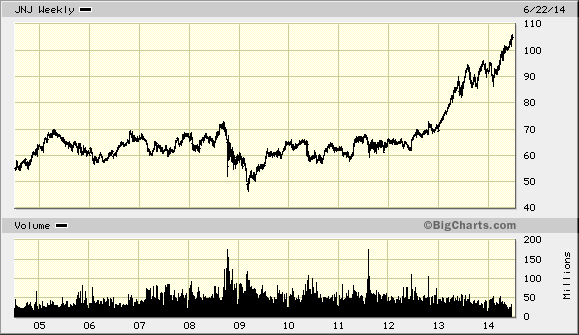
The company has managed to deliver 7.20% average increase in annual EPS over the past decade. Johnson & Johnson is expected to earn $5.89 per share in 2014 and $6.34 per share in 2015. In comparison, the company earned $4.81/share in 2013.
The company’s latest dividend increase was announced in April 2014 when the Board of Directors approved a 6.10% increase in the quarterly dividend to 70 cents /share. The company’s peer group includes Novartis (NVS), Pfizer (PFE) and Covidien (COV).
Over the past decade this dividend growth stock has delivered an annualized total return of 12.10% to its shareholders.
The company has managed to deliver 7.20% average increase in annual EPS over the past decade. Johnson & Johnson is expected to earn $5.89 per share in 2014 and $6.34 per share in 2015. In comparison, the company earned $4.81/share in 2013.
Monday, August 4, 2014
14 Dividend Growth Stocks I Bought On the Dip Last Week
In the past week, share prices started going down for the first time in a few months. As a buyer of quality businesses, this is always something that I look for with excitement. This is because when prices for good businesses decrease, this means that I am able to purchase them at lower valuations and I am also able to get more dividend income for every dollar I put to work.
I screened my list of dividend ideas, and came up with the following group of companies that I purchased. I am mostly looking for value these days, and cheap dividend growth at a low price multiple. I was lucky that last week prices of many companies started falling. If I am more lucky, prices will finally start a correction, and I will be able to put my future contributions to work at lower prices. I was able to allocate the funds for the next 2 months, which is why I won’t be able to make another purchase until sometime in September.
The companies I purchased include:
Aflac Incorporated (AFL), through its subsidiary, American Family Life Assurance Company of Columbus, provides supplemental health and life insurance products in Japan and in the United States of America. I really like this insurer, particularly given the low valuation and dedication to dividend growth. Unfortunately, this is one of my top ten positions, which is why further additions are less likely. The company is a dividend champion, which has been able to increase dividends for 31 years in a row. Over the past decade, the company has been able to boost dividends by 16.80%/year. The stock is selling for 9.50 times forward earnings and yields 2.30%. Check my analysis of Aflac.
Baxter International Inc. (BAX) develops, manufactures, and markets products for people with hemophilia, immune disorders, infectious diseases, kidney diseases, trauma, and other chronic and acute medical conditions. The company has been able to increase dividends for 8 years in a row. Over the past decade, the company has been able to boost dividends by 12.40%/year. The stock is selling for 14.60 times forward earnings and yields 2.80%. I like the low valuation on Baxter, and the opportunities for further growth in earnings and distributions. The company was a dividend champion until a spin-off 1998, but then froze it for 8 years. Currently, it is in the process of splitting in two parts some time in 2015, which could unlock some value for shareholders. Check my analysis of Baxter.
The Chubb Corporation (CB), through its subsidiaries, provides property and casualty insurance to businesses and individuals. The company is a dividend champion, which has been able to increase dividends for 32 years in a row. Over the past decade, the company has been able to boost dividends by 9.20%/year. The stock is selling for 12.30 times forward earnings and yields 2.10%. I like the valuation for Chubb, and I believe that management is of great quality and integrity. Therefore, I believe they have the discipline to keep earning more over time and allocate company resources intelligently. Company’s management has been on a mission to repurchase a large amount of shares each year since 2006. My position is small, but I would welcome even lower prices in order to build it higher, and provide me more exposure to financials with dividend growth streaks. Check my analysis of Chubb.
Deere & Company (DE), together with its subsidiaries, manufactures and distributes agriculture and turf, and construction and forestry equipment worldwide. The company is a dividend achiever, which has been able to increase dividends for 11 years in a row. Over the past decade, the company has been able to boost dividends by 16.30%/year. The stock is selling for 10.10 times forward earnings and yields 2.60%. As I discussed in my analysis of Deere, the company is cyclical which means that earnings rise and fall with the economic cycle. However, I believe that in the future there will be a higher need for equipment that Deere sells, due to increased world population and demand for food, and the rise of disposable incomes for that population.
Diageo plc (DEO) produces, distills, brews, bottles, packages, and distributes spirits, beer, wine, and ready to drink beverages. The company is a dividend achiever, which has been able to increase dividends for 15 years in a row. Over the past decade, the company has been able to boost dividends by 5.80%/year. The stock is selling for 18.10 times forward earnings and yields 2.60%. In fact, Diageo is the cheapest spirits maker that pays dividends out there. My position there is small, which is why I would welcome further declines in order to build my exposure further. Check my analysis of Diageo.
General Electric Company (GE) operates as an infrastructure and financial services company worldwide. The company has been able to increase dividends for five years in a row. The stock is selling for 15.10 times forward earnings and yields 3.30%. This is the first purchase of General Electric I have made since 2008. I am starting out slow, and plan to ultimately build this position into a sizeable one. I also sold a few puts, and actually used the premiums to purchase that first initiation position in GE. Check my analysis of GE.
General Mills, Inc. (GIS) manufactures and markets branded consumer foods in the United States and internationally. The company is a dividend achiever, which has been able to increase dividends for 11 years in a row. Over the past decade, the company has been able to boost dividends by 9.90%/year. The stock is selling for 16.90 times forward earnings and yields 3%. I want to build my position in this quality company, which is why I keep nibbling here and there. This is another opportunity where I sold puts, and then used the premium to purchase shares in the underlying company. Check my analysis of General Mills.
International Business Machines Corporation (IBM) provides information technology products and services worldwide. The company is a dividend achiever, which has been able to increase dividends for 19 years in a row. Over the past decade, the company has been able to boost dividends by 19.40%/year. The stock is selling for 10.60 times forward earnings and yields 2.40%. I am slowly building my exposure to IBM, where I like the consistency of share repurchases and dividend increases. When you consistently repurchase 4%-5% of outstanding shares at low prices and you pay an almost 2.50% annual dividend yield, you can generate total returns even without growing revenues by much. Any gain in organic earnings per share will further turbocharge investor returns. Check my analysis of IBM.
McDonald’s Corporation (MCD) franchises and operates McDonald's restaurants in the United States, Europe, the Asia/Pacific, the Middle East, Africa, Canada, and Latin America. The company is a dividend champion, which has been able to increase dividends for 38 years in a row. Over the past 5 years, the company has been able to boost dividends by 13.90%/year. The stock is selling for 16.70 times forward earnings and yields 3.20%. As I build out my portfolio, and don’t add to my legacy positions for a while, their relative weight tends to shrink. I have a good exposure to the Golden Arches, but need to add more to my allocation there. Check my analysis of McDonald’s.
United Technologies Corporation (UTX) provides technology products and services to the building systems and aerospace industries worldwide. The company is a dividend achiever, which has been able to increase dividends for 20 years in a row. Over the past decade, the company has been able to boost dividends by 14.50%/year. The stock is selling for 15.30 times forward earnings and yields 2%. I like the company, and believe that it offers a compelling value for the growth potential here, plus it also provides exposure to industrials for my dividend portfolio. Check my analysis of United Technologies.
Wells Fargo & Company (WFC) provides retail, commercial, and corporate banking services to individuals, businesses, and institutions. The company has been able to increase dividends for 4 years in a row. The stock is selling for 12.20 times forward earnings and yields 2.60%. I initiated a small position in 2013, and now I am adding to it. Wells Fargo is one of the best run banks in the US, which also has pretty good returns on capital, sells at an attractive price to book and has managed to grow book value pretty consistently in the past. Check my analysis of Wells Fargo.
Wal-Mart Stores Inc. (WMT) operates retail stores in various formats worldwide. The company is a dividend champion, which has been able to increase dividends for 42 years in a row. Over the past decade, the company has been able to boost dividends by 18%/year. The stock is selling for 14.20 times forward earnings and yields 2.50%. While sales and dividend growth appear to be slowing down, and size is a drag on future growth, I like the scale and moat for this retailer. While everyone claims that Amazon will disrupt retail sales, I believe Wal-Mart to be one of the few retailers who can and will compete successfully on the web. Check my analysis of Wal-Mart.
McCormick & Company (MKC) manufactures, markets, and distributes spices, seasoning mixes, condiments, and other flavorful products to retail outlets, food manufacturers, and foodservice businesses. The company is a dividend champion, which has been able to increase dividends for 28 years in a row. Over the past decade, the company has been able to boost dividends by 11.40%/year. The stock is not cheap as it is selling for 20 times forward earnings and yields 2%. Check my analysis of McCormick.
Eaton Corporation plc (ETN) operates as a power management company worldwide The company has been able to increase dividends for five years in a row. Over the past decade, the company has been able to boost dividends by 13.80%/year. The stock is selling for 14.60 times forward earnings and yields 2.50%. I have been monitoring Eaton for several months now, and finally initiated a decent size position in the company last week. While the company froze dividends during the financial crisis, and it doesn’t raise them every year, it has not cut them ever, and it tends to grow earnings and dividends over time. This is good enough for me. I am also increasing my exposure outside consumer staples with this investment, and am also buying future dividend growth at a compelling valuation. I will do a more detailed analysis of Eaton shortly.
I am hopeful that stock prices decrease further from here, and that that 20% correction everyone has been waiting for over the past two years actually does finally materialize. I am hopeful for a further correction, because I was only able to allocate two months or so worth of investment savings at those prices. The problem is that I am planning on saving and investing for several years. Therefore, I need lower prices, in order to get more stock for my buck and further speed up my goals.
Another thing that is helping me is the fact that my investment costs are now about $1/trade, thanks to my switch to Interactive Brokers early last month. This means that if I put $1000 in a dividend paying stock, I will end up paying 0.10% in a one-time commission. If I hold this stock for more than one year, the investment costs will be cheaper than even the cheapest mutual fund out there. Over time, investment savings add up, and could result in more capital working for me.
This list is not a recommendation to buy or sell any stocks. Just because I managed to buy so many companies, doesn’t mean that you should do that too. I am able to monitor a lot of companies pretty regularly, which is probably not the case for the majority of investors out there. Many of those purchases were bolt-on additions to existing positions, with only a few being newly initiated positions for me.
Full Disclosure: Long all stocks mentioned above
Relevant Articles:
- Why do I use a P/E below 20 for valuation purposes?
- Dividend Investors Should Focus on Valuation, not Just Dividend Yield
- The importance of pricing and valuation in dividend investing
- Price is what you pay, value is what you get
- Dividend Investing Over the Past Seven Years Was Never Easy
I screened my list of dividend ideas, and came up with the following group of companies that I purchased. I am mostly looking for value these days, and cheap dividend growth at a low price multiple. I was lucky that last week prices of many companies started falling. If I am more lucky, prices will finally start a correction, and I will be able to put my future contributions to work at lower prices. I was able to allocate the funds for the next 2 months, which is why I won’t be able to make another purchase until sometime in September.
The companies I purchased include:
Aflac Incorporated (AFL), through its subsidiary, American Family Life Assurance Company of Columbus, provides supplemental health and life insurance products in Japan and in the United States of America. I really like this insurer, particularly given the low valuation and dedication to dividend growth. Unfortunately, this is one of my top ten positions, which is why further additions are less likely. The company is a dividend champion, which has been able to increase dividends for 31 years in a row. Over the past decade, the company has been able to boost dividends by 16.80%/year. The stock is selling for 9.50 times forward earnings and yields 2.30%. Check my analysis of Aflac.
Baxter International Inc. (BAX) develops, manufactures, and markets products for people with hemophilia, immune disorders, infectious diseases, kidney diseases, trauma, and other chronic and acute medical conditions. The company has been able to increase dividends for 8 years in a row. Over the past decade, the company has been able to boost dividends by 12.40%/year. The stock is selling for 14.60 times forward earnings and yields 2.80%. I like the low valuation on Baxter, and the opportunities for further growth in earnings and distributions. The company was a dividend champion until a spin-off 1998, but then froze it for 8 years. Currently, it is in the process of splitting in two parts some time in 2015, which could unlock some value for shareholders. Check my analysis of Baxter.
The Chubb Corporation (CB), through its subsidiaries, provides property and casualty insurance to businesses and individuals. The company is a dividend champion, which has been able to increase dividends for 32 years in a row. Over the past decade, the company has been able to boost dividends by 9.20%/year. The stock is selling for 12.30 times forward earnings and yields 2.10%. I like the valuation for Chubb, and I believe that management is of great quality and integrity. Therefore, I believe they have the discipline to keep earning more over time and allocate company resources intelligently. Company’s management has been on a mission to repurchase a large amount of shares each year since 2006. My position is small, but I would welcome even lower prices in order to build it higher, and provide me more exposure to financials with dividend growth streaks. Check my analysis of Chubb.
Deere & Company (DE), together with its subsidiaries, manufactures and distributes agriculture and turf, and construction and forestry equipment worldwide. The company is a dividend achiever, which has been able to increase dividends for 11 years in a row. Over the past decade, the company has been able to boost dividends by 16.30%/year. The stock is selling for 10.10 times forward earnings and yields 2.60%. As I discussed in my analysis of Deere, the company is cyclical which means that earnings rise and fall with the economic cycle. However, I believe that in the future there will be a higher need for equipment that Deere sells, due to increased world population and demand for food, and the rise of disposable incomes for that population.
Diageo plc (DEO) produces, distills, brews, bottles, packages, and distributes spirits, beer, wine, and ready to drink beverages. The company is a dividend achiever, which has been able to increase dividends for 15 years in a row. Over the past decade, the company has been able to boost dividends by 5.80%/year. The stock is selling for 18.10 times forward earnings and yields 2.60%. In fact, Diageo is the cheapest spirits maker that pays dividends out there. My position there is small, which is why I would welcome further declines in order to build my exposure further. Check my analysis of Diageo.
General Electric Company (GE) operates as an infrastructure and financial services company worldwide. The company has been able to increase dividends for five years in a row. The stock is selling for 15.10 times forward earnings and yields 3.30%. This is the first purchase of General Electric I have made since 2008. I am starting out slow, and plan to ultimately build this position into a sizeable one. I also sold a few puts, and actually used the premiums to purchase that first initiation position in GE. Check my analysis of GE.
General Mills, Inc. (GIS) manufactures and markets branded consumer foods in the United States and internationally. The company is a dividend achiever, which has been able to increase dividends for 11 years in a row. Over the past decade, the company has been able to boost dividends by 9.90%/year. The stock is selling for 16.90 times forward earnings and yields 3%. I want to build my position in this quality company, which is why I keep nibbling here and there. This is another opportunity where I sold puts, and then used the premium to purchase shares in the underlying company. Check my analysis of General Mills.
International Business Machines Corporation (IBM) provides information technology products and services worldwide. The company is a dividend achiever, which has been able to increase dividends for 19 years in a row. Over the past decade, the company has been able to boost dividends by 19.40%/year. The stock is selling for 10.60 times forward earnings and yields 2.40%. I am slowly building my exposure to IBM, where I like the consistency of share repurchases and dividend increases. When you consistently repurchase 4%-5% of outstanding shares at low prices and you pay an almost 2.50% annual dividend yield, you can generate total returns even without growing revenues by much. Any gain in organic earnings per share will further turbocharge investor returns. Check my analysis of IBM.
McDonald’s Corporation (MCD) franchises and operates McDonald's restaurants in the United States, Europe, the Asia/Pacific, the Middle East, Africa, Canada, and Latin America. The company is a dividend champion, which has been able to increase dividends for 38 years in a row. Over the past 5 years, the company has been able to boost dividends by 13.90%/year. The stock is selling for 16.70 times forward earnings and yields 3.20%. As I build out my portfolio, and don’t add to my legacy positions for a while, their relative weight tends to shrink. I have a good exposure to the Golden Arches, but need to add more to my allocation there. Check my analysis of McDonald’s.
United Technologies Corporation (UTX) provides technology products and services to the building systems and aerospace industries worldwide. The company is a dividend achiever, which has been able to increase dividends for 20 years in a row. Over the past decade, the company has been able to boost dividends by 14.50%/year. The stock is selling for 15.30 times forward earnings and yields 2%. I like the company, and believe that it offers a compelling value for the growth potential here, plus it also provides exposure to industrials for my dividend portfolio. Check my analysis of United Technologies.
Wells Fargo & Company (WFC) provides retail, commercial, and corporate banking services to individuals, businesses, and institutions. The company has been able to increase dividends for 4 years in a row. The stock is selling for 12.20 times forward earnings and yields 2.60%. I initiated a small position in 2013, and now I am adding to it. Wells Fargo is one of the best run banks in the US, which also has pretty good returns on capital, sells at an attractive price to book and has managed to grow book value pretty consistently in the past. Check my analysis of Wells Fargo.
Wal-Mart Stores Inc. (WMT) operates retail stores in various formats worldwide. The company is a dividend champion, which has been able to increase dividends for 42 years in a row. Over the past decade, the company has been able to boost dividends by 18%/year. The stock is selling for 14.20 times forward earnings and yields 2.50%. While sales and dividend growth appear to be slowing down, and size is a drag on future growth, I like the scale and moat for this retailer. While everyone claims that Amazon will disrupt retail sales, I believe Wal-Mart to be one of the few retailers who can and will compete successfully on the web. Check my analysis of Wal-Mart.
McCormick & Company (MKC) manufactures, markets, and distributes spices, seasoning mixes, condiments, and other flavorful products to retail outlets, food manufacturers, and foodservice businesses. The company is a dividend champion, which has been able to increase dividends for 28 years in a row. Over the past decade, the company has been able to boost dividends by 11.40%/year. The stock is not cheap as it is selling for 20 times forward earnings and yields 2%. Check my analysis of McCormick.
Eaton Corporation plc (ETN) operates as a power management company worldwide The company has been able to increase dividends for five years in a row. Over the past decade, the company has been able to boost dividends by 13.80%/year. The stock is selling for 14.60 times forward earnings and yields 2.50%. I have been monitoring Eaton for several months now, and finally initiated a decent size position in the company last week. While the company froze dividends during the financial crisis, and it doesn’t raise them every year, it has not cut them ever, and it tends to grow earnings and dividends over time. This is good enough for me. I am also increasing my exposure outside consumer staples with this investment, and am also buying future dividend growth at a compelling valuation. I will do a more detailed analysis of Eaton shortly.
I am hopeful that stock prices decrease further from here, and that that 20% correction everyone has been waiting for over the past two years actually does finally materialize. I am hopeful for a further correction, because I was only able to allocate two months or so worth of investment savings at those prices. The problem is that I am planning on saving and investing for several years. Therefore, I need lower prices, in order to get more stock for my buck and further speed up my goals.
Another thing that is helping me is the fact that my investment costs are now about $1/trade, thanks to my switch to Interactive Brokers early last month. This means that if I put $1000 in a dividend paying stock, I will end up paying 0.10% in a one-time commission. If I hold this stock for more than one year, the investment costs will be cheaper than even the cheapest mutual fund out there. Over time, investment savings add up, and could result in more capital working for me.
This list is not a recommendation to buy or sell any stocks. Just because I managed to buy so many companies, doesn’t mean that you should do that too. I am able to monitor a lot of companies pretty regularly, which is probably not the case for the majority of investors out there. Many of those purchases were bolt-on additions to existing positions, with only a few being newly initiated positions for me.
Full Disclosure: Long all stocks mentioned above
Relevant Articles:
- Why do I use a P/E below 20 for valuation purposes?
- Dividend Investors Should Focus on Valuation, not Just Dividend Yield
- The importance of pricing and valuation in dividend investing
- Price is what you pay, value is what you get
- Dividend Investing Over the Past Seven Years Was Never Easy
Friday, August 1, 2014
Hershey (HSY) Dividend Stock Analysis
The Hershey Company (NYSE:HSY), together with its subsidiaries, manufactures, markets, distributes, and sells chocolate and sugar confectionery products, pantry items, and gum and mint refreshment products. The company has paid dividends since 1930 and has managed to increase them for 5 years in a row. Prior to the dividend freeze in 2009, the company was a dividend champion that had managed to raise dividends for 34 years in a row.
The company's latest dividend increase was announced in July 2014 when the Board of Directors approved a 10.30% increase in the quarterly dividend to 53.50 cents/share. The company's peer group includes Mondelez International (NASDAQ:MDLZ), Nestle (OTCPK:NSRGY) and Mars. Hershey is one of the five world class dividend companies I plan to buy during the next bear market.
Over the past decade this dividend growth stock has delivered an annualized total return of 10.70% to its shareholders.
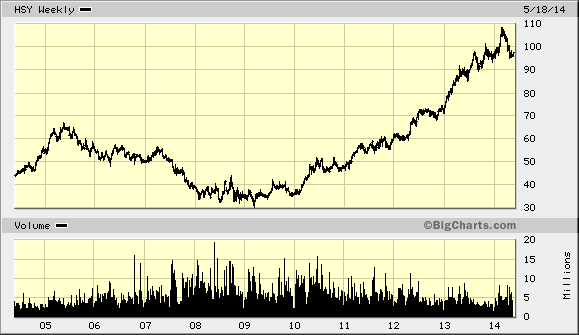
The company's latest dividend increase was announced in July 2014 when the Board of Directors approved a 10.30% increase in the quarterly dividend to 53.50 cents/share. The company's peer group includes Mondelez International (NASDAQ:MDLZ), Nestle (OTCPK:NSRGY) and Mars. Hershey is one of the five world class dividend companies I plan to buy during the next bear market.
Over the past decade this dividend growth stock has delivered an annualized total return of 10.70% to its shareholders.
Subscribe to:
Posts (Atom)
