Planning your retirement is one of the most challenging exercises in the world. There are plenty of ways, methods and advisors, who try to influence your choice with formulas and narratives. Some of these methods may work, while others will fail most of the time. Everyone’s situation is different of course, which further complicates things. The investment path and environment will vary from individual to individual as well. For example, your experiences will be different if you started retirement in 2012, versus starting retirement in 2007 or 1929.
Some lucky investors have the benefit of pensions in addition to social security. This alone can be enough to quit your job, albeit in your late 50s or early 60s.
Others plan to rely on a combination of investments, and withdraw a portion for so many years. There are hundreds of articles, papers and opinions on the best way to live off investments. I have read a portion of them, but have decided to largely focus elsewhere.
For my retirement, I plan to live off the dividends generated from my equity portfolio.
Dividend payments are more stable than share prices and the potential for capital gains, which makes them an ideal source of income for retirement. Historically, US dividend growth has exceeded the rate of inflation. This means that dividend income not only maintains purchasing power, but increases it over time.
I go a step further by focusing on companies that can grow those dividends, have adequate dividend payout ratios and are available at attractive valuations. By assembling a portfolio of carefully selected dividend growth stocks, I can easily see how much income my retirement portfolio generates right from day one. When I compare my dividend income to my expenses, I know exactly where I am on my journey towards financial independence or retirement. This is the so called the divided crossover point.
Dividends also take into consideration current valuation available to investors today. A lot of retirees rely on historically backtested studies that show how they will not outlive their money by withdrawing 4% of their portfolios annually. Unfortunately, some of these studies are using data from historical periods that may not be directly comparable with todays situation. If the data was for periods where bond yields were above 4% and dividend yields were above 4%, it may make sense that withdrawing 4% from a portfolio was sustainable ( even when prices largely went nowhere, such as the period between 1965 and 1982). The question is whether it makes sense to withdraw 4% from a portfolio today, during a time when bond yields are closer to 2% and equity dividend yields are closer to 2% as well.
These studies attempt to make up the difference by hoping for quick annual gains in principle. Unfortunately, it is difficult to predict what share or bond prices will do in the short run when you need to sell. While the yields themselves will vary, the dividend payments will not. Relative to share prices, dividend payments look like an ocean of stability. They make retirement planning to be a breeze.
I have decided to focus on dividend income, since it is easier to predict. For example, I am reasonably certain that Johnson & Johnson will pay at least $3.60/share in annual dividend income over the next 12 months. Chances are high that this dividend king will continue growing the dividend at least once during the same time as well. However, I have no idea whether the stock price will go above $150/share or below $100/share. If you plan to sell shares to pay for retirement expenses, it makes a difference whether you sell at a high price or at a low price. Unfortunately, no one can predict share prices. On the other hand, predicting dividend incomes is much easier. This is why I focus on dividend income for my retirement planning, and ignore share price fluctuations. I think like a business owner.
Again, I focus on analyzing each individual business, in order to determine if it can safely pay and grow dividends per share over time. I also focus on underlying valuations, in order to lock in a set rate of dividend yield today. I also go a step further, by trying to build out a diversified portfolio consisting of as many companies as possible that meet my basic criteria. Besides diversification by sector, I also try to diversity over time, in order to build my positions in these companies more gradually.
The focus on dividend income makes the transition from earning a paycheck to retirement much easier. When you work, you receive a paycheck once or twice per month. When you create a dividend portfolio, you generate dividend income that replaces those paychecks. In effect, with dividemd investing you are creating your own paycheck to live off in retirement.
Compared to my paycheck however, dividend income is more reliable because it is generated from at least 30 – 60 global businesses, and not a single client ( employer). My job is to diversify, build over time, buy at the right valuation and ensure that the underlying profit machine is humming along nicely. When you start with the end in mind, and you keep at it, you can track your progress until you reach your own dividend crossover point.
To put things in perspective, I believe that it is relatively easy to create a diversified portfolio today with a starting yield of roughly 3%. This portfolio will have adequate sector allocations, and could be built out over a period of several months to an year, in order to take advantage of dollar cost averaging and the variety of different opportunities available at different periods. If you place $1,000 in such a portfolio, it can easily generate $30 in annual dividend income today. If history is any guide, this dividend income will increase over time at or above the rate of inflation.
An investor who needs $30,000 in retirement income can get there by potentially investing $1,000,000. Few investors have this type of cash ready to be deployed however. The mindset of viewing income and expenses through the lens of dividend income investing however, can change you. The investor can see that if they only require $24,000 in annual retirement income, they need a nest egg with $800,000 today. However, if they need $36,000 to live off in retirement, they will need a nest egg worth $1,200,000.
For each extra dollar of extra expenses in retirement, our investor will have to save $33 extra dollars. These 33 extra dollars, invested at a 3% starting yield will generate one dollar in dividend income for ever. If you increase expenses by $10,000/year, prepare to come up with an extra $333,000. This can take quite a few years of hard work to accumulate.
Alternatively, if our investor manages to cut expenses, they can rest assured that for reducing each dollar in annual expenses, they need to save and invest $33 less. If you decrease expenses by $10,000/year, you can retire with a nest egg that is $333,000 less than originally expected. If you are the average person, the fact that you need to save a lower amount for retirement means that you can also retire earlier.
As I mentioned above, few investors have $1,000,000 to invest right from the start. However, if you choose to invest regularly over a set period of time, you can get there within a reasonable period of time. The inputs will vary from individual to individual of course, because different investors can invest different amounts every month. The conditions will vary as well. For example, when I invested in 2008 - 2010, it was much easier to find quality companies yielding 4% than it is today. However, if you keep investing regularly, keep reinvesting dividends, and manage to put money to work in a diversified portfolio of quality blue chip dividend payers, you may reach that goal in a reasonable amount of time.
For example, lets look at how long it would take you to reach $30,000 in annual dividend income if you invest $3,000 per month in dividend growth stocks. Let's assume an average yield of 3% and an average dividend growth of 6%/year. We will assume automatic reinvesting of dividends.
At this rate, it would take the investor roughly 14 years to reach their goals. This is not bad.
If money is tight, and our investor can only afford to put $2,000 to work each month, they can reach their goal within roughly 17.50 years. If the investor can put only $1,000 to work every month, they will be able to generate $30,000 in annual dividend income after 24 years. I used the spreadsheet in this article to calculate the different scenarios.
In this article, I showed that it pays to focus on the end goal in mind when investing for retirement. The first step involves coming up with a target monthly dividend income to pay for retirement expenses. The next step involves creating a dividend strategy that allows the investor to build a dividend portfolio that showers them with a growing stream of dividend income. Depending on current condition, investors can see how each dollar they invest generates a certain amount of dividend income. As a result, investors can see their progress towards the coveted dividend crossover point after every new investment they make, after every dividend increase and after every single action to reinvest dividends. By investing regularly, keeping investment costs low, and sticking to their strategy through thick or thin, our investors have a very high chance of hitting their retirement objectives.
Thank you for reading!
Relevant Articles:
- Dividend Investing Resources I Use
- Financial Independence Is Easier to Model with Dividends
- What drives future investment returns?
- Generate a retirement paycheck with these dividend stocks
Showing posts with label dividend strategy. Show all posts
Showing posts with label dividend strategy. Show all posts
Thursday, August 28, 2025
Saturday, March 30, 2024
Dollar Cost Averaging Versus Lump Sum Investing
Dollar cost averaging is a process, where the same amount of funds is allocated to preset investment/s at regular intervals of time. It is widely believed that investors who choose to systemically allocate funds towards their investments are reducing their risk of investing their whole amount at the top of the price range.
Most individuals use dollar cost averaging to purchase investments. The reason behind these actions is the fact that most individuals are able to allocate funds for investing once a month or every two weeks for example, depending on the frequency with which they are able to save money. If our investor is able to save 15% of their illustrative $1000 monthly salary, which is paid every two weeks or twice/month, they would be able to allocate anywhere between $150 - $225 every month towards their retirement investments. The $225/month is derived for the situation where a person who is paid bi-weekly ends up receiving three paychecks instead of three. Either way, the typical 401 (k) investor would purchase the same funds whenever they get paid. The typical dividend investor would likely accumulate new contributions with any distributions from their portfolios, before they make their stock investments. Depending on portfolio sizes, minimum amount of purchases and amount of distributions per month, dividend investors end up purchasing different dividend stocks on a regular basis, which closely mimics the practice of dollar cost averaging.
Unfortunately, few investors have large amounts of cash simply sitting around, that they need to dollar cost average. For those lucky enough to have this happen to them, dollar cost averaging can be a tool to minimize risk of purchasing at the top. It would also help them in gaining more experience in the markets, particularly if they had none whatsoever previously. For lottery winners or those lucky individuals who happen to obtain a lump sum of cash, dollar cost averaging might be a great way to handle the bounty.
In order to test whether dollar cost averaging gives investors an advantage over lump sum investing, I obtained monthly data for the Vanguard S&P 500 mutual fund (VFINX) between 1986 and 2023. In order to calculate dollar cost averaging results for a given year, I would put $100 in investment every month beginning in the last day of the last month of the previous year, up until the last day of November for the next year. For lump-sum amounts, I would put a theoretical $1200 investment either at the closing prices for the previous year. I would then multiply the number of shares accumulated for both dollar cost averaging and lump sum investing times the ending prices by the end of the current year. Next, I would then compare which strategy delivered better results for the given year.

Overall, lump-sum investing performed better in 31 out of 38 years. Dollar cost averaging performed better in only 7 out of 38 years. Not surprisingly, these were the years when the stock market was either flat or declined. As a result, dollar cost averaging reduces investor’s risk when things were difficult, but at the expense of foregone gains when things went well. Because stocks have a historical tendency to move up over time, investors who practice dollar cost averaging might be at a disadvantage. Of course, for those who practice dollar cost averaging because they didn’t have the lump-sum in the first place, this is still the best way to accumulate a sizeable nest egg.
In this exercise we did not look at other key components of investment which deals with investment selection, analysis, valuation and purchase. We assumed that these decisions have already been made. In reality however, there could be a situation where our investor might not find any potential assets that have sufficient low valuation to merit investment in them. Most index investors or savers in a 401 (k) invest regardless of overall valuations.
Relevant Articles:
- How to accumulate your nest egg
- How to retire in 10 years with dividend stocks
- Optimal Cash Allocation for Dividend Investors
- How to Generate an 11% Yield on Cost in 6 Years
- How to be a successful dividend investor
Most individuals use dollar cost averaging to purchase investments. The reason behind these actions is the fact that most individuals are able to allocate funds for investing once a month or every two weeks for example, depending on the frequency with which they are able to save money. If our investor is able to save 15% of their illustrative $1000 monthly salary, which is paid every two weeks or twice/month, they would be able to allocate anywhere between $150 - $225 every month towards their retirement investments. The $225/month is derived for the situation where a person who is paid bi-weekly ends up receiving three paychecks instead of three. Either way, the typical 401 (k) investor would purchase the same funds whenever they get paid. The typical dividend investor would likely accumulate new contributions with any distributions from their portfolios, before they make their stock investments. Depending on portfolio sizes, minimum amount of purchases and amount of distributions per month, dividend investors end up purchasing different dividend stocks on a regular basis, which closely mimics the practice of dollar cost averaging.
Unfortunately, few investors have large amounts of cash simply sitting around, that they need to dollar cost average. For those lucky enough to have this happen to them, dollar cost averaging can be a tool to minimize risk of purchasing at the top. It would also help them in gaining more experience in the markets, particularly if they had none whatsoever previously. For lottery winners or those lucky individuals who happen to obtain a lump sum of cash, dollar cost averaging might be a great way to handle the bounty.
In order to test whether dollar cost averaging gives investors an advantage over lump sum investing, I obtained monthly data for the Vanguard S&P 500 mutual fund (VFINX) between 1986 and 2023. In order to calculate dollar cost averaging results for a given year, I would put $100 in investment every month beginning in the last day of the last month of the previous year, up until the last day of November for the next year. For lump-sum amounts, I would put a theoretical $1200 investment either at the closing prices for the previous year. I would then multiply the number of shares accumulated for both dollar cost averaging and lump sum investing times the ending prices by the end of the current year. Next, I would then compare which strategy delivered better results for the given year.
Overall, lump-sum investing performed better in 31 out of 38 years. Dollar cost averaging performed better in only 7 out of 38 years. Not surprisingly, these were the years when the stock market was either flat or declined. As a result, dollar cost averaging reduces investor’s risk when things were difficult, but at the expense of foregone gains when things went well. Because stocks have a historical tendency to move up over time, investors who practice dollar cost averaging might be at a disadvantage. Of course, for those who practice dollar cost averaging because they didn’t have the lump-sum in the first place, this is still the best way to accumulate a sizeable nest egg.
In this exercise we did not look at other key components of investment which deals with investment selection, analysis, valuation and purchase. We assumed that these decisions have already been made. In reality however, there could be a situation where our investor might not find any potential assets that have sufficient low valuation to merit investment in them. Most index investors or savers in a 401 (k) invest regardless of overall valuations.
Relevant Articles:
- How to accumulate your nest egg
- How to retire in 10 years with dividend stocks
- Optimal Cash Allocation for Dividend Investors
- How to Generate an 11% Yield on Cost in 6 Years
- How to be a successful dividend investor


Friday, May 12, 2023
How I Would Invest A Lump Sum Today
One of the most common questions I receive relates about the idea of how to invest a lump-sum amount. I believe that the answer is not a one sized fit all approach. I also believe that the answer for the same person may vary from time to time.
In general, there are pros and cons to each approach. If you look at the historical data, it makes sense to invest money as soon as possible. The stock market usually goes up most of the time, and when you invest, you get to enjoy receiving dividends and the opportunity for capital gains. Of course, this approach assumes that past performance is an indication of future results – this is the warning below each investment that is discussed. The future cannot be forecasted, so in theory, any historical data is not going to be a bulletproof way for future riches.
Either way, the lump sum investing approach also uses the common-sense theory that since no one can predict the future, it makes sense to invest right away. If you do not invest right away, then you are engaging in timing the market.
To put more support behind lump-sum investing, if you have the money to buy 100 shares of Johnson & Johnson today, you get to enjoy the right to $404 in future annual dividends from the start. That’s much better than waiting in cash, and earning a lower level of interest income. (taxed at worse rates as well).
The longer you sit in cash, putting off investing in a stock, the more future dividend income you are missing out on. So perhaps, as long as the valuation is not ridiculous, it may make sense to invest as soon as one has the cash. That assumes that this investor will continue buying even during the next bear market or two, and even after securities fall by 20% - 50% or more. It assumes that the investor will not sell in panic, merely because the stock price is lower.
If you are more risk averse, it may make sense to wait before you invest. Some readers spread the money over a certain period of time. They do so in order to avoid the risk of putting everything at the highest point, only to see a 40% - 50% loss, dividend cuts etc. I believe that if that approach works for the risk tolerance of these investors, it is preferable to them trying to wait for a bear market for several years, while they are waiting in cash for a crash. At least with the dollar cost averaging approach, they have a plan in action to conquer their fears. An imperfect plan you can stick to is much better than not having a plan in place. The downside to that plan however is that you may be missing out on dividend income, and the potential for future appreciations, because you are sitting in cash for a decent chunk of time. To put it in other words, if you plan to own 100 shares of Johnson & Johnson that pay $4.04 in dividends, and have the money to do it, you miss out on $404 in annual dividends by sitting in cash.
Both of those examples are looking at money that is earmarked for long-term investment. If you need money within the next 1 – 3 years for a major expense such as a down payment on a house, a health issue, a car or college, it makes sense to keep the money in cash/fixed income. If you have a large credit card debt, you are better off paying it off in full, before starting to invest in equities.
Depending on your risk tolerance, it may make sense to de-risk by paying off your mortgage. The downside of course is that you may miss out on future dividends and appreciation by doing so – just ask anyone who paid off their mortgage between 2010 and 2014. The upside is that you will get a totally different perspective for someone who paid off their mortgage in 1999 - 2000, and missed out on the bear market from 2000 - 2003.
I have thought a lot about the topic, and my opinion has shifted over the years. I went from being risk-averse to slightly less so. But If get a large enough lump-sum amount, I would most likely invest it right away. If I were a reader of my newsletter, I would likely put the money in an equally weighted portfolio of all companies in the portfolio. I would of course keep costs to the bone, and invest preferably in a tax-advantaged account. Either way, I would continue investing in the companies I identify every month afterwards. The weights may be different, if we for example put $50,000 in the 50 or so companies in the portfolio today, and then put $1,000/month in ten companies for several months. Over the course of the next 5 – 10 years however, things will work themselves out of this initial lopsided situation.
While some companies appear to have stopped growing dividends, others seem to have reduced the rate of dividend growth, while a third group may appear overvalued, I believe that after a long period of time, (e.g. ten years), the investor may be better off investing right away and holding, than sitting in cash waiting for the right pitch. This opinion may have been influenced by the relentless rise of equity prices over the past decade however too. My earlier experiences in 2007 – 2009 showed me that it pays to wait before you invest, despite the data showing me that under most scenarios it has historically paid to invest right away. The issue of course has always been that past performance is not an indication for future results. The other issue is that your personal situation may vary from the averages due to skill or luck. Speaking of personal experiences being different than averages, at the beginning of the decade, I had a colleague who went into a surgery that supposedly had a 98% success rate. Unfortunately, he turned out to be of the unlucky 2% and perishing at the tender age of 27. He was one day older than me. Fate can be a tricky thing.
Alternatively, one could also put the money on an equally weighted scale in the 30 members of the Dow Jones Industrials Average or Dividend Aristocrats or Dividend Champions if they had a lump sum.
If I invest right away, I get to enjoy dividends right away. If share prices decline after my investment, I will just use the dividend cash to acquire more shares that pay more dividends. I have come to believe that timing the markets is a fruitless endeavor. Certain decisions such as waiting to invest are a way of market timing. I invest my money regularly whenever I have cash to invest, so I do not see a reason not to do that with lump sum amounts too.
Thank you for reading!
Relevant Articles:
- Should I buy dividend stocks now, or accumulate cash waiting for lower prices?
- Dividend Investors: Stay The Course
Friday, April 14, 2023
Dividend Growth Stocks Offer Higher Returns With Less Volatility
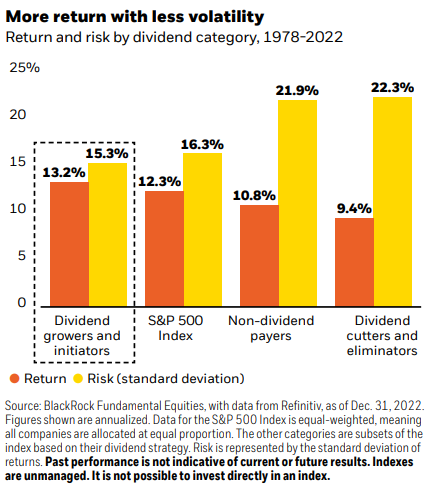
I recently came upon an interesting study from investment manager Blackrock. They analyzed the total returns for different categories of companies in the S&P 500, based on their dividend policy.
They looked at total returns per year for dividend growers and initiators, S&P 500, non-dividend payers and dividend cutters between 1978 and 2022. They compared the total returns between each category. In addition, they also included volatility for each group as well. You can view the results in the chart below:
Source: Blackrock
I have included the commentary from Blackrock verbatim below:
"Dividend-paying stocks have outperformed nondividend payers over the long term with less volatility, but companies that grow their dividends stand out most, as shown at the upper right. Statistically, a company’s record of and commitment to paying a dividend has instilled a measure of resilience. We find their managements are loath to cut a dividend and send a negative signal to the market, so dividend growers tend to be well-run companies built to weather diverse markets. Stocks with a history of dividend growth also have tended to fare better in a rising-rate environment versus the highest-yielding stocks (essentially “bond proxies”) that tend to follow bond prices down as rates rise."
The results of this study run contrary to the popular narrative I see today. Many investors do not understand the signaling value of increasing dividends. Only a quality company can afford to grow the business and also generate a growing amount of excess cashflows for many years, in order to establish a long track record of annual dividend increases.
Thursday, November 3, 2022
Simple Investing Principles to Follow
I have been overdosing on everything about Warren Buffett in the past two-three years. This has spilled over to learning more about Warren’s business partner Charlie Munger. Charlie Munger is big on the so called mental models, which are principles on how to live your life.
In this article, I have outlined several simple principles on investing, which I think should be the foundation of your investment strategy, whether you are a dividend investor or choose to do something entirely different.
The first concept you want to understand is the power of compounding. Compounding is the process where you earn money on the money you invested a certain amount of time ago. You start with an initial amount and have a certain rate of return, and you reinvest gains and dividends back into your portfolio. As a result, you are exponentially increasing your net worth and income.
The second simple principle to take into account is that over the past 200 years, the US stock market has been going up almost every decade. This is a phenomenon not just limited to the US however. A study of most other countries show that equities outperform all other assets over time. This is because stocks represent ownership of real businesses, which over time have more consumers, raise prices, bring new products and gain efficiencies and know-how on how to do things better, cheaper and faster. Reinvested earnings drive growth in the businesses, while reinvested dividends compound your net worth and income even faster. While there are occasional blips that could last for years, equities should be the main cornerstone behind your investment strategy. These occasional declines in share prices, no matter how severe, should not scare the individual investor. On the contrary, they should be seen as opportunities to acquire more equity interests in quality companies at discounted prices.
The third principle to remember is that stocks represent partnership interests in real businesses. Stocks are not just some blips on a computer screen. While investor sentiment drives stock prices in the short-run, underlying fundamentals drive whether you are going to make or lose money from your investment in the long-run. Over time, growing earnings, dividends make businesses more valuable, hence you will see 52 week highs and all-time highs most of the time. As a result, as a part-owner in a business, your goal is to determine whether the business can earn more money over time. The rise in stock price and dividend will follow if earnings increase.
The fourth principle is diversification. It is important to realize that things can happen to a business that cannot be even considered as a problem today. If you spread your capital in at least 30 – 40 businesses over your lifetime, you would do just fine in the long-run, while protecting your principle in the process. Having exposure to different industries, countries is a must in protecting investment capital from the destructive forces of time.
The fifth principle you need to take in consideration is that increasing investment activity is bad for your returns. The goal of the investor should be to buy or create an equity portfolio, and then sit on it for decades. If you try to time the market by trying to sell at what looks like a top, and try to buy at what looks like a bottom, you might be unable to achieve your investment goals and objectives. In fact, studies have shown that increased levels of activity among individual investors are correlated with extremely low returns relative to their benchmark. In addition, did you know that if you had simply purchased the original 500 components of S&P 500 in 1957, and then did nothing for the next 50 years, you would have outperformed the S&P 500? Therefore, if a company you own spins-off a subsidiary, just hold on to the stock. From a tax efficiency perspective, you should do just fine.
The sixth important principle to ingrain in your memory is to be unemotional about your investments as much as possible. Most investors are terrible at investing, because they lack the emotional characteristics associated with dealing with rising and falling prices. They get excited when stock prices have been rising for a long period of time, but get depressed when stock prices start going down. These investors are always afraid that they are missing out, which is why they frequently change strategies to chase the next hot fad. You should not let emotions run your investments. The successful investor should have a plan, and stick to it through thick and thin. The best plan is to buy, hold and occasionally monitor your portfolio. Remember, it is time in the market that can lead to success, not timing the market.
Another important principal to remember is that entry price does matter. For dividend investors who focus on selecting individual stocks, there are always some attractively valued opportunities available. There were quality companies available at fair prices during the 1972 Nifty-Fifty Bubble, and the 1996 – 2000 Technology Bubble to name a few. Dearly overpaying even for the best companies is a mistake. This is because your initial dividend yield will be ridiculously low, and the price you paid would have all the growth for the next decade already baked into it. In the case of Coca-Cola and Wal-Mart investors, who overpaid in 1999 – 2000, earned low returns over the subsequent decade. This was despite the fact that the underlying businesses produced stellar operating results during the same time period. In addition, one should focus on the current and future ability of the business to generate profits, and not focus on profits that were generated 5 or 10 years ago. In the case of the Nifty-Fifty, the companies generated returns close to that of a stock market index. Of course, investors would have had to patiently hold for a quarter of a century in order to obtain this result. This was difficult, because the first decade was characterized with heavy losses that were more severe than losses experienced by blue chips stocks as a whole.
Relevant Articles:
- Buy and hold dividend investing is not dead
- Fixed Income for dividend investors
- The Pareto Principle in dividend investing
- Why dividend investors should never touch principal
- Dividend Portfolios – concentrate or diversify?
In this article, I have outlined several simple principles on investing, which I think should be the foundation of your investment strategy, whether you are a dividend investor or choose to do something entirely different.
The first concept you want to understand is the power of compounding. Compounding is the process where you earn money on the money you invested a certain amount of time ago. You start with an initial amount and have a certain rate of return, and you reinvest gains and dividends back into your portfolio. As a result, you are exponentially increasing your net worth and income.
The second simple principle to take into account is that over the past 200 years, the US stock market has been going up almost every decade. This is a phenomenon not just limited to the US however. A study of most other countries show that equities outperform all other assets over time. This is because stocks represent ownership of real businesses, which over time have more consumers, raise prices, bring new products and gain efficiencies and know-how on how to do things better, cheaper and faster. Reinvested earnings drive growth in the businesses, while reinvested dividends compound your net worth and income even faster. While there are occasional blips that could last for years, equities should be the main cornerstone behind your investment strategy. These occasional declines in share prices, no matter how severe, should not scare the individual investor. On the contrary, they should be seen as opportunities to acquire more equity interests in quality companies at discounted prices.
The third principle to remember is that stocks represent partnership interests in real businesses. Stocks are not just some blips on a computer screen. While investor sentiment drives stock prices in the short-run, underlying fundamentals drive whether you are going to make or lose money from your investment in the long-run. Over time, growing earnings, dividends make businesses more valuable, hence you will see 52 week highs and all-time highs most of the time. As a result, as a part-owner in a business, your goal is to determine whether the business can earn more money over time. The rise in stock price and dividend will follow if earnings increase.
The fourth principle is diversification. It is important to realize that things can happen to a business that cannot be even considered as a problem today. If you spread your capital in at least 30 – 40 businesses over your lifetime, you would do just fine in the long-run, while protecting your principle in the process. Having exposure to different industries, countries is a must in protecting investment capital from the destructive forces of time.
The fifth principle you need to take in consideration is that increasing investment activity is bad for your returns. The goal of the investor should be to buy or create an equity portfolio, and then sit on it for decades. If you try to time the market by trying to sell at what looks like a top, and try to buy at what looks like a bottom, you might be unable to achieve your investment goals and objectives. In fact, studies have shown that increased levels of activity among individual investors are correlated with extremely low returns relative to their benchmark. In addition, did you know that if you had simply purchased the original 500 components of S&P 500 in 1957, and then did nothing for the next 50 years, you would have outperformed the S&P 500? Therefore, if a company you own spins-off a subsidiary, just hold on to the stock. From a tax efficiency perspective, you should do just fine.
The sixth important principle to ingrain in your memory is to be unemotional about your investments as much as possible. Most investors are terrible at investing, because they lack the emotional characteristics associated with dealing with rising and falling prices. They get excited when stock prices have been rising for a long period of time, but get depressed when stock prices start going down. These investors are always afraid that they are missing out, which is why they frequently change strategies to chase the next hot fad. You should not let emotions run your investments. The successful investor should have a plan, and stick to it through thick and thin. The best plan is to buy, hold and occasionally monitor your portfolio. Remember, it is time in the market that can lead to success, not timing the market.
Another important principal to remember is that entry price does matter. For dividend investors who focus on selecting individual stocks, there are always some attractively valued opportunities available. There were quality companies available at fair prices during the 1972 Nifty-Fifty Bubble, and the 1996 – 2000 Technology Bubble to name a few. Dearly overpaying even for the best companies is a mistake. This is because your initial dividend yield will be ridiculously low, and the price you paid would have all the growth for the next decade already baked into it. In the case of Coca-Cola and Wal-Mart investors, who overpaid in 1999 – 2000, earned low returns over the subsequent decade. This was despite the fact that the underlying businesses produced stellar operating results during the same time period. In addition, one should focus on the current and future ability of the business to generate profits, and not focus on profits that were generated 5 or 10 years ago. In the case of the Nifty-Fifty, the companies generated returns close to that of a stock market index. Of course, investors would have had to patiently hold for a quarter of a century in order to obtain this result. This was difficult, because the first decade was characterized with heavy losses that were more severe than losses experienced by blue chips stocks as a whole.
Relevant Articles:
- Buy and hold dividend investing is not dead
- Fixed Income for dividend investors
- The Pareto Principle in dividend investing
- Why dividend investors should never touch principal
- Dividend Portfolios – concentrate or diversify?
Thursday, June 16, 2022
Dividend Investors: Stay The Course
The past month has been difficult for many investors. It is during times like these that you see who really is a long-term investor, and who is just a pretender. When you are a long-term buy and hold investor, you stand the best chances to take maximum advantage of the power of compounding, and end up with the probability for the highest dividend income and capital gains. These are the times where having a disciplined approach to investing pays off. These are the times when the ability to allocate capital to use in quality dividend stocks would seem stupid in the short-term, but potentially really brilliant 10 – 20 years down the road. When stock prices fall, there is an urge in the investor to protect their nest eggs from further price impairment.
This is a dangerous situation to be in because:
1) Noone knows in advance today when this correction is going to run out of steam or what its ultimate severity will be. So when you act on short-term noise, you are actually shooting yourself and those who will depend on you in the foot.
2) Therefore, if you act based on short-term price fluctuations, you are speculating and have essentially thrown out your edge of being a long-term investor. It is extremely difficult to win in investing as a short-term speculator – you will be in an out of stocks and paying taxes and commissions through the nose. Your main edge in the stock market lies in the ability to hold on to your stocks through thick and thin for decades, and cashing in those growing dividend checks ( or reinvesting them in the accumulation phase)
3) If you are in the accumulation phase, you should be praying for lower prices, because you are buying shares to provide for you in 20 – 30 years. A 200 point decline on the S&P 500 decline will likely look just like a blip on the charts 20 – 30 years from now. If you don’t believe me, check the 1987 crash. A lower entry price results in more future dividend income for you.
4) If you are in the retirement phase, you already have a plan to live off your assets. You are likely spending those dividends, and hopefully those dividends are coming from a diversified portfolio of dividend growth stocks. You are likely getting social security and possibly a pension. As long as there is some margin of safety in financial independence, and the dividend portfolio mostly consists of quality blue chips, the investor should be just cashing in their dividend checks and enjoy the fruits of their lifetime of labor.
I know that seeing unrealized capital losses hurts. However, the important thing is to just stick to your plan and stay the course. This is why I have chosen to be a dividend growth investor. When the stock market is going up, everyone is a total return investor and chases hot growth stocks and talks about how much capital gains they have made.
However, when the stock market starts going down in price, those capital gains could quickly turn into losses. Imagine having to sell chunks of your portfolio for living expenses when the stock market is going lower. You will eat your principal quickly, and increase your chances of panicking and doing the wrong thing of selling everything out. When your dividends cover your living expenses however, it is much easier to ignore those stock price fluctuations. As long as those dividends are coming from a diversified portfolio of quality blue chip stocks that are dependable, the investor has nothing to worry about. In fact, receiving cash dividends when the stock prices are going down is very reassuring, and provides the investor with positive reinforcement to just stay the course.
There is a reason why stocks have done much better than bonds in the long-run – they are riskier. With stocks, there is always the chance that there will be violent fluctuations in the price. You can have steep downturns, which can have many weak hands scrambling for the exits. When stock prices go down, many investors assume that something is wrong, they panic and sell. They forget that your upside potential in terms of dividends and capital gains is virtually unlimited. Some companies you own will ultimately cut dividends and sell at levels that were lower than what you paid for. Other companies in your portfolio will do well enough in the long term that will more than compensate for the failures you have experienced.
The issue with stocks of course is that the amount and timing of future capital gains is largely unknown in advance. This is why people panic when prices start going down – they project the recent past onto the future indefinitely. They forget that stocks are not just some pieces of paper or blips on a computer screen, but real businesses that sell real goods and services to consumers who are willing to exchange the fruits of their labor for those goods and services. Over time, those businesses as group will likely learn ways to sell more, charge more, earn more and reward their shareholders. No matter the turbulence we will experience in the US and Global stock markets and economies in the short-run, I believe that things will be better for all of us ten years from now. And as investors, we invest for the long term, not for the next 5 years or 5 months.
With bonds, you get limited upside mostly in terms of the interest payment you receive, and then hopefully a guaranteed return on investment after a set period of time. So while a portfolio of bank CD’s will not be quoted every day, providing an illusion that the money is safe, it is difficult to live off the small yields we see today. Even if inflation returns to its normal course of 3%/year, those bank CD’s will likely be unable to keep up purchasing power.
Holding on to stocks pays in the long term better than holding bonds precisely due to their “riskier” nature. If you stay the course of regularly adding money to your accounts, you will be able to buy more shares of quality companies at a discount. After the dust settles, you will be ending up with more valuable pieces of real businesses than before. It intuitively makes sense that if one share of Altria (MO) will sell for $500 in 30 years, you will be better off buying the company at $40/share as opposed to $75/share. It also intuitively makes sense that if you reinvest your dividends when prices are low, you will end up with more shares and more dividend income over time.
Again, in order to benefit from all of this, you need to stay the course. This means saving money every month, putting money to work regularly, and not getting scared away. Perhaps if you are concerned about prices and you are in the accumulation phase, it may make sense to just start reinvesting dividends automatically. Or alternatively, it may make sense to automatically invest a portion of your paycheck through your 401 (k).
Relevant Articles:
- Successful Dividend Investing Requires Patience
- Fixed Income for dividend investors
- Dividend income is more stable than capital gains
- How to think like a long term dividend investor
- Long Term Dividend Growth Investing
This is a dangerous situation to be in because:
1) Noone knows in advance today when this correction is going to run out of steam or what its ultimate severity will be. So when you act on short-term noise, you are actually shooting yourself and those who will depend on you in the foot.
2) Therefore, if you act based on short-term price fluctuations, you are speculating and have essentially thrown out your edge of being a long-term investor. It is extremely difficult to win in investing as a short-term speculator – you will be in an out of stocks and paying taxes and commissions through the nose. Your main edge in the stock market lies in the ability to hold on to your stocks through thick and thin for decades, and cashing in those growing dividend checks ( or reinvesting them in the accumulation phase)
3) If you are in the accumulation phase, you should be praying for lower prices, because you are buying shares to provide for you in 20 – 30 years. A 200 point decline on the S&P 500 decline will likely look just like a blip on the charts 20 – 30 years from now. If you don’t believe me, check the 1987 crash. A lower entry price results in more future dividend income for you.
4) If you are in the retirement phase, you already have a plan to live off your assets. You are likely spending those dividends, and hopefully those dividends are coming from a diversified portfolio of dividend growth stocks. You are likely getting social security and possibly a pension. As long as there is some margin of safety in financial independence, and the dividend portfolio mostly consists of quality blue chips, the investor should be just cashing in their dividend checks and enjoy the fruits of their lifetime of labor.
I know that seeing unrealized capital losses hurts. However, the important thing is to just stick to your plan and stay the course. This is why I have chosen to be a dividend growth investor. When the stock market is going up, everyone is a total return investor and chases hot growth stocks and talks about how much capital gains they have made.
However, when the stock market starts going down in price, those capital gains could quickly turn into losses. Imagine having to sell chunks of your portfolio for living expenses when the stock market is going lower. You will eat your principal quickly, and increase your chances of panicking and doing the wrong thing of selling everything out. When your dividends cover your living expenses however, it is much easier to ignore those stock price fluctuations. As long as those dividends are coming from a diversified portfolio of quality blue chip stocks that are dependable, the investor has nothing to worry about. In fact, receiving cash dividends when the stock prices are going down is very reassuring, and provides the investor with positive reinforcement to just stay the course.
There is a reason why stocks have done much better than bonds in the long-run – they are riskier. With stocks, there is always the chance that there will be violent fluctuations in the price. You can have steep downturns, which can have many weak hands scrambling for the exits. When stock prices go down, many investors assume that something is wrong, they panic and sell. They forget that your upside potential in terms of dividends and capital gains is virtually unlimited. Some companies you own will ultimately cut dividends and sell at levels that were lower than what you paid for. Other companies in your portfolio will do well enough in the long term that will more than compensate for the failures you have experienced.
The issue with stocks of course is that the amount and timing of future capital gains is largely unknown in advance. This is why people panic when prices start going down – they project the recent past onto the future indefinitely. They forget that stocks are not just some pieces of paper or blips on a computer screen, but real businesses that sell real goods and services to consumers who are willing to exchange the fruits of their labor for those goods and services. Over time, those businesses as group will likely learn ways to sell more, charge more, earn more and reward their shareholders. No matter the turbulence we will experience in the US and Global stock markets and economies in the short-run, I believe that things will be better for all of us ten years from now. And as investors, we invest for the long term, not for the next 5 years or 5 months.
With bonds, you get limited upside mostly in terms of the interest payment you receive, and then hopefully a guaranteed return on investment after a set period of time. So while a portfolio of bank CD’s will not be quoted every day, providing an illusion that the money is safe, it is difficult to live off the small yields we see today. Even if inflation returns to its normal course of 3%/year, those bank CD’s will likely be unable to keep up purchasing power.
Holding on to stocks pays in the long term better than holding bonds precisely due to their “riskier” nature. If you stay the course of regularly adding money to your accounts, you will be able to buy more shares of quality companies at a discount. After the dust settles, you will be ending up with more valuable pieces of real businesses than before. It intuitively makes sense that if one share of Altria (MO) will sell for $500 in 30 years, you will be better off buying the company at $40/share as opposed to $75/share. It also intuitively makes sense that if you reinvest your dividends when prices are low, you will end up with more shares and more dividend income over time.
Again, in order to benefit from all of this, you need to stay the course. This means saving money every month, putting money to work regularly, and not getting scared away. Perhaps if you are concerned about prices and you are in the accumulation phase, it may make sense to just start reinvesting dividends automatically. Or alternatively, it may make sense to automatically invest a portion of your paycheck through your 401 (k).
Relevant Articles:
- Successful Dividend Investing Requires Patience
- Fixed Income for dividend investors
- Dividend income is more stable than capital gains
- How to think like a long term dividend investor
- Long Term Dividend Growth Investing
Thursday, May 26, 2022
How to turn $40 into $21 million
Coca-Cola (KO) is a dividend king, which has managed to increase dividends to shareholders for 57 years in a row. The company has paid dividends for 100 years. It is a widely-owned company, and a favorite for many dividend investors.
In 1919, Coca-Cola had its IPO. The stock sold at $40/share to investors and had a yield of 5%.
By 1920, the stock had declined by 50% on fears that sugar prices were going up. Investors saw unrealized losses and a gloomy near terms picture.
As we all know, Coca-Cola ultimately became a dominant blue chip company. But that wasn’t so evident in 1920.
As Ben Graham said: "In the short-run, the market is a voting machine - reflecting a voter-registration test that requires only money, not intelligence or emotional stability - but in the long-run, the market is a weighing machine."
Those $40 invested in 1919 turned into a little over $21 million a century later with dividend reinvestment. This investment would be paying almost $600,000 in annual dividend income.
This is the result of a long-term compounding at a high rate of return over long periods of time. It is basic math.
Getting those returns was not easy however. There were obstacles along the way, which would have easily convinced any investor that the best days for Coca-Cola were behind it.
Back in 1938 for example, Fortune Magazine warned investors that the best days for Coca-Cola are already behind it: "Several times every year a weighty and serious investor looks long and with profound respect at Coca-Cola's record, but comes regretfully to the conclusion that he is looking too late. The specters of saturation and competition rise before him."

If you look at the stock price chart however, it looks like there were several long periods, which didn't offer much in terms of returns:
1938 – 1959
1972 – 1985
1998 – 2011
It is very likely that investors were questioning their choices, given the stagnant share price for extended periods of time. There was always some fear that the best days are behind Coca-Cola. Yet, after forming a long base, and exhausting impatient stockholders into selling, Coca-Cola reinvigorated itself and became a Wall Street darling one more time.
Patient dividend investors who were satisfied with the stability of the product demand, and the stability of their dividend checks kept holding onto the stock through thick and thin. When you are getting paid to own a stock, it is much easier to ignore where the stock price goes. It is also easier to ignore negative news about a company, which surely come after share prices have gone nowhere for a long period of time or after they have declined. Buying a stock for its dividend is the ultimate edge that gives dividend investors the patience to endure challenging conditions such as the long periods of time where prices went nowhere. Receiving a dividend is a reminder that you are a part owner of a real business, which provides an economic purpose to others. As a result, you receive your proportional share of the profits in the form of cold hard cash.
I have found quite a few stories about successful Coca-Cola shareholders, who held on for decades. Their descendants held on for decades as well. Those smart and patient enough to invest in Coca-Cola 100 years ago have managed to provide for their families for several generations.
As I mentioned above, a $40 investment turned into $21 million with dividend reinvestment. The portfolio would be generating over half a million dollars in annual dividend income, which is twelve times the median income for a worker in the United States today. This is all coming from a $40 investment that compounded for a century. These $40 from 1919 had the same purchasing power of roughly $600 today.
If you and your trust fund kids and grandkids had simply lived off the dividend income during the past century however, you would have still done well.
For example, one of SunTrust’s predecessor companies was paid $100,000 in Coca-Cola stock for its work on its IPO in 1919. The bank kept the stock, and cashed in those dividends for over 90 years, before finally selling in 2012 for a tidy sum of $2 billion. Had they waited for seven more years, they could have doubled their money to $4 billion, but who is counting?
I received a lot of pushback when I originally posted the results of that fateful $40 investment in Coca-Cola in 1919, turning into $21 million with dividends reinvested. The common response to “ if you had invested in Coca-Cola in 1919..” was that you would be dead by now.
That is a very shortsighted response, because it ignores the realities of financial planning. In general, if you and your spouse are in your 20s or 30s, you could realistically have a 60 – 70 year period to plan for. This includes the lifetimes for you and your spouse only, as it is quite possible that at least one of these partners will make it for a longer time than the other. If you have children in your 20s or 30s, it is quite possible that you are looking at a 70 – 80 or even 90 year period for planning. If you want to create a sort of generational wealth that covers a few generations after you, and you have sufficient means, you can always set up a trust fund that can serve your goals in a way that you want them accomplished. While I would not put everything in one stock for a trust fund, I would have principal be held and just dividends be distributed to beneficiaries. Long-term planning is beyond the scope of this article, but if this concerns you, you should speak with a licensed professional who can set things up for you ( for a reasonable fee).
The long-term returns of the original investment in Coca-Cola has been widely publicized of course.
Warren Buffet has invested heavily into Coca-Cola, and has been an investor for over 30 years now. Between 1988 and 1994, Berkshire Hathaway acquired 400 million shares of Coca-Cola for $1.3 billion. He has a split-adjusted cost of $3.25/share. Coca-Cola has an annual dividend of $1.76/share.
In 1919, Coca-Cola had its IPO. The stock sold at $40/share to investors and had a yield of 5%.
By 1920, the stock had declined by 50% on fears that sugar prices were going up. Investors saw unrealized losses and a gloomy near terms picture.
As we all know, Coca-Cola ultimately became a dominant blue chip company. But that wasn’t so evident in 1920.
As Ben Graham said: "In the short-run, the market is a voting machine - reflecting a voter-registration test that requires only money, not intelligence or emotional stability - but in the long-run, the market is a weighing machine."
Those $40 invested in 1919 turned into a little over $21 million a century later with dividend reinvestment. This investment would be paying almost $600,000 in annual dividend income.
This is the result of a long-term compounding at a high rate of return over long periods of time. It is basic math.
Getting those returns was not easy however. There were obstacles along the way, which would have easily convinced any investor that the best days for Coca-Cola were behind it.
Back in 1938 for example, Fortune Magazine warned investors that the best days for Coca-Cola are already behind it: "Several times every year a weighty and serious investor looks long and with profound respect at Coca-Cola's record, but comes regretfully to the conclusion that he is looking too late. The specters of saturation and competition rise before him."

If you look at the stock price chart however, it looks like there were several long periods, which didn't offer much in terms of returns:
1938 – 1959
1972 – 1985
1998 – 2011
It is very likely that investors were questioning their choices, given the stagnant share price for extended periods of time. There was always some fear that the best days are behind Coca-Cola. Yet, after forming a long base, and exhausting impatient stockholders into selling, Coca-Cola reinvigorated itself and became a Wall Street darling one more time.
Patient dividend investors who were satisfied with the stability of the product demand, and the stability of their dividend checks kept holding onto the stock through thick and thin. When you are getting paid to own a stock, it is much easier to ignore where the stock price goes. It is also easier to ignore negative news about a company, which surely come after share prices have gone nowhere for a long period of time or after they have declined. Buying a stock for its dividend is the ultimate edge that gives dividend investors the patience to endure challenging conditions such as the long periods of time where prices went nowhere. Receiving a dividend is a reminder that you are a part owner of a real business, which provides an economic purpose to others. As a result, you receive your proportional share of the profits in the form of cold hard cash.
I have found quite a few stories about successful Coca-Cola shareholders, who held on for decades. Their descendants held on for decades as well. Those smart and patient enough to invest in Coca-Cola 100 years ago have managed to provide for their families for several generations.
As I mentioned above, a $40 investment turned into $21 million with dividend reinvestment. The portfolio would be generating over half a million dollars in annual dividend income, which is twelve times the median income for a worker in the United States today. This is all coming from a $40 investment that compounded for a century. These $40 from 1919 had the same purchasing power of roughly $600 today.
If you and your trust fund kids and grandkids had simply lived off the dividend income during the past century however, you would have still done well.
For example, one of SunTrust’s predecessor companies was paid $100,000 in Coca-Cola stock for its work on its IPO in 1919. The bank kept the stock, and cashed in those dividends for over 90 years, before finally selling in 2012 for a tidy sum of $2 billion. Had they waited for seven more years, they could have doubled their money to $4 billion, but who is counting?
I received a lot of pushback when I originally posted the results of that fateful $40 investment in Coca-Cola in 1919, turning into $21 million with dividends reinvested. The common response to “ if you had invested in Coca-Cola in 1919..” was that you would be dead by now.
That is a very shortsighted response, because it ignores the realities of financial planning. In general, if you and your spouse are in your 20s or 30s, you could realistically have a 60 – 70 year period to plan for. This includes the lifetimes for you and your spouse only, as it is quite possible that at least one of these partners will make it for a longer time than the other. If you have children in your 20s or 30s, it is quite possible that you are looking at a 70 – 80 or even 90 year period for planning. If you want to create a sort of generational wealth that covers a few generations after you, and you have sufficient means, you can always set up a trust fund that can serve your goals in a way that you want them accomplished. While I would not put everything in one stock for a trust fund, I would have principal be held and just dividends be distributed to beneficiaries. Long-term planning is beyond the scope of this article, but if this concerns you, you should speak with a licensed professional who can set things up for you ( for a reasonable fee).
The long-term returns of the original investment in Coca-Cola has been widely publicized of course.
Warren Buffet has invested heavily into Coca-Cola, and has been an investor for over 30 years now. Between 1988 and 1994, Berkshire Hathaway acquired 400 million shares of Coca-Cola for $1.3 billion. He has a split-adjusted cost of $3.25/share. Coca-Cola has an annual dividend of $1.76/share.
The company will distribute $704 million in annual dividends to Berkshire in 2022. That means every two years, Buffett gets his cost basis back, while retaining ownership of the stock. That’s a nice yield on cost of 50%. The dividend is also a tax advantaged way for Berkshire Hathaway to recognize profits, and is more tax advantaged than capital gains. That's why Warren Buffett prefers dividends over capital gains.
Warren Buffett spoke extensively about it in his 1993 letter to shareholders:
Earlier I mentioned the financial results that could have been achieved by investing $40 in The Coca-Cola Co. in 1919. In 1938, more than 50 years after the introduction of Coke, and long after the drink was firmly established as an American icon, Fortune did an excellent story on the company. In the second paragraph the writer reported: "Several times every year a weighty and serious investor looks long and with profound respect at Coca-Cola's record, but comes regretfully to the conclusion that he is looking too late. The specters of saturation and competition rise before him."
Yes, competition there was in 1938 and in 1993 as well. But it's worth noting that in 1938 The Coca-Cola Co. sold 207 million cases of soft drinks (if its gallonage then is converted into the 192-ounce cases used for measurement today) and in 1993 it sold about 10.7 billion cases, a 50-fold increase in physical volume from a company that in 1938 was already dominant in its very major industry. Nor was the party over in 1938 for an investor: Though the $40 invested in 1919 in one share had (with dividends reinvested) turned into $3,277 by the end of 1938, a fresh $40 then invested in Coca-Cola stock would have grown to $25,000 by yearend 1993.
I can't resist one more quote from that 1938 Fortune story: "It would be hard to name any company comparable in size to Coca- Cola and selling, as Coca-Cola does, an unchanged product that can point to a ten-year record anything like Coca-Cola's." In the 55 years that have since passed, Coke's product line has broadened somewhat, but it's remarkable how well that description still fits.
Charlie and I decided long ago that in an investment lifetime it's just too hard to make hundreds of smart decisions. That judgment became ever more compelling as Berkshire's capital mushroomed and the universe of investments that could significantly affect our results shrank dramatically. Therefore, we adopted a strategy that required our being smart - and not too smart at that - only a very few times. Indeed, we'll now settle for one good idea a year.
He also discussed it in a speech from the late 1990s. The video is titled “how to turn $40 into $5 million”. Source: Youtube
Even Coca-Cola itself posted a press release in 2012 that a $40 investment in 1919 would have turned into $9.80 million 93 years later. Those figures assume dividend reinvestment. Source: Coca-Cola Press Release
Today, the future for Coca-Cola looks bleak again. The company is at the crossroads, as sugary drinks consumption is declining, and people are supposedly becoming more health conscious. However, there is a bright spot for international expansion in developing markets. The share price is only marginally higher than the highs reached in 1998. At the time, the stock price was overvalued, while today it is still richly valued though not as high as 20 years ago.
Coca-Cola and many other great consumer franchises became extremely expensive in the late 1990s. At that time they could not be bought at prices that would produce a satisfactory return. Market prices for these stocks were materially higher than intrinsic value. The lost decade ending in 2009 has managed to correct that. As you can see, prices tend to overshoot on the upside, as in 1972 and 1998, and overshoot on the downside (as in 1999 – 2009).
It remains to be seen whether the best days of Coca-Cola are behind it, or whether it would stage another massive comeback. We won’t know for the next twenty years unfortunately. I do believe that a patient holder of Coca-Cola stock will probably do ok over the next 20 years for as long as the dividend is maintained and not cut. If the dividend is cut, I would be selling my shares one second after the announcement, because it would prove to me that my thesis and initial argument to buy and hold the stock was invalid.
Relevant Articles:
- Coca-Cola (KO) Dividend Stock Analysis
- How Warren Buffett earns $1,140 in dividend income per minute
- This Is Why Warren Buffett Prefers Dividends Over Capital Gains
- Investors Get Paid for Holding Dividend Stocks
Warren Buffett spoke extensively about it in his 1993 letter to shareholders:
Earlier I mentioned the financial results that could have been achieved by investing $40 in The Coca-Cola Co. in 1919. In 1938, more than 50 years after the introduction of Coke, and long after the drink was firmly established as an American icon, Fortune did an excellent story on the company. In the second paragraph the writer reported: "Several times every year a weighty and serious investor looks long and with profound respect at Coca-Cola's record, but comes regretfully to the conclusion that he is looking too late. The specters of saturation and competition rise before him."
Yes, competition there was in 1938 and in 1993 as well. But it's worth noting that in 1938 The Coca-Cola Co. sold 207 million cases of soft drinks (if its gallonage then is converted into the 192-ounce cases used for measurement today) and in 1993 it sold about 10.7 billion cases, a 50-fold increase in physical volume from a company that in 1938 was already dominant in its very major industry. Nor was the party over in 1938 for an investor: Though the $40 invested in 1919 in one share had (with dividends reinvested) turned into $3,277 by the end of 1938, a fresh $40 then invested in Coca-Cola stock would have grown to $25,000 by yearend 1993.
I can't resist one more quote from that 1938 Fortune story: "It would be hard to name any company comparable in size to Coca- Cola and selling, as Coca-Cola does, an unchanged product that can point to a ten-year record anything like Coca-Cola's." In the 55 years that have since passed, Coke's product line has broadened somewhat, but it's remarkable how well that description still fits.
Charlie and I decided long ago that in an investment lifetime it's just too hard to make hundreds of smart decisions. That judgment became ever more compelling as Berkshire's capital mushroomed and the universe of investments that could significantly affect our results shrank dramatically. Therefore, we adopted a strategy that required our being smart - and not too smart at that - only a very few times. Indeed, we'll now settle for one good idea a year.
He also discussed it in a speech from the late 1990s. The video is titled “how to turn $40 into $5 million”. Source: Youtube
Even Coca-Cola itself posted a press release in 2012 that a $40 investment in 1919 would have turned into $9.80 million 93 years later. Those figures assume dividend reinvestment. Source: Coca-Cola Press Release
Today, the future for Coca-Cola looks bleak again. The company is at the crossroads, as sugary drinks consumption is declining, and people are supposedly becoming more health conscious. However, there is a bright spot for international expansion in developing markets. The share price is only marginally higher than the highs reached in 1998. At the time, the stock price was overvalued, while today it is still richly valued though not as high as 20 years ago.
Coca-Cola and many other great consumer franchises became extremely expensive in the late 1990s. At that time they could not be bought at prices that would produce a satisfactory return. Market prices for these stocks were materially higher than intrinsic value. The lost decade ending in 2009 has managed to correct that. As you can see, prices tend to overshoot on the upside, as in 1972 and 1998, and overshoot on the downside (as in 1999 – 2009).
It remains to be seen whether the best days of Coca-Cola are behind it, or whether it would stage another massive comeback. We won’t know for the next twenty years unfortunately. I do believe that a patient holder of Coca-Cola stock will probably do ok over the next 20 years for as long as the dividend is maintained and not cut. If the dividend is cut, I would be selling my shares one second after the announcement, because it would prove to me that my thesis and initial argument to buy and hold the stock was invalid.
Relevant Articles:
- Coca-Cola (KO) Dividend Stock Analysis
- How Warren Buffett earns $1,140 in dividend income per minute
- This Is Why Warren Buffett Prefers Dividends Over Capital Gains
- Investors Get Paid for Holding Dividend Stocks
Thursday, May 12, 2022
The Dividend Crossover Point
The goal of every dividend investor is to one day accumulate a portfolio of income producing stocks, which would throw off a large amount of dividends every month. The magic point is where the dividend income exceeds the expenses of the dividend investor. At the dividend crossover point your dividend income meets or exceeds your expenses. For many dividend investors, this is the point synonymous with financial independence. After all, after years of sacrifice, wise investment and sticking to a plan, investors would finally be able to do be free from a nine to five job. The goal of reaching the dividend crossover point is achievable, but it takes capital, time, skill or luck in order to get to the magic point.

In order to reach that magical point, a lot of work needs to be done. Investors need to design a retirement strategy, and then stick to it through thick and thin, while also improving along the way. Some of the biggest dangers to successful dividend investing are not market volatility, dividend cuts or recessions, but investor psychology.
The process of accumulating a viable dividend stream will take anywhere from several years for those who are starting out with a large amount in their 401 (k) or IRA’s to a few decades for these young investors who are just starting out in their professional careers. Along the way, many investors will lose track of the goal due to sheer boredom or due to lack of patience. Successful dividend investing is sometimes as exciting as watching paint dry. Unfortunately, investors who enter dividend investing for the sheer excitement do not stick to it. On the other hand, investors who attempt to find shortcuts to speed up the process of capital accumulation by using options and futures, risky growth stocks or massive leverage will likely be disappointed along the way.
The key ingredients to accumulating a sufficient dividend income stream include time, dividend reinvestment and regular contributions to your portfolio. The power of regular contributions is important, because this ensures that investors consciously keep working towards their goal of dividend independence by investing in dividend stocks every month. While markets fluctuate greatly, I have always found at least 15 – 20 attractively valued income stocks at all times. Dividend reinvestment in dividend growth stocks is essential for turbo-charging your passive income. And last but not least, investors need the time to let their income compound to their desired amount.
Dividend investing takes time, before the amount of distributions reaches decent levels. Imagine that someone managed to save $1000/month for one year. Each month, they put $1000 total in two companies ($500 dollars per company per month). At the end of the first year, they would have about 24 companies, and the portfolio cost will be $12,000. If the average yield were 4%, this portfolio will generate $480 in annual dividends, which accounts for roughly $40/month. On the positive side, the dividends from this portfolio will generate enough to purchase one additional stock position per year. In addition, $40/month could pay for utilities, phone or internet bills for the investor pretty much for life. On the negative side, assuming that the investor needs $1000/month to cover their basic expenses, he or she would calculate that they would need to sacrifice almost for one decade, before their income reaches a decent amount. Once they are there however, and their portfolios consist of wide-moat dividend champions with sustainable distributions, investors will be able to live off dividends.
You can see that building that dividend machine can be a long term process. The levers within the control of the investor include their savings rate, ability to develop a strategy and stick to it, in order to allow the power of long-term investment compounding to do its magic.
In my investing, I have found very important to follow a few simple rules in order to create a sustainable dividend producing machine, which would produce dependable income for decades.
First, investors should focus on companies which have a long history of paying and raising dividends. I typically look for companies which have increased dividends for at least ten years in a row.
Second, investors should make sure that these companies are trading at attractive valuations. I have found that paying a P/E of over 20 could lead to poor results.
Third, investors should make sure that the company’s dividend is sustainable out of earnings or cash flows. I typically look for a dividend payout ratio of less than 60% for ordinary stocks. For REITs or Master Limited Partnership I look for FFO Payout and DCF Payout Ratios.
Fourth, investors should perform a qualitative analysis of the dividend paying company they consider for purchasing. This analysis should include understanding how the business makes money, growth prospects, competitive landscape, whether the business has any moat, whether the company has any strong brands, which consumers are loyal to and result in pricing power.
Fifth, investors should try to build a diversified dividend portfolio consisting of at least 50 -60 individual stocks coming from at least ten sectors. Having exposure to internationally based companies is a plus, despite the fact that most dividend growth stocks derive a major part of their profits from outside the US.
Conclusion
Today we discussed the concept of the dividend crossover point, which is the point where dividend income exceeds expenses. We also discussed the tools within the investor’s control to get there.
Finally, I shared a brief overview of the types of simple investing rules I follow to evaluate dividend paying stocks. All of the principles listed in this article are the cornerstones of the Dividend Growth Portfolio Newsletter that I launched a few years ago. I believe that by showing how I am building a real world portfolio from scratch, I can educate investors on the inner works of dividend investing.
At the same time, dividend income makes it easy to see how we are doing against our ultimate goal of $1,000 in monthly dividend income. Right now, the dividend growth portfolio is earning $110 in expected average monthly dividend income after three years of saving and investing.

In order to reach that magical point, a lot of work needs to be done. Investors need to design a retirement strategy, and then stick to it through thick and thin, while also improving along the way. Some of the biggest dangers to successful dividend investing are not market volatility, dividend cuts or recessions, but investor psychology.
The process of accumulating a viable dividend stream will take anywhere from several years for those who are starting out with a large amount in their 401 (k) or IRA’s to a few decades for these young investors who are just starting out in their professional careers. Along the way, many investors will lose track of the goal due to sheer boredom or due to lack of patience. Successful dividend investing is sometimes as exciting as watching paint dry. Unfortunately, investors who enter dividend investing for the sheer excitement do not stick to it. On the other hand, investors who attempt to find shortcuts to speed up the process of capital accumulation by using options and futures, risky growth stocks or massive leverage will likely be disappointed along the way.
The key ingredients to accumulating a sufficient dividend income stream include time, dividend reinvestment and regular contributions to your portfolio. The power of regular contributions is important, because this ensures that investors consciously keep working towards their goal of dividend independence by investing in dividend stocks every month. While markets fluctuate greatly, I have always found at least 15 – 20 attractively valued income stocks at all times. Dividend reinvestment in dividend growth stocks is essential for turbo-charging your passive income. And last but not least, investors need the time to let their income compound to their desired amount.
Dividend investing takes time, before the amount of distributions reaches decent levels. Imagine that someone managed to save $1000/month for one year. Each month, they put $1000 total in two companies ($500 dollars per company per month). At the end of the first year, they would have about 24 companies, and the portfolio cost will be $12,000. If the average yield were 4%, this portfolio will generate $480 in annual dividends, which accounts for roughly $40/month. On the positive side, the dividends from this portfolio will generate enough to purchase one additional stock position per year. In addition, $40/month could pay for utilities, phone or internet bills for the investor pretty much for life. On the negative side, assuming that the investor needs $1000/month to cover their basic expenses, he or she would calculate that they would need to sacrifice almost for one decade, before their income reaches a decent amount. Once they are there however, and their portfolios consist of wide-moat dividend champions with sustainable distributions, investors will be able to live off dividends.
You can see that building that dividend machine can be a long term process. The levers within the control of the investor include their savings rate, ability to develop a strategy and stick to it, in order to allow the power of long-term investment compounding to do its magic.
In my investing, I have found very important to follow a few simple rules in order to create a sustainable dividend producing machine, which would produce dependable income for decades.
First, investors should focus on companies which have a long history of paying and raising dividends. I typically look for companies which have increased dividends for at least ten years in a row.
Second, investors should make sure that these companies are trading at attractive valuations. I have found that paying a P/E of over 20 could lead to poor results.
Third, investors should make sure that the company’s dividend is sustainable out of earnings or cash flows. I typically look for a dividend payout ratio of less than 60% for ordinary stocks. For REITs or Master Limited Partnership I look for FFO Payout and DCF Payout Ratios.
Fourth, investors should perform a qualitative analysis of the dividend paying company they consider for purchasing. This analysis should include understanding how the business makes money, growth prospects, competitive landscape, whether the business has any moat, whether the company has any strong brands, which consumers are loyal to and result in pricing power.
Fifth, investors should try to build a diversified dividend portfolio consisting of at least 50 -60 individual stocks coming from at least ten sectors. Having exposure to internationally based companies is a plus, despite the fact that most dividend growth stocks derive a major part of their profits from outside the US.
Conclusion
Today we discussed the concept of the dividend crossover point, which is the point where dividend income exceeds expenses. We also discussed the tools within the investor’s control to get there.
Finally, I shared a brief overview of the types of simple investing rules I follow to evaluate dividend paying stocks. All of the principles listed in this article are the cornerstones of the Dividend Growth Portfolio Newsletter that I launched a few years ago. I believe that by showing how I am building a real world portfolio from scratch, I can educate investors on the inner works of dividend investing.
At the same time, dividend income makes it easy to see how we are doing against our ultimate goal of $1,000 in monthly dividend income. Right now, the dividend growth portfolio is earning $110 in expected average monthly dividend income after three years of saving and investing.
I expect that by following the principles outlined in this post, we should be able to hit the dividend crossover point of $1,000 in monthly dividend income within ten to fifteen years. The outcomes vary, because the conditions over the next decade or so will likely vary as well. If more securities are available at higher starting yields or if dividend growth is faster than anticipated we will achieve our goals quicker. If on the other hand starting yields are lower and dividend growth is lower, we will achieve our goals in a slower fashion
Relevant Articles:
- Use these tools within your control to get rich
- Getting Started – The Hardest Part About Dividend Investing
- What are your investment goals?
- Financial Independence Is Easier to Model with Dividends
Relevant Articles:
- Use these tools within your control to get rich
- Getting Started – The Hardest Part About Dividend Investing
- What are your investment goals?
- Financial Independence Is Easier to Model with Dividends
Wednesday, February 23, 2022
35 Dividend Aristocrats For Further Research
The Dividend Aristocrats list includes companies in the S&P 500, which have managed to increase annual dividends for at least 25 years in a row. There are only 65 companies that fit its stringent requirements.
I often use this list as a starting point for further research. I believe that most of the companies in it are of high quality, and have strong competitive positions in their respected industries. However, I do not believe that all companies are automatic buys at all times.
In order to focus on companies whose recent dividend growth has been supported by earnings growth, I reviewed the financials for all 65 dividend aristocrats. I looked at a ten year summary of earnings for each company, in order to determine if earnings are growing. Without growth in earnings per share, a company cannot grow dividends, and it will not grow intrinsic value per share.
As a result of my review, I came up with a list of 35 dividend aristocrats for further research:
|
Name |
Name |
Years Annual Dividend Increases |
10 year Dividend Growth |
P/E Ratio |
Dividend Yield |
Dividend Payout Ratio |
|
ABT |
Abbott Laboratories |
49 |
7.15% |
24.06 |
1.61% |
38.74% |
|
ADP |
Automatic Data Processing |
46 |
11.45% |
29.37 |
2.08% |
61.09% |
|
AFL |
Aflac |
40 |
7.94% |
12.01 |
2.53% |
30.39% |
|
AOS |
A. O. Smith |
28 |
21.60% |
20.06 |
1.61% |
32.30% |
|
APD |
Air Products and Chemicals |
39 |
10.11% |
23.44 |
2.68% |
62.82% |
|
ATO |
Atmos Energy |
38 |
6.47% |
19.26 |
2.57% |
49.50% |
|
BF.B |
Brown-Forman |
37 |
7.50% |
39.82 |
1.13% |
45.00% |
|
BRO |
Brown & Brown |
28 |
8.87% |
28.16 |
0.62% |
17.46% |
|
CB |
Chubb |
28 |
8.80% |
13.82 |
1.56% |
21.56% |
|
CHD |
Church & Dwight Co. |
25 |
11.50% |
30.81 |
1.09% |
33.58% |
|
CINF |
Cincinnati Financial |
61 |
4.51% |
23.39 |
2.23% |
52.16% |
|
CTAS |
Cintas |
39 |
20.20% |
33.89 |
1.02% |
34.57% |
|
DOV |
Dover |
66 |
7.28% |
18.47 |
1.26% |
23.27% |
|
EMR |
Emerson Electric |
65 |
3.53% |
18.72 |
2.22% |
41.56% |
|
ESS |
Essex Property Trust |
27 |
7.23% |
22.61 |
2.65% |
59.92% |
|
EXPD |
Expeditors International of
Washington |
27 |
8.78% |
13.9 |
1.09% |
15.15% |
|
GD |
General Dynamics |
30 |
9.82% |
17.85 |
2.21% |
39.45% |
|
GPC |
Genuine Parts Company |
65 |
6.04% |
16.69 |
2.90% |
48.40% |
|
GWW |
W.W. Grainger |
50 |
9.75% |
19.37 |
1.37% |
26.54% |
|
HRL |
Hormel Foods |
54 |
14.41% |
24.21 |
2.19% |
53.02% |
|
JNJ |
Johnson & Johnson |
59 |
6.42% |
15.53 |
2.60% |
40.38% |
|
LOW |
Lowe's Companies |
59 |
18.80% |
18.62 |
1.44% |
26.81% |
|
MCD |
McDonald's |
46 |
7.57% |
24.67 |
2.20% |
54.27% |
|
MKC |
McCormick & Company |
35 |
9.28% |
30.67 |
1.51% |
46.31% |
|
MMM |
3M |
63 |
10.41% |
14.19 |
4.04% |
57.33% |
|
O |
Realty Income |
29 |
5.02% |
19.65 |
4.48% |
88.03% |
|
PG |
The Procter & Gamble |
65 |
5.16% |
27.07 |
2.18% |
59.01% |
|
PPG |
PPG Industries |
50 |
7.18% |
20.03 |
1.61% |
32.25% |
|
ROP |
Roper Technologies |
29 |
17.73% |
28.32 |
0.56% |
15.86% |
|
SHW |
The Sherwin-Williams |
43 |
16.28% |
28.27 |
0.90% |
25.44% |
|
SPGI |
S&P Global |
48 |
11.91% |
25.97 |
0.81% |
21.04% |
|
SWK |
Stanley Black & Decker |
54 |
6.15% |
13.33 |
1.95% |
25.99% |
|
TGT |
Target |
54 |
11.13% |
15.45 |
1.76% |
27.19% |
|
TROW |
T. Rowe Price Group |
35 |
13.29% |
11.85 |
3.35% |
39.70% |
|
WST |
West Pharmaceutical Services |
29 |
7.18% |
40.06 |
0.20% |
8.01% |
You can view the company, ticker, and ten year dividend growth. I have also included P/E ratio and dividend yield, as well as dividend payout ratio.
Each of these companies has managed to grow earnings over the past decade, which means that dividends have been well supported. If these companies can continue growing earnings per share over the next decade or two, I am confident that they would continue their streak of consecutive annual dividend increases.
However, our work here is not done. Just because we have identified a group of companies for further research, which I would love to own forever, that still doesn't mean that these companies are automatic buys today. Some of these companies seem attractively valued to me today, based on a combination of their P/E ratios and dividend growth.
Others however seem a little pricey. Therefore, they would likely find a place in my portfolio if they become more attractively valued. This can be achieved either by earnings per share growth, by declines in the share price, or a combination of the two.
This my general framework on how I value companies. I take into consideration many inputs, such as P/E, interest rates, stability of earnings, dividend growth, in order to come up with a general idea of what to invest my money in. It is not a formula however.
It is helpful to be prepared to act when the right opportunities present themselves. This is why I have a watchlist and general ideas on valuation, so I can act when the time is right.
Relevant Articles:
- Dividend Growth Investor Newsletter
- Dividend Aristocrats List for 2022
- How to value dividend stocks
- Rising Earnings – The Source of Future Dividend Growth
Subscribe to:
Posts (Atom)
