Showing posts with label taxes. Show all posts

Thursday, January 1, 2026

Roth IRA’s for Dividend Investors

Nothing is certain in this world except for death and taxes. For many dividend growth investors, this could be characterized as a feeling that they are being taxed to death. I am always on the lookout to legally minimize my investment taxes as much as possible. In fact there is an easy way to invest in dividend paying stocks without ever having to pay taxes on your investment.

The Roth IRA allows individuals who have earned income in a given year to contribute up to $7,500 in after-tax dollars to their retirement account for 2026. The contribution limit for 2025 was $7,000.. There is a catch-up contribution of $1,100 for individuals who are 50 years of age or older. While contributions to Roth IRA’s are not deductible on your tax returns, earnings and principal distributions are tax free once certain age and time requirements are met. 

Roth IRA’s allow for tax-free compounding of capital over time. This means that you will not pay taxes on dividends or capital gains on your investments that are placed in a Roth IRA.

The earned income includes compensation from salary, wages, commissions, bonuses and alimony. Income from interest, dividends, annuities or pensions does not count as earned income in the eyes of the IRS.

A non-working spouse can set-up a Spousal Roth IRA, even if they have no working income, as long as the other spouse has enough working income to contribute. For example, if one of the spouses earns $50,000/year, and the other one stays home, they can each contribute $7,500/year to their own Roth IRA's. If they are over the age of 50, the $1,100 catch-up contribution still applies.

The contribution limit for a Roth IRA is the same as the contribution limit for a regular IRA. However the amount that can be contributed to a Roth IRA is the amount remaining after subtracting any contribution made to a regular IRA. This means that if you contributed the maximum allowable amount to your regular IRA of $7,500, you would not be able to contribute anything to a Roth IRA in that year.

There are no required minimum distribution rules for Roth IRAs. 

However, there are phase-out income limits for high earning taxpayers, which reduce the opportunity to use this tax advantaged investment account. A modified adjusted gross income (MAGI) of $252,000 for a couple filing jointly, or $168,000 for an individual makes you ineligible to contribute to a Roth IRA in 2026. The following table outlines the Roth IRA Contribution limits for 2026.


Source: Schwab

There are ways around it of course, using the "Backdoor IRA Conversion" Strategy.  Basically, it entails contributing to a Regular IRA, and immediately converting it to a Roth.

In order to avoid paying taxes on distributions from Roth IRA accounts, investors need to become acquainted with the qualified nontaxable distribution rules.

According to the IRS, qualified nontaxable distributions for Roth IRA’s are those made at least 5 years after the taxpayer’s first contribution to a Roth IRA and made:

1) After the taxpayer become 59.5 years old
2) To a beneficiary after the death of the taxpayer
3) Because the taxpayer becomes disabled
4) For a use of a first time homebuyer

The biggest benefits of a Roth IRA are the long-term tax free compounding of capital, the fact that qualified distributions are tax-free and the fact that there are no required minimum distributions.

Another little known fact behind Roth IRA’s is that direct contributions may be withdrawn at any time. 

This makes them a perfect investment vehicle for investors who plan on retiring early and living off dividends before they reach typical retirement ages of 60 years.

I hold a portion of my assets in a Roth IRA. While the contribution limit is only $7,500, that is still a good start. For a married couple maxing out their Roth IRA's, you have $15,000 to invest. 

In today's commission free world and fractional shares, you can build a diversified portfolio fairly easily.


Saturday, June 3, 2023

Health Savings Account (HSA) for Dividend Investors

A Health Savings Account is a tax-advantaged medical account which is available to individuals in the US who have enrolled into a high-deductible health plan (HDHP). For 2023, individuals cannot contribute more than $3,850/year, while families cannot put more than $7,750. There is a catch-up contribution of $1,000 for those 55 or older. Individuals who are enrolled in Medicare are not eligible to open an HSA. 

I first signed up for a Health Savings Account (HSA) with my employer almost a decade ago. I signed up for the HSA mainly as another way to defer money for future investment. As most of you know, I am already maxing out other tax-deferred accounts in an effort to cut one of my largest expenses.

Benefits

An HSA offers a triple tax advantage in most states. The contributions are before tax, which means that the account holder does not pay Federal, State and FICA taxes. If you were in the 24% marginal tax bracket, had a 5% state income tax rate, and you didn’t pay 7.65% for FICA, you will end up saving 36.65% merely by contributing to an HSA account. On $3,850, this comes out to $1,411.02 in tax savings right off the bat. The money can be used for qualified medical expenses at any age, without having to pay any taxes on such withdrawals. However, support documentation should be retained in case of an audit. Withdrawals not for qualified medical expenses are subject to a 20% penalty and income tax. After age of 65, withdrawals are not subject to a 20% penalty. While they continue to be tax-free for medical expenses, they are taxed at your ordinary income rate for any other type of distribution from the account.

I was attracted to HSA’s because of the large up-front tax deduction. When I contribute money to a tax-deferred vehicle, I have more money under my control, since I reduce the largest expense in my household budget ( taxes). I have done a similar thing by maxing out 401 (k) and Sep IRA contributions since early 2013. 

I was also attracted by the fact that money put in an HSA account compounds tax-free. In addition, unlike a Flexible Spending Account (FSA), the money does not have to be used by a certain date. Hence with an HSA the money carries over from one year to the next, and thus stays in the account and could potentially compound over time.

The other nice thing about HSA accounts is that they are portable. I can move balances to another plan, even if I am still employed and using my employer's HSA plan. In other words, I am not stuck with an HSA plan that may have high fees. I can either do an HSA Transfer or an HSA Rollover. 

An HSA Transfer involves filling up a form, and having the current HSA Custodian send the money to another HSA Custodian. Usually there is a small fee involved.

An HSA Rollover involves filling up a form, obtaining a check from the current Custodian and then depositing the money into the new HSA Account. While this avoids fees, you have to be careful to rollover the money within 60 days, or else face penalties and fees by the IRS. You can only do one HSA rollover within a 12 month period.

Drawbacks

One of the major drawbacks to HSA accounts is the large monthly fees with many providers. When I reviewed different providers in 2014 - 2015, it looked like a minimum account balance that is anywhere between $3,000 - $5,000 has to be maintained in cash, in order to avoid a monthly charge in the range of $2 - $5/month. 

Many employers tend to cover this amount for their employees, so this is a benefit. However, there are additional fees on each withdrawal, ordering checks to pay for items, opening fees, account closing fees etc. Plus, there are monthly fees if you plan to invest that HSA money into something. This is in addition to the fees for failing to maintain a minimum balance in the account. In addition, most of the investment options are limited to mutual funds, some of which have really high expense ratios that come close to 1%/year.

The one positive thing however is that a person is not stuck with an HSA provider, if their employer offers a high-fee HSA provider. One can simply rollover the funds from their original HSA administrator, to the HSA administrator of their choice. This is one thing I did a few years ago. I moved my HSA money to LivelyMe, which is a no-cost HSA alternative. 

The other drawback is the low limits on how much one can potentially defer. If limits for individuals are increased to at least match those on IRA or Roth IRA accounts, this would be a good start.

Best Providers

I looked at different providers, and looked at their costs to have an account, and availability of investment options. In my research, I give extra points for companies that are not going to charge me $4- $5/month on a $3,000 - $6,000 balance that takes 1 – 2 years to build up, or at least will not charge me monthly fees after my total balances exceed a reasonable amount of dollars. I am talking about eliminating as much in monthly or annual fees are possible, since some administrators tend to charge you an HSA Bank fee if you have less than $3,000 - $5,000 in a bank, in addition to charging you a monthly brokerage fee. I also wanted to find the broker that would allow me as much flexibility as possible in choosing investments that do not cost me a lot. 

When I originally wrote this article in 2015, there were not a lot of good options out there. At the end of 2021 however, there are two great options.

The first one is with Fidelity. Up until a few years ago, it was impossible to open an account with Fidelity. But now, it is relatively easy and anyone can open one to move money to a Fidelity HSA.

It offers No-Fee-HSA's, which means that you have a maximum amount of money working for you. There are no account service charges, minimum fees, or fees to invest your money. You can pretty much invest the money in anything you want from individual stocks, to ETFs or mutual funds. Plus, this is with Fidelity, which is an investing brokerage powerhouse.

The second one was with Lively up to 2023. It had no fees for HSA accounts, and also offered free investing options. There were no hidden charges. You could invest the money through TD Ameritrade. My only downside for Lively was that it is a relatively new player, so it may not be around for a long time if it gets acquired or goes out of business. 

One recent change with Lively is that their investment option is moving from TD Ameritrade to Charles Schwab. That's because Schwab has acquired TD Ameritrade. Unfortunately, that means there will be an annual fee of $24, unless the account holder holds $3,000 in cash in their Lively Account. At a 4% interest rate, that's an opportunity cost of $120/year to save on $24 in fees.

I have used both Fidelity and Lively, and really like the ease of opening and funding accounts. You can do pretty much everything electronically. You do need to fax information if moving assets, but that is similar to moving assets from one broker to the next. 

The thing to consider of course is that fees can change if minimum balances are changed as well. Plus, there might be fees assessed if you transfer money from one custodian to the next.

I have contributed to a Health Savings Account since 2015, and have enjoyed the process of accumulating funds there and investing them. One thing to note is that all of my employers that have offered an HSA have also matched a certain portion of contributions. This is similar to a 401 (k) match, but only for HSA's. In a way, it is another account to use to accumulate a nest egg in a tax efficient way.

Health Savings Accounts make perfect sense for those like me who are looking for another vehicle where they get a tax deduction upfront today, and receiving a tax-advantaged growth of their investments. The real nice part is that after age of 65 I can withdraw the money for whatever reasons I desire, and will not have to pay any penalties (if the money is spent on non-medical expenses, it is taxed at ordinary income tax rates). I have decided that even if I have to end up with an index fund in that Health Savings Account, I would be better off than picking individual dividend stocks in a taxable account. Let me walk you through a hypothetical (made-up) calculation.

I calculated that if I choose to invest $1,000 in an HSA that generates a net annual total return of 7%/year, I would end up with $5,807 in 26 years. This return assumes that no taxes are taken and also assumes fees paid are subtracted from returns ( meaning the gross return is slightly higher). However, if I were to earn those $1,000 from my day job but decided not to put them in an HSA, I would be left with $623.50. This is because I would be paying 24% Federal Tax, 5% State Tax, 1% City Tax and 7.65% FICA. If I managed to earn an after-tax annual total return of 9%/year for 26 years in a row, my account balance will be $5860. The break-even point will be 26 years. Of course I am not comparing apples to apples here, because an after-tax return of 9% in a taxable account usually requires a return above 10% even at today’s low rates on dividends and capital gains.

Conclusion

To summarize, I believe that HSA accounts provide several benefits to investors who want to build retirement savings, and have exhausted common vehicles such as 401 (k) or IRA's. 

The first advantage of HSA's is triple tax advantage, because of the deduction for Federal, State and FICA taxes. This leaves more money working for the investor. 

The second advantage is tax-deferred growth of that capital for decades. 

The third advantage is that this money can be withdrawn at any time, penalty free if it is for qualified medical expenses. It can also be withdrawn penalty free after the age of 65.  

The money is taxed after the age of 65 if used for non-medical purposes at the ordinary income tax rates. 

The drawbacks behind HSA's include fees, low variety of investment options and the fact that annual contribution limits are low. Of course, for those of us who understand the power of compounding, we know that even a small contribution of $3,000/year over a period of a couple decades could turn into a few nice supplement to the retirement nest egg.

Relevant Articles:

Why I Considered Tax-Advantaged Accounts for My Dividend Investments
Roth IRA’s for Dividend Investors
Six Dividend Paying Stocks I Purchased for my IRA
Twenty Dividend Stocks I Recently Purchased for my 401 (k) Rollover
Nine Quality Dividend Stocks Purchased for the Roth IRA

Monday, March 14, 2022

Dividends Provide a Tax-Efficient Form of Income

A famous saying goes that there are two things certain in this world: death and taxes. While I am pretty sure I can’t escape death, I know that I can try to legally minimize taxes as much as possible. I hate paying more taxes than I have to. In a previous series of articles I discussed how I am maxing out tax-deferred accounts today, in order to minimize my tax liabilities as much as possible. In addition, I am trying to get a deduction today, and then roll these amounts into Roth and try to pay as close to zero percent on the conversion as possible. The amounts in tax-deferred accounts will be the tip of the iceberg, or the “safety net” in case my main strategy experiences turbulence. In effect, these tax-deferred accounts are equivalent to an emergency fund for my retirement.

However, I think I didn't stress enough the fact that most of my income in retirement would be coming from qualified dividends. This will be my bread and butter, because dividends provide the best tax-efficient method of income in the US.

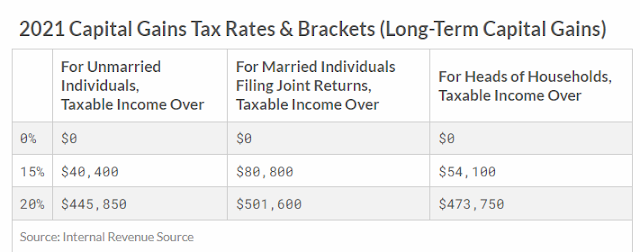
Did you know that if you were single, and your taxable income does not exceed $40,400 in 2021, you would owe zero dollars in Federal taxes on your qualified dividend income? If you were married, filing jointly, you won’t owe a dime in taxes on qualified dividends at the Federal level as long as your taxable income does not exceed $80,800 in 2021.

This means that if you are single, living on your own, and only claiming yourself as a dependent, you can essentially make $52,950 in annual qualified dividend income, and pay zero taxes on that. This includes the Standard Deduction of $12,550. This calculation also assumes you have no other sources of income and no other deductions for the sake of simplicity and to illustrate the point. In order for you to generate so much in income, your portfolio would likely be worth around $1.765 million at a dividend yields of 3%. If you made your selections wisely, your dividend income should at least keep up with inflation over time. With most dividend growth stocks, I expect a 5% - 6% annual dividend increase in the long run, ahead of the long-term annual inflation rate of 3%.

This net dividend income for the single individual above is equivalent to $65,298 in salary earnings. In other words, if you are single, it would take you to earn $65,298 from a day job in order to end up with the same amount of net income that the same individual can achieve with “only” $52,950 in qualified dividend income. And you were wondering why Warren Buffett’s secretary is so vocal about her bosses taxes.

Let’s see how this translates for a married couple, filing jointly, without any kids, mortgages and student loans. They could essentially earn $105,900 in annual qualified dividend income, before owing a single cent to the Federal government in 2021. This includes the standard deductions of $25,100 added to the $80,800 maximum threshold for married couples. In order for this couple to generate so much in income, their dividend growth portfolio would likely be worth around $3.523 million at yields of 3%.

This net dividend income for the married individuals above is equivalent to $130,597 in salary earnings. In other words, if you are married with no children, it would take the couple to earn $130,597 from a day job in order to end up with the same amount of net income they can achieve with “only” $105,900 in qualified dividend income.


For the sake of simplicity, and to illustrate a point about the tax efficiency of dividends, I have compared salary only income versus dividend only income. The tax code is so complicated, that it would probably take me years and hundreds of pages before I can explain every single possible scenario affecting those sample single and married individuals.

I claim that the dividend income is the most efficient form of income in the US, because it can increase over time to compensate for inflation. With municipal bonds, you do not pay any income tax, no matter how much you make. However, since your income is fixed, your “real” purchasing power is decreasing over time. As a result, you are worse off than with dividend stocks over extended periods of time.

Some readers may be more fortunate than others, and wonder about the taxation of qualified dividends and long-term capital gains above $105,900/year for a married couple filing jointly.

I found the following table, which shows the income levels for various brackets, and how much taxes will be owed on that income.


This means that for a single filer, qualified dividend income up to $458,400 ($445,850 plus 12,550 standard deduction) will be taxed at only 15%. For the married filing jointly couple, qualified dividend income up to $526,700 ($501,600 plus $25,100 standard deduction) will be taxed at only 15%.

If the modified adjusted gross income exceeds $200,000 ($250,000 if married filing jointly), the 3.8% net investment income tax still applies.

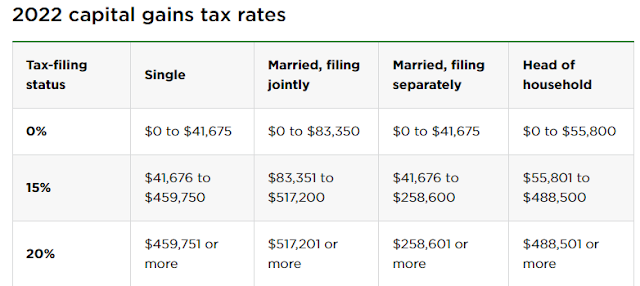
You can view the updated table for 2022 here:

The standard deduction for single payers rose to $12,950, while the standard deduction for married, filing jointly rose to $25,900.

This means that a married couple that is earning up to $109,250 in annual dividend income would pay zero in Federal Income taxes. That's a pretty sweet deal in my opinion.


Long-term capital gains are taxed the same way as qualified dividends. In order to have your gain classified as long-term capital gain, you should have held the asset that you sold for a profit for at least one calendar year. If you held for less than one year, your income will be treated as an ordinary gain, subject to your marginal tax rate.

I should also mention that ordinary dividend income is taxed like ordinary income. Luckily, this type of dividends are not taxed at the FICA level. One example of ordinary dividend income includes the income sent your way by Real Estate Investment trusts, net of any depreciation for example. Each REIT has a different tax picture, which also varies every year. I didn’t include these into my scenario above, because I didn’t want to overly complicate something that was already complicated. But feel free to play it out safely at home. If you do not believe me, you can check the website of National Retail Properties (NNN) at this link.

Under the new tax law, REIT investors to deduct 20% of the income, with the remainder of the income taxed at the filer’s marginal rate. It is available even if the taxpayer doesn’t itemize deductions.

Shareholders of REITs who now pay the top income-tax rate of 37% on dividends received would see that rate drop to 29.6%, according to NAREIT, formerly the National Association of Real Estate Investment Trusts.

I purposefully also avoided included MLP distributions, because these are even hairier at tax time. These distributions might not even be taxable to you as long as your cost basis is above zero.

Foreign dividends are another type of income which is taxed usually as qualified dividends. The twist is that some governments withhold the tax at the source, which entitles you to a credit. Therefore, if you paid $15 in dividend taxes to Canada on your $100 dividend check from Canadian National Railway (CNI), you don’t also have to pay Uncle Sam $15 additional dollars in dividend income. You can essentially get a credit for this. If you are single earning under $46,250 in dividend income, you might even get a check in the mail for $15.


Full Disclosure: I am not a tax advisor, and this article should not be considered as individual tax advice. Please discuss your individual tax situation with a licensed CPA. I have no position in the companies listed above.

Relevant Articles:

Best International Dividend Stocks
My Retirement Strategy for Tax-Free Income
How to Retire Early With Tax-Advantaged Accounts
Six Dividend Paying Stocks I Purchased for my IRA
Should income investors worry about higher dividend taxes?

Thursday, July 30, 2020

What if taxes increase?

When I invest in a taxable account, I have to pay taxes on any ordinary and qualified dividends I receive over the course of an year. While I am a buy and hold investor, I also have the occasional capital gain or loss. Naturally, I expect to receive a net capital gain when companies get acquired or perhaps a smaller gain when they cut dividends.

Taxes reduce the amount I can re-invest back into my portfolio. I view these investment taxes as waste in the accumulation process.

I made the capital for my investments through labor. I pay taxes on the income I generate through employment, which further reduces the amounts I can invest every month.

As part of my investment plan, I try to prioritize investing through tax-deferred accounts first, before adding to taxable accounts.

I do this in order to minimize the tax bite on dividends and capital gains in the accumulation phase, which can amount to a substantial amount. I also do this in an effort to reduce the amount of taxes I pay upfront, and compound my dividend income and capital without tax waste for decades down the road.

When I reduce the amount of taxes I pay today, I have more money to invest. I achieve that due to the tax breaks I have up-front from some accounts such as regular 401 (k), H SA and SEP IRA. I also have more money to invest, since a larger portion of my investment income is now in tax-sheltered accounts. For regular IRA/401 (k) accounts tax may either be due at some point in 30 – 40 years. For others like my Roth IRA/Roth 401(k), I will never have to pay tax on the distributions.
You can read a brief overview of each account in this article. You may also find it helpful to read about ways to withdraw from retirement accounts prior to the age of 59 1/2.

I have discussed previously how utilizing tax-deferred accounts correctly can result in higher dividend incomes for the same levels of effort. This simple change can shorten your financial independence journey by shaving off years of extra effort toiling away at a thankless job for no other benefit than to pay more taxes. If you enjoy working, tax advantaged accounts help shelter a ton in taxes in the accumulation process, when you are in a higher tax bracket than when you retire.

I view investing through tax-deferred accounts as a natural hedge against rising rates on income.
When you are investing in a taxable account, you have to pay the going tax rate on dividends and capital gains. You will likely have to pay money every single year. Under the current administration it is possible to avoid paying taxes if you earn $100,000 in qualified dividend income and have no other income source. However, it would take you many years of paying a lot in taxes on income and investments before reaching this goal. Naturally, you will be having less dollars working for you, since you will be paying the tax man every year.

If you invest through a tax-deferred account, you get to defer paying taxes on dividends and capital gains. Roth IRA’s are funded with after-tax dollars, but you will not have to pay taxes on withdrawals. This means that you paid your Federal and State taxes first, and then used that after-tax money to start your Roth IRA. This concept is the same for Roth IRA, Roth 401 (K) accounts as well, even if their contribution limits vary. Typically, you can withdraw contributions after 5 years, but you can only withdraw gains penalty-free after the age of 59 ½. There are required minimum distributions for Roth 401 (k) accounts at the age of 72, but not for Roth IRA accounts. Withdrawals are not taxable. In order to avoid required minimum distributions on Roth 401 (k) accounts, an investor can simply rollover that Roth 401 (k) into a Roth IRA. There may be other considerations involved, like asset protection, so it may make sense to speak to a tax professional first.

Regular IRA’s are funded with before-tax dollars, meaning that you get to avoid paying a tax at the Federal and State level when you contribute to these accounts. The concept is the same for Regular/SEP IRA’s, Regular 401 (k)/457b/403(a) plans, even if the contribution limits for each account varies. As a result of this tax hack, you get more money to invest today, since you are reducing your taxable amount due to your retirement plan contribution. When you withdraw principal and earnings from the account, they are all taxable at your ordinary income tax rate. It is not a problem for most folks however, since people tend to be at higher tax brackets when they work, and in lower tax brackets when they retire.

Other benefits of before-tax accounts include reducing your taxable income, which may potentially qualify you for different credits or benefits such as ACA credits. If maxing out your 401 (k) put you in a lower taxable income, and you became eligible for the 2020 economic relief payments, that was an ROI that was unexpected, but still a plus for maxing out your retirement contributions.

The government does want you to start taking money out of these retirement accounts by the time you are 72, because they want you to start paying taxes and not just defer paying forever. There are ways to avoid taking distributions however. My popular one is that if you are still working at a company that you own no more than 5% in, your 401 (k) at this company does not need to start required minimum distributions. I am sure that there are other loopholes to defer distributions from an IRA or 401 (k), but you would likely have to hire an expensive CPA for it.

The nice thing about retirement accounts is that you get to defer or avoid paying taxes in the crucial accumulation phase. This may also simplify your life if you actively manage your investments too.
As I mentioned above, when people work, they are usually in a higher tax bracket than when they retire.

As a result, putting money in regular IRA/401 (k) accounts is better than using the Roth option, due to this tax arbitrage nature of things. The risk you face with regular accounts is that the tax rates will be much higher when you withdraw the money, even if you are in a lower tax bracket.

With Roth accounts, you are essentially locking in the money at your going tax rate. If you end up moving up in your career, you would likely be better off starting with a Roth and then evaluating if a Regular IRA is better for you. The risk you take with Roth IRA’s is that tax rates would go lower by the time you retire, which means that you would have ended up with less money than ideal.
I believe that contributing to Roth IRA’s or Roth 401 (k) is best if you are a in lower tax bracket today, and effectively want to lock that rate in. Another reason for contributing to a Roth over a Regular account is if you cannot contribute to a regular IRA.

I recently shared my ideas with investors, and received some interesting pushback. It looked like some investors prefer taxable accounts to retirement accounts, because they are afraid that tax rates in 20 – 30 – 40 years will be much higher than they are today.

Naturally, no one knows where tax rates will be in the next 30 – 40 years. However, we do know that in general, most folks will be in lower tax brackets in retirement, in comparison to the tax brackets they had when they were working. It is all a moving target of course, since the lowest tax rate in 40 years may turn out to be higher than the highest tax bracket we have today. It could also be that the highest tax rate in 40 years will be about the same as the lowest rate we have today.

I decided to run some scenario analyses, in order to compare and contrast different outcomes. You can download this spreadsheet that includes the calculations behind each scenario.

The first scenario looks at an investor who is in the 22% Federal Tax Bracket today, and is in the 5% State Tax Bracket. The tax on qualified dividends is 15%, and they also owe their friendly state another 5% on dividends. We are going to assume that this investor will generate a total return of 7%/year –5% for capital gains and 2% for dividends. Our investor will save $1,000 in 2020, and have the option of doing a regular taxable account or a regular IRA account. We would assume that our investor would be withdrawing ALL the money in 2060 at the prevailing tax rates. My assumptions are that Federal tax rates in 2060 will be at 40%, the state tax rates will be at 5%, and qualified dividends will be taxed at 15% at the Federal and 5% at the State Level. This is an unfair comparison to tax-deferred accounts, because it assumes that the tax rates on ordinary income double, while taxes on investment income stay flat. We are also deferring at a pretty reasonable tax rate today, but that rate is average. The numbers would look differently for a highly paid physician, lawyer or executive.
It looks like in 2060, the taxable account ends up being worth 12,891.05. After selling all stock, and paying taxes on gains (15% + 5% = 20%), we are left with 10,512.84.

The IRA account is worth 20,512.96 by 2060. If we withdraw the money at once, we pay 40% to the Federal Government and 5% to the state government, and we are left with 11,282.13. The Federal Tax rate would have had to increase to 43.50% for the after-tax return on traditional IRA to be on par with the taxable account.

The reason for the difference is because the taxable account pays taxes on dividends each year, which results in a net return of 6.60%/year, versus 7%/year for the tax-deferred account. This difference would have been more pronounced if dividend yields were higher than 2% too. In addition, by contributing to an IRA in the accumulation phase, we save $369.86 on taxes, which are then plowed back into that IRA.

I had to double check the amount saved on taxes and make sure it makes sense. If we have hit the limits on how much we can put in a tax-deductible IRA, the savings are simply the tax rate times the amount contributed. So the amount saved would be $270 invested in a taxable account.
Because the IRA limits are much higher than $1,000/year, we have at least $5,000 in extra room to contribute. And if you view the traditional 401 (k) as a form of traditional IRA, we have an additional $19,000 to contribute to.

When you receive a tax deduction to contribute to an IRA, and you have extra room left to contribute, you can compound those tax advantages in a way.

That’s because if we just contributed an extra $270 to the IRA from the savings on the $1,000 contribution, we would also generate tax savings on the $270. That’s 72.90 in savings on the $270 extra that we were able to contribute to the IRA, because of tax savings in the first place.
That 72.90 in additional tax savings open up room for 19.68 in additional tax savings… And so on, until we are left with a total savings of $369.86 merely because we contributed to an IRA that is tax-deductible.

Either way, the upfront tax savings, and the deferral of investment gains for 40 years definitely help the traditional IRA investor over the taxable one.

If we had simply placed the money in a Roth IRA however, we would have not generated any upfront tax savings. However, we would have compounded the money at 7% per year, and we would have $14,974.46. Since there are no taxes on withdrawals, we have 14,974.46 to withdraw.

It looks like under this scenario, the Roth IRA beats the traditional IRA and the taxable account on an after-tax return basis. On a gross return basis in 2060, the IRA beats the Roth and taxable accounts.
The increase in taxes definitely makes the traditional IRA a worse option than the Roth in this scenario.

If you could pay less than 27% in taxes on the Traditional IRA distributions, you would have done better than the Roth. That would require forecasting future tax rates, but also knowing the intricacies of the tax code. If it comes down to moving from a state with income tax to a state with no income tax, this may be worth it. Again, a good CPA may be able to find a way to help you keep a larger portion of your wealth. And they may be able to help in planning along the way.

In a real-time scenario however it may be possible to withdraw money strategically, by increasing distributions before taxes rise and reducing them when they are higher. But tackling every individual scenario is beyond the scope of this blog post. You should feel inspired or bored out of your mind so that you think about your tax planning situation, and perhaps even hire a friendly CPA/tax accountant to help you plan ahead and devise a plan to minimize taxes and maximize wealth.

If you could pay less than 27% in taxes on the Traditional IRA distributions, you would have done better than the Roth. That would require forecasting future tax rates, but also knowing the intricacies of the tax code. If it comes down to moving from a state with income tax to a state with no income tax, this may be worth it. Again, a good CPA may be able to find a way to help you keep a larger portion of your wealth from the hands of the tax man.

The second scenario will look at the same inputs as the first one. The difference will be that taxes on dividends will rise to 20% at the Federal Level in 2021 but stay at 5% at the State Level. Taxes on Federal Level will be at 40% and at State Level 5% in 2060. The return assumptions are the same.
It looks like in 2060, the taxable account ends up being worth $12,416.07. After selling all stock, and paying taxes on gains (15% + 5% = 20%), we are left with 9,562.06. We end up compounding money at 6.50%/year, due to higher taxes on dividend income in the accumulation phase.

The IRA account is worth 20,512.96 by 2060. If we withdraw the money at once, we pay 40% to the Federal Government and 5% to the state government, and we are left with 11,282.13. The Federal Tax rate would have had to increase to 48.50% for the after-tax return on traditional IRA to be on par with the taxable account.

The Roth IRA ends up with $14,974.46 to withdraw tax free. It is a clear winner, unless you managed to find a way to obtain the distributions from a Traditional IRA while paying less in taxes. If you could pay less than 27% in taxes on the Traditional IRA distributions, you would have done better than the Roth. That would require forecasting future tax rates, but also knowing the intricacies of the tax code. If it comes down to moving from a state with income tax to a state with no income tax, this may be worth it. Again, a good CPA may be able to find a way to help you keep a larger portion of your wealth.

The third scenario looks at a situation where tax rates are unchanged for 40 years. This means that we get to withdraw the money at the same rates used when we put money in.

It looks like in 2060, the taxable account ends up being worth 12,891.05. After selling all stock, and paying taxes on gains ( 15% + 5% = 20%), we are left with 10,512.84.

The IRA account is worth 20,512.96 by 2060. If we withdraw the money at once, we pay 22% to the Federal Government and 5% to the state government, and we are left with 14,974.46. The after-tax return on the traditional IRA matches that of the Roth IRA in this example.

The fourth scenario looks at a situation where tax rates are lower in 40 years. The rates at which we would be contributing stay the same ( 22% Federal, 5% state, 15% dividends), but the rates at which we withdraw money will be reduced ( 12% Federal, 0% state, 0% dividends).

At this level, the rates of return for taxable and Roth and Regular IRA are at 7%/year. We end up at the same level of worth for the taxable and Roth IRA’s - $14,974.46.

For the Traditional IRA, we end up with 20,512.96 pre-tax. After we withdraw the funds, and pay the 12% tax rate, we are left with $18,051.40.

After reading through these examples, it may seem to you that I am a little biased towards the traditional IRA/ 401 (k). It is likely the case, or perhaps it is wishful thinking on my part that building a higher net worth in a traditional IRA is better from a pure numbers perspective, because it gives you a higher base to work with. It is easier in relative terms to have $1 million in an IRA, and have to worry about paying $200K - $400k in taxes on it, than to have $600K in a taxable account. You will likely find a solution on how to minimize the tax bite on the traditional, and find ways to tap the money in a tax-efficient way too.

In my personal situation, my assets are diversified across traditional 401K and IRA and Roth IRA /Roth 401 (k) accounts. I also have a taxable account. Since there are limitation on how much I can contribute, I maximize everything I am eligible for today. I see various scenarios playing out, so I will do differently under each. My withdrawals will be optimized to the situation at the time of withdrawals.

I try to maximize the traditional 401 (k) and IRA’s first, because I believe that I will be in a lower tax bracket than today when I withdraw these funds. This may be because my income is lower, because taxes are lower or because I may have also moved to a state that doesn’t tax income. Or perhaps a combination of all of the above. I would put H S A in this category as well. I am not going to calculate the effect of using H S A versus other accounts, because it affects social security contributions and income. I am not an actuary so I won’t go there today. You have already been bored sufficiently on this tax tirade.

I then try to max out any Roth amounts. If there is anything left over, I place it in a taxable account.
I would prefer tax-deferred compounding to compounding in taxable accounts.

My goal is to keep building, because I enjoy building my portfolios. I will probably defer withdrawing funds for as long as possible and just live off any active income I generate in the process (and trying to save and invest any remaining amounts too).

Right now, I won’t have to withdraw until the age of 72. I will consider converting regular 401 (k) dollars into Roth 401 (k) or Roth IRA if I ever find myself in the lowest tax brackets along the way.

As you can see, there are various scenarios when it comes to tax-deferred accounts. And we are assuming a typical 40 year career. Imagine how much more complicated the situation gets if we were looking for an early retirement, where we have to withdraw money in our 30s or 40s.

I actually discussed that in a way in a previous post. But the short summary is that you can withdraw Roth IRA/Roth 401 (k) contributions after 5 years. You can withdraw earnings after the age of 59 ½ without penalty.

For Regular IRA/401 (k) plans, the withdrawal options are very different. If you convert a 401 (k) into a Roth, you will pay taxes on the proceeds, but then you can withdraw that money in 5 years tax free. This makes sense if your rate in retirement is lower than the rate at which you were accumulating capital. You also have the 72 t option, which is the Substantially Equal Periodic Payments option, which allows you to withdraw money from retirement accounts according to a longevity formula. You have to do it every year. Finally, for 401 (k) accounts, you can start withdrawals from the 401 (k) account at the company you worked at, if you leave at or after the age of 55.

Today, we looked at a few different scenarios for contributing money to taxable and tax-deferred accounts. We also looked at how those scenarios play out when we change our assumptions just a little bit. I encourage you all to play around with the spreadsheet assumptions, and test various outcomes. I would also encourage all of you to think more about tax planning.

We also revisited various retirement account types in brief, and also discussed ways to withdraw from them early.

We should remember that life is not linear, and we will have occasional bumps on the road. These may be blessings in disguise. For example, a person who is laid off a couple of years before they plan to retire may be able to convert old IRA's into Roth by paying a minimum amount in taxes. Alternatively, a younger person may also be able to Rothify their 401 (k) accounts if they take an year off for graduate school for example, after a few years of working.

There are avarious possiblities and outcomes to think through. This is why I believe that it is important as investors to think through various scenarios, and learn at least a basic understanding of the tax code. That may pay real dividends down the road.

That being said, if you are afraid of taxes rising in the future, hedging that bet by maxing out retirement accounts may be a good start. Investing in a taxable account is an inefficient way to build wealth, particularly in the accumulation phase for dividend investors.

Thank you for reading!

Relevant Articles:

Taxable versus Tax-Deferred Accounts for Dividend Investing
How to buy dividend paying stocks at a 25% discount
How early retirees can withdraw money from tax-deferred accounts such as 401 (k), IRA & HSA
How to Grow Dividend Income Much Faster With Tax Advantaged Accounts

Friday, December 2, 2016

The best asset class to hold in retirement accounts

Regular readers know that I have assets held in taxable and non-taxable accounts.

Taxable account provide me with more flexibility in the range of investments I can select, and ease of accessing my money at a moments notice. However, I have to pay taxes on dividends and realized capital gains.

Non-taxable accounts ( also referred to as tax-deferred or retirement accounts) allow me to defer paying taxes on investments I have made. These retirement accounts come in all shapes and forms, but generally they allow me to defer paying taxes anywhere from a few decades to indefinitely. Taking money out of them is generally more difficult. It is not impossible however, and worth it, if you are willing to do some planning that will shave years off your journey towards financial independence. This is also not an issue for me, because I am a long-term investor and my investment money is not going to all be needed in a lump sum right away.

I have started to ask myself how to optimize my portfolio better. Deciding which assets belong in taxable accounts, and which belong in retirement accounts is one decision that would help me achieve a more optimized result (translation: more money). I want to make sure I am making the best long term asset placement for my portfolio.

Friday, October 21, 2016

How to Grow Dividend Income Much Faster With Tax Advantaged Accounts

When I was doing my taxes for 2012, I realized that tax expenses were larger than my living expenses. I realized that in order to correct this, I need to legally minimize as much of taxes today as possible. I achieved that by maxing out all tax deferred accounts within my reach.

Since my epiphany in 2013 on the benefits of tax-deferred accounts, I have plowed most of my dollars into my 401 (k), Heatlh Savings Account (HSA), Roth IRA and SEP IRAs. I have noticed that since those moves, my dividend income and net worth increased much faster than before. This was not simply due to the bull market we experienced. It was because I just dutifully put money to work every two weeks or so, and let it sit there without touching it. In addition, the tax incentives really increased my net dividend income, and the amount I have to reinvest back.

For example, assume that all I can invest is $21,000/year. If I invested that in dividend stocks yielding 3%, I would generate $630 in annual dividend income. The types of dividend growth stocks that could make up this portfolio could include the likes of:

Wednesday, June 29, 2016

Consolidating assets into my 401 (k)

Many of you are aware that I have been a big fan of tax-deferred investing over the past three – four years. After my awakening moment in late 2012/early 2013, I have been maxing out any tax-deferred account I could get my hands on. This includes my 401k, Roth IRA, SEP IRA and Health Savings Account (H S A). These moves have allowed me to:

1) Obtain substantial tax benefits upfront, allowing me to essentially purchase more stock for the same amount of money I would have invested through taxable accounts
2) The ability to compound capital tax-free for decades into the future
3) The ability to manage taxes in a way where tax expense is minimized when I do access that money
4) Obtain an employer match on funds contributed to a 401 (k) plan.

I have bought funds in my 401 (k) and HSA plans, and individual dividend stocks in my IRA, SEP IRA, Roth IRA accounts. As I max out those tax-deferred vehicles, I end up saving my whole salary, and essentially live off my dividend income and side income I generate. As a result, my tax deferred savings as a percentage of investable assets are increasing, and will be increasing over time.

Wednesday, March 23, 2016

How to Earn $95,000 in Qualified Dividend Income, and pay no taxes

There are two certainties in life – death and taxes. Every April, we have to file a tax return with the Federal government and pay our taxes due. Whenever I do my tax return, I always come up with the same conclusion: The US tax code is set up in a way, that it encourages investing, and discourages working for money.

For example, qualified dividends are taxed at an effective rate of zero percent for those individuals who are in the 15% tax bracket. The 2015 tax brackets for a couple that is married and filling jointly is posted below (Source: IRS.com):

Taxable Income
Tax Rate
$0 to $18,450
10%
$18,451 to $74,900
$1,845.00 plus 15% of the amount over $18,450
$74,901 to $151,200
$10,312.50 plus 25% of the amount over $74,900
$151,201 to $230,450
$29,387.50 plus 28% of the amount over $151,200
$230,451 to $411,500
$51,577.50 plus 33% of the amount over $230,450
$411,501 to $464,850
$111,324.00 plus 35% of the amount over $411,500
$464,851 or more
$129,996.50 plus 39.6% of the amount over $464,850

This is the 2015 tax bracket for a single individual (Source: IRS.com):

Monday, January 11, 2016

Living off dividends in 2016 – My New Goal

I posted my goals for 2016 a few weeks ago. After some changes that I became aware of subsequent to posting the article, I have some changes.  I have had some change in plans about my goals for 2016. I have decided to essentially live off dividends in 2016. I will be spending my dividend income that comes from my taxable accounts. My annual expenses are close to $18,000 – 24,000/year. My taxable dividends are approximately $10,000 - $11,000/year ( out of $14,000 - $15,000 in total dividend income). The shortfall could be covered by any side income activities I engage in.

I have decided to try and save my entire paycheck in 2016, after taxes of course. I will manage to do that by taking the maximum contributions to my 401 (k) and Health Savings Account (H S A) plans. After speaking with several reps at my 401 (k) administrator, I learned that I can make after-tax contributions, which can be converted to Roth. I already plan to max-out my 401 (k) with pre-tax money, which provides me with an instant tax break. I also receive an even larger tax break in my investment through my Health Savings Account. Any after-tax money I manage to put away will be converted to Roth on a few occasions throughout the year. This means that under current legislation, any earnings derived from that money will never be taxable. I would not be opposed if a larger portion of my net worth is held through tax-deferred assets, and therefore any dividends and capital gains would be deferred.

Monday, November 2, 2015

How early retirees can withdraw money from tax-deferred accounts such as 401 (k), IRA & HSA

One of the biggest mistakes I ever made was not maxing out my 401 (k), IRA and HSA accounts between 2007 and 2012. As a result, I ended up paying tens of thousands of dollars in income taxes and taxes on capital gains and dividends. Those are tens of thousands of dollars in taxes that could have built up my networth and passive dividend income. Instead I ended up handing those over to the IRS and my state. The opportunity cost of these money is in the hundreds of thousands if not the millions over the next 30 - 40 - 50 years.

The reason why I never maxed those out is because I didn’t know a lot about them. I also prided myself with my success that I was paying a lot in taxes. When I was doing my 2012 tax return however, I was sick that my total tax liability exceeded the amount I paid on housing and food. In fact, the amount I paid in taxes was equivalent to what I can live on in retirement. I saw that a fellow blogger from the site Budgets Are Sexy had written about maxing out his SEP IRA and Roth IRA’s, thus saving tens of thousands of dollars in taxes just for one year. So I opened a SEP IRA and maxed it out, saving 30 cents in taxes from every dollar I contributed to. Here was I researching companies, competitive advantages, earnings and valuations, yet I had overlooked the simple power of tax-deferral and tax-deferred compounding of capital. As I kept researching, I I found the sites of Mad Fientist and Go Curry Cracker, which opened my eyes on the benefits of tax deferred accounts. These investors had managed to retire early by taking advantage of the tax code, and then were paying zero dollars in taxes during their early retirement. Another one I thoroughly enjoy is Justin from Root of Good, who retired at the tender age of 33 and paid pretty much zero in taxes.

My biggest misconception was the fact that I thought that the money is locked until the age of 59 and a half years, and that I cannot touch the money. This was wrong. I also see this misconception has deep roots in many dividend investors I have talked to. These investors mistakenly believe that you cannot withdraw money from retirement accounts when you are aiming for early retirement in your 30s or 40s or 50s. As a result of this misconception, these dividend investors will end up hundreds of thousands of dollars poorer over their lifetimes. This is the reason why I am writing this article. Ever since I had my awakening moment in 2013, I have tried to educate investors. I have been unsuccessful for some, but I will continue fighting.


Monday, August 17, 2015

Tax Loss Harvesting for Dividend Investors

As an investor my goal is to attain financial independence using my dividend growth strategy. As a dividend investor, my goal is to generate enough dividend income to pay for my expenses in retirement.

In order to achieve this goal, I have spent several years selecting quality dividend paying stocks. However, as I gain more knowledge, I also try to pick new tricks that would help me on my journey.

One of those tricks is tax-loss harvesting. Tax loss harvesting is selling securities at a loss in order to offset a capital gains tax liability. Tax loss harvesting is typically used to limit the recognition of short-term capital gains, which are normally taxed at higher federal income tax rates than long-term capital gains.

The benefit of tax-loss harvesting is that I will reduce my taxable income, which will reduce taxes I pay and results in more money available for me to allocate.

A taxpayer can use that loss to offset against other short-term or long-term capital gains. If there are no capital gains however for the year, then the taxpayer can reduce their income by $3,000 at most of a given year. If their capital loss exceeds $3,000, they can use it on future gains they incurred. If that taxpayer never earns another dime in capital gains, they can go on to reduce their income by $3,000/year, until their capital loss is exhausted. Depending on your marginal tax rates, triggering this $3,000 loss could result in a substantial tax benefit. I am in the 25% tax bracket, which means that $1,000 in capital losses translates into a reduction of my tax liability by $250. This of course assumes I earned no capital gains. However this is not a problem for me, since I am quick to book my losses, but I let my gains compound for years.

Wednesday, April 1, 2015

Taxable versus Tax-Deferred Accounts for Dividend Investing


Dividend investing is a great strategy for accumulating income producing securities, which pay their owners cash on a regular basis. These cash distributions are viewed as taxable incomes in the eyes of the Internal Revenue Service (IRS). Depending on the taxpayers adjusted gross income, they could end up paying as much as 20% on the dividends they received. Compared to the top marginal rates on ordinary income such as salaries or bond interest however, dividend income has much lower tax rates. In retirement, qualified dividend income will not be subject to federal taxes for married couples earning $95,000/year (assuming no other sources of income). Unfortunately, it would take the average dividend investor years of accumulating assets, before they reach their dividend crossover point. This will result in them paying taxes throughout their accumulation phase. Many investors have the choice to shelter some or most of their investments in tax-sheltered accounts which could either postpone or eliminate the need to pay taxes on their investment incomes. By reducing or eliminating tax waste in the accumulation phase, dividend investors could reach the dividend crossover point much sooner than by doing it with taxable accounts alone.

There are several tax deferred account options for US investors who are still earning a paycheck. These include regular and Roth IRA’s in addition to 401 (k) plans. Each of these accounts has its pros and cons.

Traditional IRA’s provide investors with a tax benefit today, and allow them to compound their gains for years to come but have to take required minimum distributions at the age of 70 ½ years. Distributions are taxed as ordinary income. However there are strict eligibility rules that do not allow high income households to get the deductibility of contributions. Other negatives include the low contribution limit of just $5,500/year. There is a catch-up contribution limit increase of $1,000 for persons who are above the age of 50. The largest negative includes a 10% early distributions penalty that the IRA imposes if someone withdraws funds prior to the age of 59 ½ years. However, you can pretty much invest in almost anything with your IRA.

Roth IRA’s do not provide any tax benefit to investors today, but allow for tax free compounding of capital and tax free distributions from the account at the age of 59 ½ years. Direct contributions can be withdrawn tax-free at any time, although investors need to wait until they are 59 ½ years old, before they can withdraw gains from the account without a penalty. Investors cannot put more than $5,500/year in a Roth IRA, and there are strict income eligibility requirements to open an account as well. There is a catch-up contribution limit increase of $1,000 for persons who are above the age of 50. Another advantage of a Roth IRA is that there are no required minimum distributions requirements. With my Roth IRA’s, I can pretty much purchase any US Dividend Growth Stock I choose, and I like this flexibility. Tax payers are taking a gamble with Roth IRA’s however, as cash strapped Congress could decide to tax distributions in the future. Of course, it is also likely that tax rates on qualified dividend income will increase before Congress doing anything about limiting or taxing Roth IRA's for middle-class consumers.

The 401 (k) plan is the company sponsored defined contribution plan, that millions of Americans are eligible for. The annual contribution limit is $18,000/year for those under the age of 50. If you are over the age of 50, you can contribute up to $24,000/year to your 401 (k). The majority of 401 (k) plans allow participants to put pre-tax contributions today, and enjoy tax-free compounding of capital. They do have required minimum distributions starting at the age of 70 1/2 years old. This is when you will have to pay ordinary income taxes on any money you withdraw from the 401 (k). An increasing number of employers are now also offering Roth 401 (k) contributions, with the same limits as the traditional 401 (k). The nice thing is that contributions are after-tax, the money compounds tax-free, and there are no taxes to pay on investment earnings. The drawback of most 401 (k) plans for many investors is the limitation on the types of investments to choose. A good 401 (k) plan will offer low cost mutual funds to investors. A really good 401 (k) plan will also offer a Brokerage Link window, that would allow investors to pick their own investments. A really bad 401 (k) plan will include high-fee mutual funds with sales loads. If the fund you are purchasing charges an annual management fee of 1%/year, chances are this is part of the offering of a bad 401 (k) plan.

One disadvantage of both accounts (IRA and 401 (k)) is that you cannot deduct investment losses, or offset them against investment gains. In addition, foreign dividends are subject to witholding taxes at the point of origin despite the fact that they are in a tax-sheltered account. Unlike taxable accounts, investors cannot get a tax credit for these foreign tax withholdings. Dividends in tax-sheltered accounts of US investors which are derived from Canadian or UK companies are not subject to tax withholdings.

Despite popular beliefs however, Master Limited Partnerships can be held in tax deferred accounts, as the UBTI which scares investors off is mostly a non-event ( and has been in my few years as an MLP investor, although things might change). In the years that I have owned ONEOK Partners (OKS) and Enterprise Product Partners (EPD), I have never had positive UBTI.

In addition, investors need to choose whether to open a Roth or a Traditional IRA with their $5,500 in a given year, but cannot open both. Investors can still have an IRA and a 401(k) plan however. Given the lack of investment options in 401 (k) plans, they are of limited value to the self-directed dividend growth investor. 401 (k) plans are helpful as a tool to minimize taxes and get the company match, and buy a few index funds, which is why they work for mostly passive investors. The nice thing about 401(k) plans that I utilized in 2013 is that if you quit your job, you can rollover the money into an IRA. After that, you can pretty much invest in anything you want, including creating your own dividend stock portfolio.

In my investing portfolio, I keep most of my holdings in taxable accounts.The taxable accounts give me a lot of flexibility in my investments, and I can add or withdraw as much as I want at a moment’s notice. I do pay taxes on my investment income, but I also get to do tax loss harvesting on my investments.

I expect that by the end of 2015, I would have approximately 10 - 15% in tax-deferred accounts such as 401 (k), IRA, Roth IRA, SEP IRA and Health Savings Accounts (HSA). This is mostly because I used to believe that there are too many restrictions on withdrawing principle and accumulated gains from these tax-advantaged accounts. As a result, I used to contribute only the bare minimum to my 401 (k) in order to get the company match.  As I researched further, I realized that it is possible to withdraw money out of an IRA before the age of 59 and a half penalty free. With Roth IRA's, contributions can be withdrawn penalty-free at almost any time. With 401 (k) plans, investors can start withdrawals penalty free if they have separated from service, and they are 55 years of age or older. Or, just like with IRA's, investors can use Substantially Equal Period Payments (SEPP) and withdraw money to live off at any age. The only catch is that if you start withdrawing money using SEPP, you need to continue doing it for the next 5 years or until you turn 59 1/2 years - whichever is longer.

The part I don't like about taxable accounts is that I was paying too much in taxes on salary and investment income. Taxes are the largest expense item on my personal income statement. Therefore, I have been maxing out all tax-deferred investment vehicles like crazy since early 2013 (luckily for some I was able to contribute for 2012 as well). I have saved tens of thousands of dollars in Federal and State taxes in the process. Prior to that epiphany, I had only contributed slightly more than the employer match I received. If I had to do it all over again, I would have been much smarter about the tax-efficiency of my investments. If my accumulation phase lasts for one decade, this means I would have to pay taxes on the money I want to invest in a taxable account, and then pay taxes on distributions I receive for that entire decade. It is little consolation that when I become FI, my dividend income will be tax-free. When you have too much waste in the accumulation phase of investing for retirement/FI, you end up with less money to invest, since you are paying so much in taxes.

My goal in retirement is to essentially live off dividends (qualified dividends) and pay no taxes in retirement. Using 2015 rates, a couple that is married and filing jointly will not pay any federal taxes if they earn less than $95,500 in qualified dividend income. This exercise assumes that the couple has no other source of income.

The couple will have a standard deduction of $12,600, and the personal exemptions will be $8000 ( $4000 per person), for a total of $20,600. In order to avoid paying taxes on qualified dividend income, the couple needs to make sure that they stay in the 15% marginal tax bracket. The highest income per that bracket for 2015 is $74,900. Therefore, adding $74,900 to $20,600 gets us up to $95,500.

My strategy for tax-free income is to live off qualified dividends and not pay any taxes in the process. However, I also expect to convert 401 (k) and IRA balances into Roth slowly. You can recall that I get a 25% - 30% deduction for putting money in 401 (k) and IRA today. My goal is to convert that amount in 401 (k) and IRA slowly into a Roth IRA when I retire, and to pay no taxes in the process.

How is that possible?

Let’s assume that a married couple files taxes jointly and has no other income than $74,000 in annual qualified dividends. This means they will pay no taxes on that qualified dividend income. However, if they rolled over $20,600 from an old 401 (k) into a Roth IRA, they will pay zero taxes on the conversion.

This is possible, because a 401 (k) to Roth IRA conversion creates ordinary taxable income. However, ordinary taxable income that is lower than the sum total of the standard deduction and personal exemptions creates a taxable liability of zero. The sum total of the standard deduction and personal exemptions for a married couple comes out to $20,600 for 2015. And of course, since the sum of the $20,600 IRA conversion and the $74,000 in qualified dividend income is less than $95,500, the total income stream will be tax-free at the Federal level.

Therefore, if the couple has a 401 (k) with $100,000 in it, they can expect to convert it into a Roth IRA within 5 years or so and pay no taxes in the process. This is a pretty sweet deal, because the couple likely received hefty tax breaks in saving the money into a 401 (k) in the first place. However, they converted it into a Roth IRA, which means that any future distributions from this Roth IRA will be tax-free. This is the type of deal where you get your cake and you eat it too, which is very appealing to the Dividend Growth Investor.

And to add another thing for you to think about, it is important to complete these 401 (k) to Roth IRA conversions before you start claiming Social Security benefits. This is because the addition of Social Security Benefits will increase ordinary taxable income, and could lead to paying some tax on the 401 (k)/IRA to Roth IRA conversion. In addition, it is really important that the conversion of a 401 (k)/IRA to Roth IRA occurs prior to the age of 70 and a half years, in order to avoid having to make required minimum distributions (RMD). Those Required Minimum Distributions from a 401 (k) or IRA are subject to ordinary income taxes. If you have already completed the conversion to a Roth IRA prior to the age of 70 and a half, you will not have to make required minimum distributions. This is why tax planning is so important - it can add more money for the investor, speed up the process of asset accumulation, and reduce tax expenses in retirement.

Full Disclosure: None

Relevant Articles:

How to Retire Early With Tax-Advantaged Accounts
My Retirement Strategy for Tax-Free Income
Dividends Provide a Tax-Efficient Form of Income
My Dividend Goals for 2015 and after
How to accumulate your nest egg

Tuesday, February 24, 2015

How to save over $60,000/year in a Roth IRA

Recent changes in tax laws have made it possible for some people in the US to potentially defer over $60,000/year in a Roth IRA. This is perfectly legal, but requires some research upfront in order to see if you qualify, and whether it makes sense to do it. I believe that this article will be relevant for only a portion of you, because this opportunity might not be available for everyone. This new opportunity includes maxing out a Roth 401 (k) for $24,000, maxing out after tax contributions for the remaining $35,000 (assuming no employer match), as well as maxing out a Roth IRA with $6,500. The article will try to explain how some people can save $60,000/year in a Roth IRA per year, and assumes they are over the age of 50, earn more than $60,000/year, and are able and willing to defer that much in a retirement account. Nothing in this article should be considered tax planning advise for you however - please remember to always speak with a Certified Public Accountant before making any tax planning decisions.

As someone in the accumulation phase of my dividend investing journey, I end up paying a lot in taxes. In previous posts, I have discussed the strategies I am implementing in order to shorten my time to financial independence. Qualified dividend income is very tax efficient. It is quite possible to earn $90,000 as a married couple filing jointly, and pay no taxes if you have no other form of income. However, in order to get to that point, you would have to pay steep taxes in the accumulation phase. A married couple whose taxable income exceeds $73,800 in 2014 would have to pay 15% on dividend income received. By paying expensive taxes on dividends today, you are essentially shortchanging your full potential. If you can somehow avoid paying taxes on dividend income and capital gains in the accumulation phase, you can potentially shave a few years of working. I don’t know about you, but it makes sense for me to avoid filing TPS reports for 2 – 3 extra years, if I have the option to not file them. Of course, if you enjoy coming in on Saturdays and Sundays, then chances are you won’t like this article.

Many investors I talk to have used Roth IRA’s to soak up as much in quality dividend paying stocks as possible. The Roth IRA allows them to withdraw contributions at any time, lets money compound tax-free forever, doesn’t have required minimum distribution requirements for the original contributors and its earnings are not taxable if withdrawn after the age of 59 ½ years. The main problem with the Roth IRA is that contributions are limited to $5,500/year for every person under the age of 50 who has employment income. If you are over the age of 50, you can defer $6,500/year. This is not a lot to make a serious dent for you however, especially if you are one of the big savers who dreams of early retirement on your own terms. To add insult to injury, workers who make too much money are not allowed to put money in a Roth IRA. Luckily, there is a backdoor solution, where you can make a non-deductible contribution to a regular IRA, and then rollover the money into a Roth IRA. This involves more paperwork, but achieves the result.

There is another way to contribute up to $18,000/year in a Roth 401 (k) account as an employee. The problem is that not every employer allows it, some 401 (k) plans have terrible investment options, and not many 401 (k) plans offer a brokerage window to select your own stocks. The nice thing however is that even higher earning employees can contribute to the Roth 401 (k). If you are older than 50, you can take advantage of the catch-up contributions which are $6000 extra.

Some 401 (k) plans allow employees to make after-tax contributions to their 401 (k) plan. This is different than after-tax Roth 401 (k) contributions. The contributions I am talking about today are called after-tax contributions. Some 401 (k) plans allow their participants to contribute money after-tax. Up until now, it didn’t make sense to put after-tax contributions to a 401 (k). However recent changes made it potentially profitable.

One thing you might want to know is that the amount you can defer in your 401 (k) is limited to $53,000/year for those under 50 and $59,000/year for those over 50. This includes not only your employee contribution of $18,000/$24,000/year, but also the employer match. Anything left over could be put in a 401 (k) amount as an after-tax amount. If you make $80,000/year, and your employer matched 4% of your pay, that is a neat $3,200. Employer matching contributions are always pre-tax however. Either way, an employee under the age of 50, who earns $80,000/year, gets a 4% match and maxes out their 401 (k) with $18,000, can potentially get $21,200 deferred in their 401 (k). They can then contribute up to $31,800 in an after-tax 401(k). This is calculated as the difference from the limit of $53K, minus the $18K in annual contribution, minus the $3,200 matched by the employer. For someone over the age of 50, they can contribute $37,800 more, due to the $6000 catch-up contribution.

The other hurdle that you want to check is whether the 401 (k) plan allows you to either transfer those after-tax contributions to a Roth IRA account, or if it allows you to do a Roth conversion within the 401 (k) account. If your plan allows you to make after-tax contributions, but does not allow you to convert those immediately into a Roth IRA or Roth 401 (k), then the information in this article might not be worth it for you. This is because if your after-tax contributions are left in a regular 401 (k), any gains are treated like ordinary income upon distribution. Since you don’t want to pay ordinary taxes on investment income, it made no sense to use after-tax contributions before. However, under current legislation, when you quit your job, you can transfer the after-tax contributions to a 401 (k) into a Roth IRA. The gains from those money will be transferred to a regular IRA.

If you want to avoid this, you have to convert the after-tax money to a Roth IRA/Roth 401 (k) right away. That way, all gains from those contributions are Rothified and you will never have to pay income taxes on them under current tax laws.

However, if you are about to retire from your job within 2 - 3 years, it might still make sense to do the after-tax contributions in a 401 (k), since you are less likely to have earned significant returns over that short period of time (unless you are Warren Buffett, in which case thank you for reading my humble site). But everyone's situation is different, which is why the goal of my article is to tell you there is an opportunity to potentially put $60,000/year in a Roth IRA, and for you to start your research, in order to determine if this move is right for your financial situation.

So to summarize, it is possible for someone over the age of 50 to potentially contribute over $60,000/year in a Roth account. To do this, they need to max out their Roth 401 (k) account with $18,000/year. Then they need to max out their after-tax 401 (k) account with the difference between $59,000 contribution limit, minus the $18,000 Roth 401 (k) contribution, and the employer match. Those after-tax funds would then have to be immediately Rothified either by converting them to a Roth inside the 401 (k) account or by taking an in-service distribution from the 401 (k) account on the after-tax dollars into a Roth IRA. In addition, you can also contribute to the regular Roth IRA up to $6,500/year.

Unfortunately, not all company 401 (k) plans offer the option to make after-tax contributions, and from those that do, not all allow employees to transfer those contributions into a Roth IRA or a Roth 401 (k) while they are still employed by the company. However, contacting your HR department with a request to make the option for an In-Plan Roth Conversion available, might do the trick for you. If they allow it, great. If not, there might be other companies available that offer this for highly sought out employees like you.

The other thing to consider with this tax break is the fact that it could be subject to changes. So if you are able to, it might make sense to research this as soon as possible. Otherwise, it might not be even relevant if you read the article some time in 2016.

Full Disclosure: Initially I though I was unable to perform this feature, since my HR department doesn't allow for In-Roth Conversions on after-tax accounts. After talking to several people however, I realized they DO allow it.

As always, please discuss your tax situation with a CPA, before making any moves.

Relevant Articles:

Dividends Provide a Tax-Efficient Form of Income
My Retirement Strategy for Tax-Free Income
Health Savings Account (HSA) for Dividend Investors
Roth IRA’s for Dividend Investors

Popular Posts