Monday, August 14, 2023

Four Dividend Growth Stocks Rewarding Shareholders With Raises Last Week

I review the list of dividend increases as part of my monitoring process. I use this exercise to review existing holdings, and also to potentially identify companies for further research.

The dividend increase provides helpful information about the business from management's point of view. That's because management teams determine the rate of the increase after evaluating the business needs, the economic environment and the business competitive landscape. In a way, a dividend increase is a very good gauge of management expectations for how the business will perform in the near term.

For example, if a business starts growing dividends at a slower pace than usual, or it starts growing dividends at a nominal pace, that's a potential warning sign for further investigation. It doesn't mean that the business cannot recover soon; it merely shows that something is going on to cause this deceleration. 

It's helpful to review dividend increases relative to past dividend increases. It's also helpful to do that relative to the payout ratio and the trend in the payout ratio over the past decade. Last but not least, you need to review the rate of dividend growth to the trend in earnings per share as well.

I am not the only one who thinks this way and appreciates the signaling that dividend increase announcements present. Nick Train, who is the portfolio manager behind Lindsell Train shares these sentiments as well (source):

There is the noise accompanying the results from public companies, with analysts and investors poring over the numbers and CEO statements looking for an interpretative edge. Cutting through that noise, I sometimes think it is easiest to simply look at the dividend announcement by the company. To us the increase, maintain or cut decision taken by a board of directors about its current dividend captures an enormous amount of information about mid-term prospects. Below I note the six dividend announcements from our reporting companies – in order of position size in the Portfolio.

Over the past week, there were several companies that managed to increase dividends, AND also having at least a ten year track record of annual dividend increases. The companies include:


Broadridge Financial Solutions, Inc. (BR) provides investor communications and technology-driven solutions for the financial services industry. 

The company increased quarterly dividends by 10.30% to $0.80/share. Broadridge has increased its dividend every year since becoming a public company in 2007. Over the past decade, the company managed to boost dividends at an annualized rate of 14.90%. That's consistent with the 5 year average of 14.30%.

This dividend achiever managed to grow earnings from $2.20/share in 2014 to $5.36/share in 2023. The company is expected to generate $7.62/share in 2023.

The stock sells for 23.87 times forward earnings and yields 1.75%.


Cogent Communications Holdings, Inc., (CCOI) provides high-speed Internet access, private network, and data center colocation space services in North America, Europe, Asia, South America, Australia, and Africa. 

The company increased quarterly dividends by 1.10% to $0.945/share. This is the 11th year of consecutive annual dividend increases for this dividend achiever. Over the past decade, the company managed to boost dividends at an annualized rate of 32.70%. The five year average is 14.60%.

The company's earnings went from $1.22/share in 2013 to $0.11/share in 2022. The company is expected to generate $22.11/share in 2023. FCF/share increased from $0.71 in 2013 to $2.02 in 2022.

For some reason the stock sells for 246 times forward earnings and yields 6.48%. I do not understand this company and its financials, just reporting for the sake of consistency of this report.


J&J Snack Foods Corp. (JJSF) manufactures, markets, and distributes nutritional snack foods and beverages to the food service and retail supermarket industries in the United States, Mexico, and Canada. It operates through three segments: Food Service, Retail Supermarkets, and Frozen Beverages.

The company increased quarterly dividends by 5% to $0.735/share. This is the 18th year of consecutive annual dividend increases for this dividend achiever. Annualized dividend growth has been declining, from 17.50% over the past decade to 9.10% over the past 5 years.

The company's earnings went from $3.43/share in 2013to $2.47/share in 2022. The company is expected to generate $4.48/share in 2023.

The stock sells for 38 times forward earnings and yields 1.72%.


Nordson Corporation (NDSN) engineers, manufactures, and markets products and systems to dispense, apply, and control adhesives, coatings, polymers, sealants, biomaterials, and other fluids worldwide. It operates through three segments: Industrial Precision Solutions (IPS); Medical and Fluid Solutions; and Advanced Technology Solutions (ATS).

The company increased quarterly dividends by 4.60% to $0.68/share. This increase represents Nordson’s 60th consecutive year of annual dividend increases. It's also a pretty small increase relative to the annualized rate of 15.30% over the past decade or the 13.80% increase over the past five years.

This dividend king managed to grow earnings from $3.45/share in 2013 to $8.92/share in 2022. The company is expected to generate $9.06/share in 2023.

The stock sells for 26.80 times forward earnings and yields 1.12%.


Relevant Articles:

- Seven Dividend Growth Stocks Rewarding Shareholders with Raises


Thursday, August 10, 2023

Conviction

One of my favorite quotes states that you can borrow someone’s ideas, but not their conviction.

It is a great quote, because it deals with a problem that many investors face. Some of us may be taking tips from others, and may be investing money in companies, without really doing much research. This is a dangerous position to be in, because you are outsourcing everything to another person. You need to get to a point where you have an adequate investment plan for action. Thus, when things change, you would know whether to hold or to fold.

I tend to spend time looking for ideas, either through screening, reviewing my investable universe, reading and interacting with other investors. However, I always try to put each idea and filter it in a way that makes sense for me. That way, I can take personal responsibility for my actions, and take the next step of learning and growing as an investor from there.

I have been investing in Dividend Growth Stocks for about 15 years now, and have learned to try and devise my own set of guidelines that would do the heavy lifting for me. One such guideline has been to review my own investments that I have made. I believe that the ability to review historical transactions is very beneficial for investors, because it can help identify gaps, and improvement opportunities.

In my analysis of my own investments, I have noticed that I cannot really tell in advance which specific company would be the best performer in terms of total returns, or future dividend growth over a set period of time like ten years for example.  I have looked at some ideas I posted about in 2008, and then the list of aristocrats from 2011. I did not know that one of the best companies would be Lowe’s for examples. But, by owning a diverse portfolio of companies, I had a fair share of winners that compensated for the losers. I did ok, even if I made some mistakes along the way, such as selling perfectly good companies and replacing them with cheaper value traps. Of course, I do try to pick many quality companies, and hold on to them for as long as possible which helps. Hence, I am a fan of diversification, and dislike concentration. I do not know what my top 10 ideas would be, though I presume they would be in my diversified portfolio of 50 – 100 quality securities. Based on my experience, my best performing ideas turned out to be outside my top 10 or 20 convictions. 

Analyzing past actions is a very humbling experience, because it shows me that we can have all the information in the world, but that doesn’t mean that we would be right all the time. Hence, I do not believe in having conviction in investing, because it may potentially lead me to overconfidence, stubbornness and inflexibility. I believe that apart from having a few principles, conviction can be dangerous for most investors. It is good to have conviction to hold through the hard times assuming that they do turn, but you also need to know when the situation has changed and you need to move on. I believe that flexibility and adaptability are more important than conviction. That’s because if I am convinced of something, I risk ignoring contradictory information, so I may end up just being plain stubborn and lose money. That’s the risk I am trying to avoid of course.

In general, I assume that my investing universe would likely have a group of outstanding companies that would deliver outstanding returns. I just have to ensure I include them, and then hold on to them. I just don’t know which specific company would be the best, and which would be the worst. The goal is to just follow my strategy, letting winners ride, and keeping losses relatively limited.

This means I should not invest based on my opinions, but follow my strategy into long term trends.

It also means that I don't micromanage businesses, or create narratives. I should simply follow the performance of the business, not my opinion of it. In my case, it is as simple as just sticking around for as long as the dividend is growing, and not being cut. On average, this has been a winning strategy in the past. You won't be right on every investing decision, you may be whipsawed, but as long as you keep losses small and maximize winners, you stand a chance to make a profit.

This goes along with my favorite quote from Buffett:

Rule No.1: Never lose money. Rule No.2: Never forget rule No.1. 

Actually, I believe that to succeed in investing, one should start with the mindset of risk management and try to look for ways to minimize losses, rather than shoot for the stars. In other words, I believe that the upside would take care of itself, but it is my job as a portfolio manager to manage downside risks.

The first way that I manage risks is refusing to risk more than a certain percentage of total portfolio value on a given position. 

I believe in diversification, which means not putting all my eggs in one basket. I also do not believe in concentrating my portfolio in my best ideas, because I do not know which of my ideas today would turn out to be best ideas in 2031. I have a rough estimate, but I also want to assume that I may make mistakes, that the world is uncertain and more difficult to understand than previously believed. This is how I come up with a list of 30 – 50 companies at the very minimum. This means that I shouldn’t really have more than 2% - 3% allocated in a given company. 

If a stock goes to zero, the most I would lose is 2% - 3% of portfolio value. However, I am still in the game, and I hopefully have the other positions to carry their weight, and overcompensate for losses suffered with their gains.

I often hear the rebuttal that Buffett liked to concentrate their portfolios, and succeeded. Of course, I am not Buffett, and I would argue that you are not either. Today, Berkshire Hathaway is very well diversified, with a stock portfolio consisting of 44 individual holdings, as well as an operating business that consists of more individual businesses. I would much rather have slightly lower returns, but compound capital and income for decades, than earn more but at a higher risk of losing a large chunk of my portfolio on a concentrated bet. It’s insane to risk what you have for something you don’t need.

While Buffett may have been more concentrated during the 1950s and 1960s, he still held at least 20 - 30 investments. Most importantly however, he diversified into several investing strategies such as generals (undervalued stocks), workouts (M&A, spin-offs, liquidations) and control situations (activist investing). (source)

The second way that I manage risks is by following long-term trends, and exiting when they end

As a Dividend Growth Investor, I buy companies that have a certain track record of annual dividend increases. My idea is that a body in motion would stay in motion until something changes. I buy a stock, believing that certain business conditions exist for the business ( moat, competitive advantages, you name it), and the rising dividend is an indication of it. I then hold on to these companies for as long as possible, through thick or thin. I follow the companies, but would keep holding for as long as the dividend is not cut. I would consider adding to a position that is below my 2% - 3% cost threshold, for as long as it is still raising dividends, and those dividends are supported by strong fundamentals. But, if that company freezes dividends, I would not add to such position. This is basically a yellow light, a warning sign that things may not be going as well as what my initial thesis told me. It means I need to research further what is going on, but not take any action yet.

Once a company cuts dividends, that shows me that my original thesis was violated. I bought a company, expecting that the good times that generated its track record of annual dividend increases would continue. When the music stops and the dividends are cut, it is a good wake up call that things have changed. Perhaps this is a short term situation that would be resolved, or perhaps this is the beginning of the end. I sell and put the money elsewhere, because conditions have changed. It is very likely that I am selling at a short-term bottom, and the stock would double or triple from there. 

That doesn’t matter.

I make my money on businesses that grow and keep delivering. I make my money on businesses that I do not need to micromanage. I don’t make my money on guessing whether the stock price would go up or down in the short run.  In a given portfolio, most of the gains would come from a small portion of companies. That’s why it makes sense to identify strong companies, and then to hold them, through thick or thin.

A rising dividend payment means that things are going ok in general. I will keep holding, through dividend rises. My goal is to follow long-term secular trends, that may last many years and hopefully many decades. The goal is to get on the elevator, and just stay on it, not second guess it on every move. 

Investors generally have a hard time holding on to winners for various reasons; could be because the stock looks “expensive”, they are told it is a bubble, some other company may look cheaper, some temporary weakness is blown out of proportion, the stock price may not go anywhere for a few years, etc etc

The mental model of just sticking to a position while the dividend is still growing is very powerful. With this mentality, I can afford to focus on the evidence of growing dividends, and keep holding. While some companies may end up cutting dividends and I will end up selling them, a portion of them would end up in the portfolio for decades. These will be the winners that would cover for mistakes and losses, and hopefully result in a profit. Oh, and selling those companies early for no good reason would be the difference between making money and not making any money.

Third, I focus on fundamentals when I buy companies. In general, I tend to look for several factors, playing together.

- Rising earnings per share over a period of 5 – 10 years

- Dividend increases that outpace inflation

- Dividend payout ratio that is sustainable and mostly in a range

If a company can grow earnings per share, it can afford to pay rising dividends down the road. If it doesn’t, then it is likely that the business may not be a good fit for my portfolio for the time being. I tend to also look at valuation. However, I do not have a formula for it. I look for P/E and dividend growth, and I compare existing opportunities in my opportunity set. I also look at the stability of earnings, cyclicality and dependability.

I believe that even if I may overpay a little for a good company, rising earnings per share would ultimately bail me out. On the other hand, if I buy a company with declining earnings, even at a low P/E it may turn into a value trap.

Last, I tend to build my positions slowly. I tend to buy a starter position, then add back a little later. I have done this, because built my net worth slowly and over time. I saved a portion from each paycheck I ever earned, and invested it. 

The downside of this approach is that in a raging bull market, I would usually end up paying higher and higher prices. This shouldn’t be a problem, if the business also grows over time. 

The upside of this approach is that I have time to react to changes or to information that shows me that my original analysis may have been wrong. 

    Today, I discussed a few simple ideas on how to survive and thrive in the investing game. 

I believe in a few principles, that are helpful:

- Diversification
- Not risking more than a certain percentage of portfolio value on a given company
- Managing risks by following long-term trends
- Focus on fundamentals when reviewing a business
- Building positions over time
- Being adaptable and flexible

Relevant Articles:


Monday, August 7, 2023

Nine Dividend Growth Stocks Rewarding Shareholders With Raises Last Week

As part of my monitoring process, I review the list of dividend increases every week. This exercise helps me monitor existing investments and potentially identify hidden gems for further research.

There were 29 companies that increased dividends last week. I narrowed the list down by focusing on companies that have managed to increase distributions for at least a decade.

I included all the information that would help me determine if they are worthy of further research. In general, I look for companies with a dividend growth that exceeds inflation. I review the recent dividend increase to the average over the past decade. I also find it helpful to review if management says anything about the dividend increase.

I also look for rising earnings per share over the past decade, which is the fuel behind future dividend increases. I also look for companies where earnings can continue growing in the future.

While not calculated here, I also review the dividend payout ratio, in conjunction with earnings and dividend growth. I want companies that can continue to grow dividends during the ups and downs of the economic cycle.

Last but not least, I also look at valuation. Even the best company in the world is worth buying at any price. The downside of course is that valuation is very subjective and dependent on assumptions that may turn out to be either overly optimistic or overly pessimistic. In general, I look at earnings and dividends growth, along with P/E ratios to evaluate if I want to own a stock or not. I also look at things like interest rates, and other ideas available at the time.

I came up with this list of nine companies raising dividends last week.


American States Water Company (AWR) provides water and electric services to residential, commercial, industrial, and other customers in the United States. It operates through three segments: Water, Electric, and Contracted Services. 

The company increased quarterly dividends by 8.20% to $0.43/share. This dividend king has increased dividends for 69 consecutive years. Over the past decade, it has managed to grow dividends at an annualized rate of 9.20%.

“This significant dividend increase reflects American States Water’s strength and our Board’s confidence in the company’s ability to achieve long-term, sustainable earnings growth,” said Robert J. Sprowls, President and CEO of American States Water Company. “A growing dividend allows the company to attract capital for investments in its infrastructure that enable us to provide safe and reliable services to our customers.”

Between 2013 and 2022, the company grew earnings from $1.61/share to $2.12/share.

The company is expected to earn $2.90/share in 2023.

The stock is selling for 29.66 times forward earnings and yields 2%.


Carlisle Companies Incorporated (CSL) operates as a manufacturer of engineered products in the United States, Europe, Asia, Mexico, the United Kingdom, and internationally. It operates through four segments: Carlisle Construction Materials, Carlisle Weatherproofing Technologies, Carlisle Interconnect Technologies, and Carlisle Fluid Technologies.

The company increased quarterly dividends by 13.30% to $0.85/share. This is the 47th consecutive annual dividend increase for this dividend champion. Over the past decade, it has managed to grow dividends at an annualized rate of 13%.

Chris Koch, Chair, President and Chief Executive Officer, said, “This increase in our dividend is Carlisle’s 47th consecutive annual increase and demonstrates Carlisle’s solid financial position, favorable growth prospects and commitment to returning capital to our shareholders as part of our superior capital allocation strategies.”

Between 2013 and 2022, the company grew earnings from $3.29/share to $17.80/share.

The company is expected to earn $17.53/share in 2023.

The stock sells for 16.20 times forward earnings and yields 1.20%.


Chemed Corporation (CHE) provides hospice and palliative care services to patients through a network of physicians, registered nurses, home health aides, social workers, clergy, and volunteers primarily in the United States. The company operates in two segments, VITAS and Roto-Rooter. 

The company hiked quarterly dividends by 5.30% to $0.40/share. That's the 15th consecutive year of annual dividend increases for this dividend achiever. Over the past decade, it has managed to grow dividends at an annualized rate of 8.10%.

Between 2013 and 2022, the company grew earnings from $4.24/share to $16.72/share.

The company is expected to earn $19.98/share in 2023.

The stock sells for 25.74 times forward earnings and yields 0.31%.


Essential Utilities, Inc. (WTRG) operates regulated utilities that provide water, wastewater, or natural gas services in the United States. The company operates through Regulated Water and Regulated Natural Gas segments. 

The company increased quarterly dividends by 7% to $0.3071/share. This is the 31st consecutive annual dividend increase for this dividend champion. Over the past decade, it has managed to grow dividends at an annualized rate of 7.60%.

“The Board’s decision to increase the quarterly dividend adds to our continued record of delivering shareholder value. The long history of consecutive quarterly cash dividends is indicative of the company’s commitment to yielding strong results while providing safe and reliable services to our customers,” said Essential Chairman and Chief Executive Officer Christopher Franklin.

Between 2013 and 2022, the company grew earnings from $4.24/share to $16.72/share.

The company is expected to earn $1.86/share in 2023.

The stock sells for 21.82 times forward earnings and yields 3%.


Federal Realty (FRT) is a recognized leader in the ownership, operation and redevelopment of high-quality retail-based properties located primarily in major coastal markets from Washington, D.C. to Boston as well as San Francisco and Los Angeles. 

The company increased quarterly dividends by 0.90% to $1.09/share. This increase represents the 56th consecutive year that Federal Realty has increased its common dividend, the longest record of consecutive annual dividend increases in the REIT sector. Over the past decade, it has managed to grow dividends at an annualized rate of 4.40%.

Federal Realty managed to grow FFO/share between 2013 and 2023 from $4.41 to $6.32.

This dividend king is expected to generate $6.50/share in FFO in 2023.

The stock sells for 15.90 times forward FFO and yields 4.20%.


Hawkins, Inc. (HWKN) operates as a specialty chemical and ingredients company in the United States. It operates through three segments: Industrial, Water Treatment, and Health and Nutrition. 

The company increased quarterly dividends by 6.70% to $0.16/share. This is the 19th consecutive annual dividend increase for this dividend achiever. Over the past decade, it has managed to grow dividends at an annualized rate of 5.40%.

The company managed to grow earnings from $0.86/share in 2013 to $2.88/share in 2022.

Hawkins is expected to earn $2.57/share in 2023.

The stock sells for 19.16 times forward earnings and yields 1.30%.


Illinois Tool Works Inc. (ITW) manufactures and sells industrial products and equipment worldwide. It operates through seven segments: Automotive OEM; Food Equipment; Test & Measurement and Electronics; Welding; Polymers & Fluids; Construction Products; and Specialty Products.

The company raised quarterly dividends by 6.90% to $1.40/share. This is the 52nd consecutive annual dividend increase for this dividend king. Over the past decade, it has managed to grow dividends at an annualized rate of 13%.

Between 2013 and 2022, the company grew earnings from $3.76/share to $9.80/share.

The company is expected to earn $9.74/share in 2023.

The stock sells for 25.33 times forward earnings and yields 2.27%.


Service Corporation International (SCI) provides deathcare products and services in the United States and Canada. The company operates through Funeral and Cemetery segments.

The company increased quarterly dividends by 7.40% to $0.29/share. This is the 13th consecutive annual dividend increase for this dividend achiever. Over the past decade, it has managed to grow dividends at an annualized rate of 16.60%.

Between 2013 and 2022, the company grew earnings from $0.70/share to $3.58/share.

The company is expected to earn $3.47/share in 2023.

The stock sells for 18.81 times forward earnings and yields 1.77%.


Terreno Realty Corporation (TRNO) acquires, owns and operates industrial real estate in six major coastal U.S. markets: Los Angeles, Northern New Jersey/New York City, San Francisco Bay Area, Seattle, Miami, and Washington, D.C. 

The company increased quarterly dividends by 12.50% to $0.45/share. This is the 12th consecutive annual dividend increase for this dividend achiever. Over the past decade, it has managed to grow dividends at an annualized rate of 12.40%.

The REIT grew FFO from $0.60/share in 2013 to $2/share in 2022. It is expecting to generate $2.17/share in FFO in 2023.

The stock sells for 27.39 times forward FFO and yields 3%.


Relevant Articles:

- Seven Dividend Growth Stocks Rewarding Shareholders with Raises


Wednesday, August 2, 2023

Invest in Products People Love

A lot of times the best investment ideas are right under our noses. As individual investors and everyday consumers, we have an edge over Wall Street, because we can spot emerging products and services and get a feel for them early in the game. Other times, we may see products that seem to be dull or mundane, but enjoy a steady stream of recurring loyal customer purchases that grows over time.

In my experience, I have encountered an interesting phenomenon. Namely, that when I see company whose products or services are loved by customers, it is usually a good idea for further research. Now this may not always be a dividend growth company, but the principle still stands. 

It makes intuitive sense why a company whose products or services are loved by customers would be a good investment idea at the right price. If customers love that product, then you have an intangible moat around, especially if it is one of a kind.

On the other hand, you should not throw all common sense out of the window either. You still need to review the financials, make sure that the business is on solid footing, and make sure you are not massively overpaying for future growth.

Examples of companies I’ve observed where people love the product is chocolate or alcohol.

People love Lindt, they love Hershey (HSY), or Cadbury (MDLZ) or Lindt. They may also love Doritos (PEP).

People love Johnnie Walker Whiskey or Jack Daniels or Jim Beam or Heineken. They may love Coca-Cola (KO) or Pepsi (PEP) or some energy drink like Monster (MNST)

People love Apple (AAPL) products and wait in lines for a new phone release.

Some people love shopping at certain types of stores like T.J. Maxx (TJX), Target (TGT) or even Home Depot (HD) or Dollar General (DG). Costco (COST) members love shopping there.

Others love Chipotle (CMG), or Buffalo Wild Wings, Taco Bell (YUM) or McDonald’s (MCD).

Even during the pandemic and lockdowns, people lined up to buy their Starbucks (SBUX) coffee. This ought to tell us something.

These are just a few examples that came to mind as I was brainstorming. It's good to be on the lookout for good tasting products, which can be added to your list for future research. This is one of the methods I use to come up with investing ideas.

British fund manager Nick Train has a saying that if a company’s product tastes good, you should buy it:

The performance over the years of the holdings in AG Barr, Diageo, Heineken, Mondelez, Remy Cointreau and Unilever confirm the validity of this simple but powerful proposition. Indeed, Mondelez’ Oreos, Unilever’s Hellmann’s and Magnum and Remy cognac have all done particularly well during the pandemic (and boosted the shares of their owners) as consumers have turned to home cooking and consoling treats. Accordingly we are always alert to opportunities to add beloved or trusted consumer brands to the portfolio and over the last 18 months have initiated holdings in Fever-Tree, whose products definitely taste good and in PZ Cussons (“PZC”) whose products definitely don’t. Nonetheless, the general principle still holds for PZC. The same affection that drinkers have for Tanqueray, or chocaholics for Cadbury, is shown in the trust and reliance consumers have placed in PZC’s biggest brand, Carex – the UK’s #1 hand sanitizer – with spectacular growth this year.

The team at Ash Park seems to have confirmed that with some of their research. For example, investing in Swiss Chocolate company Lindt & Sprungli would have resulted in some sweet dividends and total returns for its shareholders over the past 50 years:


Relevant Articles:

- How to find companies for my dividend portfolio

How to get dividend investment ideas


Monday, July 31, 2023

16 Dividend Growth Stocks Raising Dividends Last Week

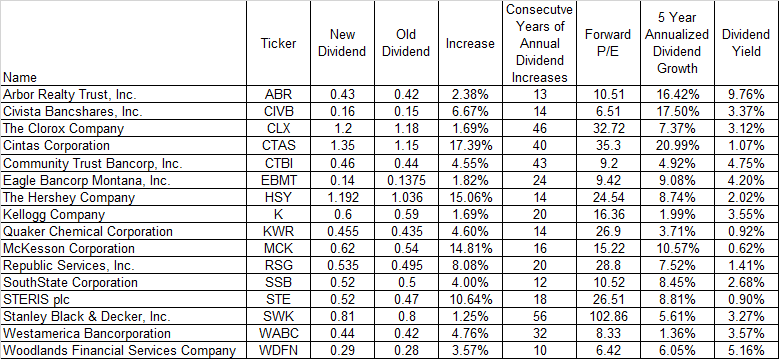
I review the list of dividend increases each week as part of my monitoring process. This exercise helps me check out new companies for further research. It also helps me to monitor existing positions.

There were over 42 companies increasing dividends last week. I narrowed the list down to 16 by only focusing on the companies that have managed to raise dividends for at least ten years in a row. I have found that to be a very helpful requirement that weeds out cyclical companies.

I included the new dividend increase and calculated the rate of change relative to the last one. I also included the track record of consistent annual dividend increases. 

I have also included valuation metrics such as forward P/E ratio, 5 year dividend growth rate and dividend yield. 

You can view the full table below:


This list is not a recommendation to buy or sell stocks. It is simply a list of companies that raised dividends last week. The companies listed have managed to grow dividends for at least ten years in a row.

The next step in the process would be to review trends in earnings per share, in order to determine if the dividend growth is on strong ground. Rising earnings per share provide the fuel behind future dividend increases.

This should be followed by reviewing the trends in dividend payout ratios, in order to check the health of dividend payments. A rising payout ratio over time shows that future dividend growth may be in jeopardy. There is a natural limit to dividends increasing if earnings are stagnant or if dividends grow faster than earnings.

Obtaining an understanding behind the company’s business is helpful, in order to determine how defensible the dividend will be during the next recession. Certain companies are more immune to any downside, while others follow very closely the rise and fall in the economic cycle.

Of course, valuation is important, but it is more art than science. P/E ratios are not created equal. A stock with a P/E of 10 may turn out to be more expensive than a stock with a P/E of 30, if the latter is growing earnings and the former isn’t. Plus, the low P/E stock may be in a cyclical industry whose earnings will decline during the next recession, increasing the odds of a dividend cut. The high P/E company may be in an industry where earnings are somewhat recession resistant, which means that the likelihood of dividend cuts during the next recession is lower.


Relevant Articles:

- Seven Companies Rewarding Shareholders With a Raise

- Five Dividend Growth Companies Raising Dividends Last Week

- Seven Dividend Growth Stocks Rewarding Shareholders with Raises

- 48 Dividend Champions For Further Research


Popular Posts