Wednesday, October 25, 2023

The one lesson from the first "Lost Decade" of the 21st Century..

At the end of 1999, S&P 500 index closed at 1469.25 points

By the end of 2012, S&P 500 index closed at 1426.19 points

The price of US Equities went nowhere for 12 years. Investors also saw two large declines of 50% in 2000 - 2003 and 2007 - 2009 as well.

Annual Earnings increased from 51.68 in 1999 to 96.82 in 2012 however. That was an 87% increase in earnings power.


Annual Dividends also increased from 16.69 to 31.25. That was also an 87% increase over the period as well.

All of the returns on S&P 500 during that time period were from dividends

The yield on 10 year Treasury Bonds went from 6.44% in 1999 to 1.76% in 2012.

$100 at the end of 1999 had the same purchasing power as $136.40 in 2012. 


Why did the index deliver no price returns, despite an 87% increase in earnings?


It's because of the valuation multiple (P/E Ratio) shrinking from 28.40 times earnings in 1999 to 14.70 times earnings in 2012.

The dividend yield increased from 1.13% at the end of 1999 to 2.19% in 2012.

As discussed before, it is important to understand the sources of investment returns.


Investment returns are a function of:

1. Dividends

2. Earnings Per Share/FCF Share Growth

3. Changes in valuation


The first two items are the fundamental returns, which are dependent on the performance of the business itself. 

The last item is the speculative return. It depends on the "mood" of market participants. In the case of S&P 500, market participants were very excited about equity prospects at the end of 1999, so they were willing to pay a premium for each dollar of earnings and dividends. In 2012 however, market participants were not excited at all about equities, and were not willing to pay much for equities. As a result, stock valuations were high in 1999, but low in 2012.

Lesson: When you overpay for an investment, you may not make much money on it, even if it delivers growth in earnings and dividends

Monday, October 23, 2023

Seven Dividend Growth Stocks Raising Dividends Last Week

As part of my monitoring process, I review the list of dividend increases every week. This exercise helps me monitor the progress of existing holdings. It also helps me identify companies for further research. I use this process in conjunction with my screening process.

As part of this process, I look at the companies that raised dividends over the past week. I narrow my focus on companies with an established track record of annual dividend increases. I look for companies that have managed to increase for at least a decade.

I then review the company’s most recent dividend increase, and compare it to the ten year average for perspective.

I also look at the growth in earnings, along with estimated earnings for this year. It is helpful to gain an understanding if the company has been able to grow dividends due to growth in the business. If growth is achieved through expanding the payout ratio, I am generally not interested in such a company.

Last but not least, I review valuation. This includes P/E ratios, dividend yields, but also compare that with historical dividend growth and trends in earnings per share. As you can see, I have come to the conclusion that valuation is more art than science.

During the past week, there were several companies that raised dividends. Each company has at least a ten year track record of annual dividend increases: The companies include:

Brown & Brown, Inc. (BRO) markets and sells insurance products and services in the United States, Canada, Ireland, the United Kingdom, and internationally. It operates through four segments: Retail, National Programs, Wholesale Brokerage, and Services. 

The company increased quarterly dividends by 13% to $0.13/share.  This is the 30th consecutive annual dividend increase for this dividend aristocrat. Over the past decade, the company has managed to grow distributions at an annualized rate of 7.70%.

Between 2013 and 2022, the company managed to grow earnings from $0.75/share to $2.38/share.

The company is expected to earn $2.65/share.

The stock sells for 25.34 times forward earnings and yields 0.68%.


Lincoln Electric Holdings, Inc. (LECO), through its subsidiaries, designs, develops, manufactures, and sells welding, cutting, and brazing products worldwide. The company operates through three segments: Americas Welding, International Welding, and The Harris Products Group

The company increased quarterly dividends by 10.90% to $0.71/share. This is the 29th consecutive annual dividend increase for this dividend champion. Over the past decade, the company has managed to grow distributions at an annualized rate of 12.70%.

“Our dividend increase reflects strong execution of our Higher Standard 2025 Strategy, record cash flow generation, and confidence in our ability to continue to generate superior long-term value for our shareholders,” said Christopher L. Mapes, Chairman, President and Chief Executive Officer.

Between 2013 and 2022, the company managed to grow earnings from $3.58/share to $8.14/share.

The company is expected to earn $9.02/share in 2023.

The stock sells for 19 times forward earnings and yields 1.49%.


Middlesex Water Company (MSEX) owns and operates regulated water utility and wastewater systems. It operates in two segments, Regulated and Non-Regulated. 

The company increased quarterly dividends by 4% to $0.325/share. This marks the 51st consecutive year of dividend increases for this dividend king. Over the past decade, the company has managed to grow distributions at an annualized rate of 4.80%.

Between 2013 and 2022, the company managed to grow earnings from $1.04/share to $2.40/share.

The company is expected to generate $2.32/share in 2023.

The stock sells for 26.75 times forward earnings and yields 2.09%.


Pinnacle West Capital Corporation (PNW), through its subsidiary, Arizona Public Service Company, provides retail and wholesale electric services primarily in the state of Arizona.

The company increased quarterly dividends by 1.70% to $0.88/share. This is the 12th year of consecutive annual dividend increases for this dividend achiever. Over the past decade, the company has managed to grow distributions at an annualized rate of 4.90%.

Between 2013 and 2022, the company managed to grow earnings from $3.69/share to $4.27/share.

The company is expected to generate $4.22/share in 2023.

The stock sells for 17.61 times forward earnings and yields 4.74%.


Prosperity Bancshares, Inc. (PB) operates as bank holding company for the Prosperity Bank that provides financial products and services to businesses and consumers. 

The company increased quarterly dividends by 2% to $0.56/share. This is the 26th year of consecutive annual dividend increases for this dividend champion. Over the past decade, the company has managed to grow distributions at an annualized rate of 10%.

Between 2013 and 2022, the company managed to grow earnings from $3.66/share to $5.73/share.

The company is expected to generate $4.90/share in 2023.

The stock sells for 10.35 times forward earnings and yields 4.34%.


1st Source Corporation (SRCE) operates as the bank holding company for 1st Source Bank that provides commercial and consumer banking services, trust and wealth advisory services, and insurance products to individual and business clients. 

The company increased quarterly dividends by 6.30% to $0.34/share. This is the 36th consecutive year of annual dividend increases for this dividend champion. Over the past decade, the company has managed to grow distributions at an annualized rate of 7.70%.

Between 2013 and 2022, the company managed to grow earnings from $2.03/share to $4.84/share.

The company is expected to generate $4.84/share in 2023.

The stock sells for 9.05 times forward earnings and yields 3.10%.


Stepan Company (SCL) produces and sells specialty and intermediate chemicals to other manufacturers for use in various end products worldwide. It operates through three segments: Surfactants, Polymers, and Specialty Products. 

The company eked out a small 2.70% raise to $0.375/share. This marks the 56th consecutive year of dividend increases for this dividend king. Over the past decade, the company has managed to grow distributions at an annualized rate of 9%.

Between 2013 and 2022, the company managed to grow earnings from $3.22/share to $6.46/share.

The company is expected to generate $2.26/share in 2023.

The stock sells for 33.52 times forward earnings and yields 1.98%.


As usual, this list is not a recommendation. It just includes a group of companies that have raised dividends last week. These are the types of companies I review, before deciding if I want to put on my list for review or not.

Relevant Articles:

- Seven Dividend Growth Stocks Raising Distributions Last Week

- Five Dividend Growth Companies Raising Dividends Last Week


Thursday, October 19, 2023

Generational Wealth

The goal of my investing from the beginning has been to build up my portfolio to the point where portfolio distributions can cover my expenses. That would provide the freedom to own my time and allocate it to my best interests, rather than be dependent on the whims of others (e.g. employers).

Being able to support yourself and your family with investments is something that happens after many years of patient and regular investing. This is an exercise in deferred gratification, and trying to take care of your future self. Very few are able to accomplish that, for a variety of reasons. 

I like the idea of Generational Wealth. This is where you are able to set-up an investment portfolio that can provide for future generations of your own family. It could also mean providing for future generations of mankind in general, if you decide to leave those funds for a charitable cause. 

I have played with compound tables of returns for many years. I have always been blown away from the power of compounding at a decent rate of return over a long period of time.

Given the fact that U.S. Equities have managed to generate annualized returns of about 10%/year over many decades and about two centuries (on average), I have often wondered why there not more families with Generational Wealth derived from the stock market. 

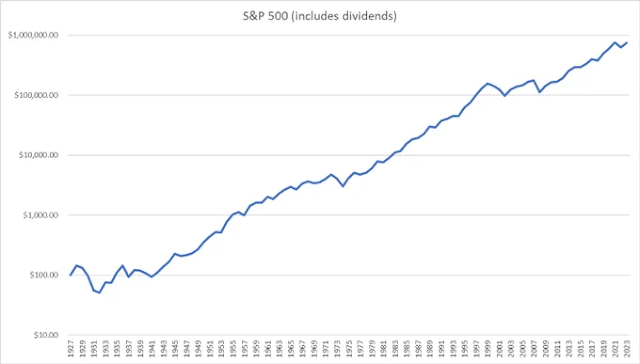
In a way, my thought process is about investing a certain amount today, and compounding it over a long period of time to get to a certain amount of money. I tested this using actual data available for US equities between 1927 and 2023. I then thought about the obstacles to that activity, and why this hasn't happened.

There are various lessons when you think backwards from it, which could be helpful in understanding the obstacles to compounding, family relations, and ensuring wealth stays in the family for generations. There's certain qualitative aspects of it all, which make it a fascinating thought exercise. Creating structures, processes, lifestyles to alleviate those concerns is definitely something to think about.

Anyway, let's imagine a family which:

1. Invested $10,000 in S&P 500 at the end of 1927

2. Turned the DRIP on

3.  Let the investment alone until today


They would have a portfolio worth $74,200,000 today. 


That's a fascinating testament to the power of compounding. For each $100 invested at the end of 1927, that family ends up with $742,000. I used S&P 500 for a proxy for US Equity returns. It yields 1.50% today, so that trust fund can generate roughly $11,300 in annual dividend income. At a 3% yield, it can generate $22,600 in annual dividend income.


Note, data is Dec 31, 1927 through July 31, 2023. Source: Prof Damodaran and Yahoo Finance.

Knowing this information, I often wonder why there aren't many millionaires and billionaires even.  All it took is a small amount of money to be invested, and then left uninterrupted for decades. 

Unfortunately, there are a lot of obstacles to this type of compounding.


1. You need to have an amount that is saved and invested in the first place. If you are unable to save anything, you can't invest and enjoy the power of compounding. 

For context, that $100 in 1927 has the same purchasing power of roughly $17,500. A daily wage at Ford Motor Company was at about $5. A Ford Model T cost about $300. I would venture that a lot of families may have had $100 to their name in 1927, at least in the US. Savings rates were probably higher back then than what they are today as well. However, only a small portion of folks in the US  invested in the stock market in the first place. Most saw it as a place for speculation, rather than long-term investment. 

Of course, you don't need to invest $100 or $10,000 at once. Probably the best way to invest is through a regular program, where one saves a certain portion of paycheck and allocates it into productive assets.

You may argue that not many families had $10,000 in 1927. However, I would argue back that the number of almost billionaires today is smaller than the number of  people who had $10,000 in 1927.


2. Your family needs to be smart about money for several generations and not waste that money.

It's very hard to save and invest and defer gratification for yourself. It's even harder to accomplish that by instilling those values to future offspring. One individual may build the wealth, and the second may grow up in a phase where wealth was not abundant yet. Hence, they may still have the habits of frugality, thrift and industry that build and maintain wealth. The third and fourth generations however may have different viewpoints, because they could have been born in relative wealth. The phrase "shirtsleeves to shirtsleeves in three generations" comes to mind when discussing this.


3. Your family would just let money compound for several decades from several generations without taking any distributions from it is a low probability event. It also means that they did not panic and sell during Depressions, Wars, Recessions, etc

Buying a holding a portfolio of US Stocks is not easy to do through the ups and downs of the US and Global Economies. There is this instinct to try and protect what you have by selling during a bear market, in order to "stop the bleeding". This is typically when the bear market is close to being over too, thus missing out on the potential recovery. Trying to time the markets is definitely a costly endeavor. 

If that family was living off the distributions however, a $100 investment in 1927 would have been turned to $26,000 by today. A $10,000 investment at the end of 1927 would have turned to $2.60 Million. 


4. You need to do proper tax planning and asset placement throughout that time. 

Income was taxable at various tax brackets and tax rates, and taxes on dividends and capital gains had varied. We didn't always have retirement accounts, but we had other tax loopholes to leverage and lower taxes. Even a successful tax efficient strategy may incur cost in the form of professional advisor expenses.


5. Speaking of taxes, you also need to be aware of the estate tax, and ensure you don't get hit by it. 

The purpose of the estate tax is to avoid having large amounts of money simply compound for decades, creating dynastic generational wealth. Even if you were to use a foundation, there is a requirement to spend 5% of assets each year on activities, which reduces corpus.


6. It is very hard to find an investment that would compound at a steady clip for decades. 

It would have been possible to replicate results of Dow Jones Industrials Average companies, but the costs of doing that would have detracted from returns. S&P 500 was introduced in 1957, and the data before that is from previous indices existing, which had less than 500 components. It was hard to invest in just S&P 500 until 1976. Long story short, it was hard to buy S&P 500. Someone could have done better or worse because they built their portfolios on their own, not knowing what we know today. They would have likely also owned other assets such as bonds, real estate, etc.


7. This also assumes that the investment is done in a low cost manner. 

I mentioned this above, but I also wanted to mention it here again. You could have paid a ton in taxes on dividends and capital gains and potentially estate tax. You could have hired a tax professional and/or a financial advisor to manage the funds. That could cost money each year however, further reducing the end dollars at stake. They could also keep the family in check, and not allow them to just spend everything. Or they may end up providing questionable advice on investments or do a poor job in planning. If they delivered more value than what they cost however, perhaps that trade-off may have been worth it. If they don't, then it may not have been worth it.


8. There is a certain element of survivorship bias at work here

It's hard to find a family that had a certain amount of money in 1927, let alone let it compound for so long at a low cost and high rate of success and keep it. It's also probable that this family disintegrates on its own if it doesn't produce offspring for example, or tragedy struck them. 

There have been other markets and countries where rich people lost everything, due to nationalizations, upheavals, etc. There are other markets where equities had dismal returns, even if they survived. 


Conclusion:

What is the purpose of this article?

Long story short, the power of compounding is powerful. But you also have many obstacles on the way to compounding for long periods of time and obtaining generational wealth for your family.

If you identify those obstacles in advance, you can design a plan to remediate them as much as possible.

This includes selecting investments with staying power, staying invested through the ups and downs, and having a diversified portfolio. It also involves ensuring that you pay the least amount in taxes and investment costs over time. In terms of stewardship, you need to work in instilling the right values in the next generations after you, including a way to instill those values to generations that you may never meet. While cost is important consideration, it may be beneficial to employ an investment professional or a team of professionals to help navigate these treacherous waters. They can help with items as investment management, tax and estate planning, and even basic financial management for future generations.

Monday, October 16, 2023

Five Dividend Growth Companies Raising Dividends Last Week

 I review the list of dividend increases as part of my monitoring process. This activity helps me to monitor existing positions and also identify potential candidates for further research. I usually focus on the companies with a ten year track record of annual dividend increases.

The next step is evaluating each company in detail, and determining if it is attractively valued.

This of course is just one exercise in my monitoring process. It helps me get ready to act when the right opportunity is available on sale.

Over the past week, there were five companies that raised dividends and had a minimum ten year track record of annual dividend increases. The companies include:


Agree Realty Corporation (ADC) is a publicly traded real estate investment trust involved in the acquisition and development of properties net leased to industry-leading, omni-channel retail tenants. 

The REIT hiked monthly dividends by 2.90% to $0.247/share. This is the 11th year of consecutive annual dividend increases for this dividend achiever. Over the past decade, the company has managed to increase dividends at an annualized rate of 5.70%.

Between 2013 and 2022, the REIT managed to grow FFO/share from $2.12 to $3.47.

The REIT is expected to generate forward FFO of $3.94/share in 2023.

The stock sells for 13.94 times forward FFO and yields 5.40%.


A. O. Smith Corporation (AOS) manufactures and markets residential and commercial gas, heat pump and electric water heaters, boilers, tanks, and water treatment products in North America, China, Europe, and India. It operates through two segments, North America and Rest of World. 

The company increased quarterly dividends by 6.67% to $0.32/share. This is the 30th consecutive annual dividend increase for this dividend champion. Over the past decade, the company has managed to increase dividends at an annualized rate of 20.30%.

"This dividend increase reflects our confidence in the stability in our replacement demand inherent in our water heating and boiler businesses, as well as our focus on returning capital to shareholders," said Kevin J. Wheeler, chairman and chief executive officer. "We are proud to say the five-year compound annual growth rate of our dividend rate is more than 10%, and that we have increased our dividend each year for over 30 years."

Between 2013 and 2022, the company grew earnings from $0.92/share to $1.52/share. The results from 2022 are reduced due to one-time charges. It was a non-cash, pre-tax expense of $417.3 million, or $1.60 per share after taxes, due to the planned settlement of pension liabilities.

A.O. Smith is expected to earn $3.62/share in 2023.

The stock sells for 19.42 times forward earnings and yields 1.82%.


HP Inc. (HPQ) provides personal computing and other access devices, imaging and printing products, and related technologies, solutions, and services in the United States and internationally. The company operates through three segments: Personal Systems, Printing, and Corporate Investments.

The company declared its plans to increase annual dividends by 5% to $1.1024/share. This is the 13th year of consecutive annual dividend increases for this dividend achiever. Over the past decade, the company has managed to increase dividends at an annualized rate of 15.50%. 

Between 2013 and 2022, the company managed to grow earnings per share from $2.64 to $3.09.

The stock sells for 8 times forward earnings and yields 4.16%.


Northwest Natural Holding Company (NWN) provides regulated natural gas distribution services to residential, commercial, industrial, and transportation customers in Oregon and Southwest Washington. 

The company raised quarterly dividends by 0.60% to $0.4875/share. This was the 68th consecutive year of dividend increases for this dividend king. Over the past decade, the company has managed to increase dividends at an annualized rate of 0.80%. 

Between 2013 and 2022 the company grew earnings per share from $2.24 to $2.54.

The company is expected to earn $2.67/share in 2023.

The stock sells for 14.66 times forward earnings and yields 4.98%.


THOR Industries, Inc. (THO) designs, manufactures, and sells recreational vehicles (RVs), and related parts and accessories in the United States, Canada, and Europe.

Thor raised quarterly dividend by 6.7% to $0.48/share. This is the 13th year of consecutive annual dividend increases for this dividend achiever. Over the past decade, the company has managed to increase dividends at an annualized rate of 10.70%.

Between 2014 and 2023 the company grew earnings per share from $3.36 to $7.

The company is expected to earn $6.80/share in 2024.

The stock sells for 13.33 times forward earnings and yields 2.12%.


Relevant Articles:

- Five Dividend Growth Stocks Increasing Shareholder Dividends

- Six Dividend Growth Stocks Raising Dividends Last Week

- Seven Dividend Growth Stocks Raising Distributions Last Week

- Three Dividend Growth Stocks Rewarding Shareholders With Raises


Thursday, October 12, 2023

How To Get Rich With Dividends

The ultimate goals of everyone reading this site is to retire wealthy and to stay retired. Financial independence provides flexibility, freedom and a lot of options in life for you. Getting there is usually the challenging part.

For Dividend Growth Investors, financial independence is achieved at the Dividend Crossover Point. The dividend crossover point is the situation where my dividend income exceeds my expenses. While I am very close to this point today however, I also want to have some margin of safety in order to withstand any future shocks that might come my way.

In the process of thinking about how to reach financial independence, I have spoken to a lot of others who are working towards financial independence. I have come up with a list of a few tools that these people have used to get rich. These are tools that are within their control. While outcomes are never guaranteed in the uncertain world of long-term investing, taking maximum advantage of things within your control tilts the odds of success in your favor.

These levers are common sense, and are at a very high level, but I have found that they are super important. If you ignore those levers however, chances are that you may not reach your goals, even if you are a more talented stock picker than Warren Buffett.


I have found that the only levers within your control as an investor such as

1) Your savings rate

2) Your investment strategy

3) Time in the market

4) Keeping costs low for taxes and commission/fees.


1) The most important thing for anyone that wants to attain financial freedom is savings. If you do not save money, you will never have the capital to invest your way to financial independence. As a matter of fact, under most situations, you have more control over your savings rate, than the returns you will earn as an investor. If you earn $50,000 per year, you can accumulate $10,000 in savings within one year if you save 20% of your income. In this case, your annual spending is $40,000/year. The $10,000 you saved will be sufficient to pay for your expenses for 3 months.

If you figure out a way to cut your expenses and to save 50% of your income, you will be able to save $25,000 in one year.

The point is not to focus on absolute dollars, but on the savings percentages. The point is that you have a higher level of control over how much you save, and this has a higher predictability of success when building wealth, than the returns on your investment. Unfortunately, future returns are unpredictable. Dividends are the more predictable component of future returns, which is why I am basing my retirement on dividend income.

This is why I have found it important to keep my costs low, in order to have a high savings rate and accumulate money faster. I have been lucky that I have essentially saved my entire after-tax salary for several years in a row. Besides keeping costs low, I have achieved that by trying to increase income as well.


2) The second important thing you have within your control is the type of investments you will put your money in. It is important to understand that despite a history of past returns, future returns are not guaranteed. You have no control over the amount and timing of future returns – the best you can do is to invest in something you understand and something that you will stick to no matter what. In my case, I invest in dividend paying stocks with long track records of regular annual dividend increases. Others have made money by investing in business, real estate, index funds, bonds etc. The important thing is to find the investment that works for you, and to stick to it.

I do this, because I have found that dividend income is more stable than capital gains. Plus, I want to only spend earnings in retirement, not my capital. With this type of investing, I am getting cash on a regular basis, which I can use to reinvest or spend. It is much easier to generate a return on my investment, and to stick to my investment plan, when I am paid cash every so often.


3) The third important tool at your disposal is your ability to compound your investments over time. You have some control over the amount of time you will let your investments compound.

Over time, a dollar invested today, that compounds at 10%/year should double in value every seven years or so. This means that in 28 – 30 years, the investor should have roughly $16 for each dollar invested at 10%. Of course, if the investor doesn’t allow their investments to compound, they would be worse off. Many investors are sold on the idea of long-term compounding. Unfortunately, a large portion end up trading far too often for various reasons. One reason is fear during a bear market. Another is the desire to take a quick profit, without letting compounding do its heavy lifting for them. I have observed people panic and sell everything when things sound difficult. Another reason for selling is the attempt to time the markets or the attempts to replace one perfectly good holding for a mediocre one.

In most situations, the investor would have been better off simply holding tight to the original investment. Almost no one can sell at the top and buy at the bottom – so don’t bother timing the market. Most investors who claim that they have avoided bear markets do so, because they are often in cash. Therefore, they miss most of the downside, but they also miss most of the upside as well. 

The best thing you can do is find a strategy you are comfortable with, and then stick to it. There aren’t any “perfect” strategies out there, so if you keep chasing strategies you are shooting yourself in the foot. As a matter of fact, you would likely do better for yourself if you buy long-term US treasuries yielding 3% and hold to maturity, than chase hot strategies/sectors/investments. So find a strategy, and stick to it through thick or thin.


4) The other important factor to remember is to keep investment costs low.


What does that mean? It means to keep commissions low. When I started out, I paid a zero commission for investments. I then switched to other brokers and tried to never pay more than 0.50%. But this is too high – there are low cost brokers today, which charge little for commissions. Try to keep costs as low as possible, because that way you have the maximum amount of dollars working for you.

It also means to make sure to minimize the tax bite on your investment income as well. Once I really spent time to learn how to minimize the impact of taxes on my investments, the rate of net worth and dividend income growth increased significantly. I have calculated that a person who maximizes tax-deferred accounts effectively in the accumulation phase could potentially shave 2 -3 years for every ten years of saving and investing.

In order to keep costs low, the amount of fees you pay to an adviser should be eliminated. Most investment advisers out there do not know that much more than you do. If you decide to educate yourself on basic finance, you will likely know as much as most investment. It makes no sense to pay someone an annual fee of 1% - 2% per year on your investment portfolio. The long – term cost of 1% - 2% fee compounds over time to a stratospheric proportion. It makes no sense to have someone who doesn’t know that much charge you 1% - 2%/year merely for holding on to your investments.


Popular Posts