I launched my Dividend Growth Investor Newsletter in July 2018, in an effort to educate investors how I build a dividend growth portfolio from scratch. I invest $1,000 per month in ten dividend growth stocks. The goal of this portfolio is to generate $1,000 in monthly dividend income. I expect this goal to be hit by the early 2030s. This is a long-term portfolio, with the goal of generating a dependable stream of dividend income, which will grow on its own, even without adding new money to it.
I have tried to distill all the lessons I have learned over the past one or two decades of writing this site and investing in dividend growth stocks. Notably, I try to focus on:
1) Quality companies with a track record of annual dividend increases
2) Diversification
3) Slowly building of positions
4) Proper risk management
5) Keeping investment turnover and costs low
Readers of my premium newsletter receive a listing of the companies I am investing in each month. This newsletter also discusses these companies in more detail. Readers also receive an updated list of dividend portfolio holdings at the end of each month as well.
I share investments in real-time, and provide trade confirmations to readers.
I just posted the list of dividend growth stocks I bought over the past month in my April 2020 Newsletter.
You can sign up for the newsletter today. I offer a 7 day free trial, which will allow you to check the last edition, and see if this service fits your educational needs.
You can subscribe using this Paypal form:
>
Once you subscribe, I will add you to my exclusive email list, and you will be able to receive premium information about the dividend growth investor portfolio.
I believe it is a bargain at $76/year, or just 20 cents/day. Each month you receive a listing of 10 attractively valued stocks I am buying. You also receive a list of dividend portfolio holdings. Plus, you get educational content as well.
Dividend Growth Investor
Saturday, April 18, 2020
Thursday, April 16, 2020
My Take On Covid-19 Dividend Cuts
We are in a health crisis, which has turned into an economic and financial crisis. Many people and organizations are hurting, which has resulted in widespread government relief efforts. Stocks are crashing, earnings expectations are getting lowered or thrown out of the window, and the economy is expected to crash and closely mirror the Great Depression. We are going to see a large spike in unemployment as well. Chances are that this economic turbulence will not be good for many dividend payments.
I do believe we are about to experience something similar to the Great Depression and Global Financial Crisis. The difference from the Great Depression of 1929 - 1932 and today is that we have several backstops in a way. Those include FDIC Insurance, Unemployment Insurance, Social Security. If people lose jobs, they have a source of income for a period of time to get them through the crisis. There are over 69 million individuals in the US relying on Social Security payments - that's money flowing into the economy every month. With FDIC insurance, there is a lower chance of a run on the bank, which means that the financial system should operate without an added strain, when the economy and loans are already troubling. We also have an accommodative Federal Reserve, whose goal is to ensure the orderly operation of financial markets. Our government is also working to provide some short-term loans and programs to help individuals and businesses through this difficult time. This could bridge some gaps, and help some individuals and businesses by buying them time. Our challenges today are different, and could result in changes in the way we go about our daily lives such as going out to restaurants, grocery stores, traveling etc. But it is also possible that at some point things return back to normal, if we find a vaccine that works ( perhaps in 2021 or 2022, or perhaps even later this year). The best things about this virus is that it is reminding us the importance of being resilient. It is also nice to see that when the private sector retreats during a contraction, the government tries to step in and help stimulate economic activity to lower the rate of economic losses.
According to futures on dividend payments on S&P 500, dividend payments are expected to drop by 15% in 2020 and by 27% by 2021. For reference, dividend payments fell by 22% during the Global Financial Crisis. Of course, those "futures" need to taken with a huge grain of salt, as they seem to be based on estimates that go up and down with the price of the stock market. For reference, the expectations just 1 week ago were for dividends to be cut by 33% in 2020 and 42% by 2021, and followed by no dividend growth till 2029, which is crazy.
I believe these expectations for 2020 – 2021 cuts are too pessimistic. I also believe that these cuts lump all dividend companies together. This takes away from the nuance of dividend investing, and creates the incorrect conclusion that ALL companies will cut dividends. While some companies may cut dividends, these are typically cyclical industries that are hurt more during a recession. There are plenty of companies that will simply stop growing dividends, but will not cut them. Then there will be a large portion of companies that keep growing those dividends, mostly because they can afford to.
The companies growing dividends will be in the dividend champions, contenders and challengers list. The companies that cut dividends so far have been in the cyclical industries that usually cut dividends during a recession. I have not seen airlines or hotels with a dividend champion status, and it is unlikely to happen in my lifetime.
Quality dividend kings with recession-proof models like Johnson & Johnson (JNJ) and Procter & Gamble (PG) handle recessions well. Their dividend raises this week show that to be the case. Wal-Mart, Target and Costco also do well through the ups and downs of a typical economic cycle.
I came to these conclusions after I have analyzed the history of dividend growth stocks and invested in them for a while. Let's look at the history of dividend aristocrats from before the financial crisis for example.
From the 60 companies on the Dividend Aristocrats list in 2007, 31 were remaining on the 2020 list. Check my article analyzing the situation at Where are the 2007 Dividend Aristocrats today?
This means that there were 29 companies that were removed from the list of dividend aristocrats for one reason or another.
Seventeen companies were removed from the list due to dividend cuts. Most of those dividend cuts occurred in 2008 and 2009. They were heavily concentrated in the financial sector too.
Three companies kept dividends unchanged for longer than one year, which meant that they were booted off the index. However, all those companies have since resumed increasing dividends.
Eight companies ended up being acquired, which is why they were booted off the index.
None of the companies went under. A lot of the companies that cut dividends in 2008 – 2009 are now recovering, and growing their dividends above their pre-crisis levels.
It is fascinating to me that investors who sold due to dividend cuts in 2008 were able to save a large portion of their capital, and avoided several of the collapses. I am referring to the likes of Citigroup, Bank of America, but also Fannie and Freddie.
However, investors who bought after a major dividend cut, such as the ones from Wells Fargo, US Bank, JP Morgan and even General Electric, did very well.
So far, I have heard about a lot of dividend cuts. We have had some notable companies like Ford, Boeing, Airlines, Hotel companies cut or eliminated dividends. I was surprised that TJX Companies (TJX) suspended dividends as well. Of course, it makes sense that when stores are closed and people are not shopping, a company should be focusing on survival first, and paying a dividend second.
The interesting fact is that the sectors that are experiencing dividend cuts or are expected to experience dividend cuts are cyclical in nature. These sectors, like hotels for example, do well during economic booms as more people travel and do business meetings in far places. When the economy stagnates however, demand for travel drops, which results in losses and dividend cuts. The same could be said for automobile manufacturers, some retailers and some REITs as well. Each crisis is different however. During the 2007 – 2009 financial crisis, we had a lot of financial companies cut or eliminate dividends. Many financial companies didn’t make it alive out of the recession. None of the companies from the dividend champions list from 2007 however failed. You may want to read my article titled "Where are the dividend champions from 2007 today"
The dividend cuts were mostly concentrated in the financial sector. My view of course focuses only on the companies with a track record of annual dividend increases. It is based on US companies too, since US companies tend to have a history of stable and growing dividend payments. Ignore studies that discuss how foreign companies cut dividends – foreign companies are notorious for paying dividends that fluctuate over time, rather than stick to a fixed payment like the US. Some exceptions exist in Canada, UK and Switzerland, but these are more of an exception than the norm.
We didn’t get a lot of dividend cuts during the 2015 – 2016 energy crisis, but we are about to get some damage in the industry in my opinion. During the 2000 – 2003 bear market the carnage was mostly in the tech sector, which wasn’t paying much in dividends in the first place. The only reason S&P 500 dividends even went flat was because of heavy exposure to tech right before the dot-com bubble burst.

Each crisis is different, which is why we can expect different sectors to be hit. Without a doubt however, the sectors being typically hit first are the cyclical sectors. When the economy recovers, these sectors will recover too. But please, do not think that dividends from iron ore companies or auto companies are going to stay stable and not get cut during a recession.
On the other hand, many well managed companies are doing well. While many companies are in cash preservation mode, I expect good companies to continue at least maintaining their dividend payments. The companies with the truly great and resilient business models will be able to also grow dividends. This was the case in 2007 – 2009 and would also be the case during this crisis. I look forward to sticking to the companies that maintain and extend their streaks of annual dividend increases in 2020.
I keep being asked about dividend cuts, and my opinion on it. So the discussion so far has hopefully elaborated my opinion on the topic. I also decided to use some data and post it. This is just fresh from 10 days ago, and this data may as well look differently for April or May. But here it goes:
I reviewed the dividend increases for S&P 500 for the first three months of 2020, and found that there hadn’t been that many dividend cuts and suspensions yet.
I saw 125 dividend increases and one dividend initiation. I saw 3 dividend cuts and 10 suspensions. This looks normal to me. I do expect April to be more turbulent for dividend cuts in the cyclical sectors, but nothing too exciting.


So to summarize, being diversified is important. That's because dividend cuts are usually centered in certain industries during a recession. Hence the need to diversify. I have also designed my risk management process in place, in order to soften the impact of being on the wrong side of dividend cuts.
It is possible that stocks continue going lower, and we are just in the initial phase of more bad things to come. That would include the number of cases growing again, the economy enduring a more sustained period of drought, which keeps unemployment higher, leads to more business losses, and more dividend cuts. My crystal ball is broken, so my guess is as good as yours.
In the meantime, I will continue sticking to my plan, because I believe that time in the market beats timing the market. I will continue buying stocks regularly, every month, reinvesting those dividends, and staying the course. I believe that investing regularly, keeping costs low, and keeping a long-term perspective are the core tenets of successful investors. In addition, the lower the share prices,the higher the current yields locked today, and the higher the future expected returns. I do believe this too shall pass, so I do believe in continuing to build my dividend portfolios. I invest when I have money to invest, so I keep doing that.
I do believe we are about to experience something similar to the Great Depression and Global Financial Crisis. The difference from the Great Depression of 1929 - 1932 and today is that we have several backstops in a way. Those include FDIC Insurance, Unemployment Insurance, Social Security. If people lose jobs, they have a source of income for a period of time to get them through the crisis. There are over 69 million individuals in the US relying on Social Security payments - that's money flowing into the economy every month. With FDIC insurance, there is a lower chance of a run on the bank, which means that the financial system should operate without an added strain, when the economy and loans are already troubling. We also have an accommodative Federal Reserve, whose goal is to ensure the orderly operation of financial markets. Our government is also working to provide some short-term loans and programs to help individuals and businesses through this difficult time. This could bridge some gaps, and help some individuals and businesses by buying them time. Our challenges today are different, and could result in changes in the way we go about our daily lives such as going out to restaurants, grocery stores, traveling etc. But it is also possible that at some point things return back to normal, if we find a vaccine that works ( perhaps in 2021 or 2022, or perhaps even later this year). The best things about this virus is that it is reminding us the importance of being resilient. It is also nice to see that when the private sector retreats during a contraction, the government tries to step in and help stimulate economic activity to lower the rate of economic losses.
According to futures on dividend payments on S&P 500, dividend payments are expected to drop by 15% in 2020 and by 27% by 2021. For reference, dividend payments fell by 22% during the Global Financial Crisis. Of course, those "futures" need to taken with a huge grain of salt, as they seem to be based on estimates that go up and down with the price of the stock market. For reference, the expectations just 1 week ago were for dividends to be cut by 33% in 2020 and 42% by 2021, and followed by no dividend growth till 2029, which is crazy.
I believe these expectations for 2020 – 2021 cuts are too pessimistic. I also believe that these cuts lump all dividend companies together. This takes away from the nuance of dividend investing, and creates the incorrect conclusion that ALL companies will cut dividends. While some companies may cut dividends, these are typically cyclical industries that are hurt more during a recession. There are plenty of companies that will simply stop growing dividends, but will not cut them. Then there will be a large portion of companies that keep growing those dividends, mostly because they can afford to.
The companies growing dividends will be in the dividend champions, contenders and challengers list. The companies that cut dividends so far have been in the cyclical industries that usually cut dividends during a recession. I have not seen airlines or hotels with a dividend champion status, and it is unlikely to happen in my lifetime.
Quality dividend kings with recession-proof models like Johnson & Johnson (JNJ) and Procter & Gamble (PG) handle recessions well. Their dividend raises this week show that to be the case. Wal-Mart, Target and Costco also do well through the ups and downs of a typical economic cycle.
I came to these conclusions after I have analyzed the history of dividend growth stocks and invested in them for a while. Let's look at the history of dividend aristocrats from before the financial crisis for example.
From the 60 companies on the Dividend Aristocrats list in 2007, 31 were remaining on the 2020 list. Check my article analyzing the situation at Where are the 2007 Dividend Aristocrats today?
This means that there were 29 companies that were removed from the list of dividend aristocrats for one reason or another.
Seventeen companies were removed from the list due to dividend cuts. Most of those dividend cuts occurred in 2008 and 2009. They were heavily concentrated in the financial sector too.
Three companies kept dividends unchanged for longer than one year, which meant that they were booted off the index. However, all those companies have since resumed increasing dividends.
Eight companies ended up being acquired, which is why they were booted off the index.
None of the companies went under. A lot of the companies that cut dividends in 2008 – 2009 are now recovering, and growing their dividends above their pre-crisis levels.
It is fascinating to me that investors who sold due to dividend cuts in 2008 were able to save a large portion of their capital, and avoided several of the collapses. I am referring to the likes of Citigroup, Bank of America, but also Fannie and Freddie.
However, investors who bought after a major dividend cut, such as the ones from Wells Fargo, US Bank, JP Morgan and even General Electric, did very well.
So far, I have heard about a lot of dividend cuts. We have had some notable companies like Ford, Boeing, Airlines, Hotel companies cut or eliminated dividends. I was surprised that TJX Companies (TJX) suspended dividends as well. Of course, it makes sense that when stores are closed and people are not shopping, a company should be focusing on survival first, and paying a dividend second.
The interesting fact is that the sectors that are experiencing dividend cuts or are expected to experience dividend cuts are cyclical in nature. These sectors, like hotels for example, do well during economic booms as more people travel and do business meetings in far places. When the economy stagnates however, demand for travel drops, which results in losses and dividend cuts. The same could be said for automobile manufacturers, some retailers and some REITs as well. Each crisis is different however. During the 2007 – 2009 financial crisis, we had a lot of financial companies cut or eliminate dividends. Many financial companies didn’t make it alive out of the recession. None of the companies from the dividend champions list from 2007 however failed. You may want to read my article titled "Where are the dividend champions from 2007 today"
The dividend cuts were mostly concentrated in the financial sector. My view of course focuses only on the companies with a track record of annual dividend increases. It is based on US companies too, since US companies tend to have a history of stable and growing dividend payments. Ignore studies that discuss how foreign companies cut dividends – foreign companies are notorious for paying dividends that fluctuate over time, rather than stick to a fixed payment like the US. Some exceptions exist in Canada, UK and Switzerland, but these are more of an exception than the norm.
We didn’t get a lot of dividend cuts during the 2015 – 2016 energy crisis, but we are about to get some damage in the industry in my opinion. During the 2000 – 2003 bear market the carnage was mostly in the tech sector, which wasn’t paying much in dividends in the first place. The only reason S&P 500 dividends even went flat was because of heavy exposure to tech right before the dot-com bubble burst.
Each crisis is different, which is why we can expect different sectors to be hit. Without a doubt however, the sectors being typically hit first are the cyclical sectors. When the economy recovers, these sectors will recover too. But please, do not think that dividends from iron ore companies or auto companies are going to stay stable and not get cut during a recession.
On the other hand, many well managed companies are doing well. While many companies are in cash preservation mode, I expect good companies to continue at least maintaining their dividend payments. The companies with the truly great and resilient business models will be able to also grow dividends. This was the case in 2007 – 2009 and would also be the case during this crisis. I look forward to sticking to the companies that maintain and extend their streaks of annual dividend increases in 2020.
I keep being asked about dividend cuts, and my opinion on it. So the discussion so far has hopefully elaborated my opinion on the topic. I also decided to use some data and post it. This is just fresh from 10 days ago, and this data may as well look differently for April or May. But here it goes:
I reviewed the dividend increases for S&P 500 for the first three months of 2020, and found that there hadn’t been that many dividend cuts and suspensions yet.
I saw 125 dividend increases and one dividend initiation. I saw 3 dividend cuts and 10 suspensions. This looks normal to me. I do expect April to be more turbulent for dividend cuts in the cyclical sectors, but nothing too exciting.
You can view the detail from this spreadsheet: (view in Google Docs)
So to summarize, being diversified is important. That's because dividend cuts are usually centered in certain industries during a recession. Hence the need to diversify. I have also designed my risk management process in place, in order to soften the impact of being on the wrong side of dividend cuts.
It is possible that stocks continue going lower, and we are just in the initial phase of more bad things to come. That would include the number of cases growing again, the economy enduring a more sustained period of drought, which keeps unemployment higher, leads to more business losses, and more dividend cuts. My crystal ball is broken, so my guess is as good as yours.
In the meantime, I will continue sticking to my plan, because I believe that time in the market beats timing the market. I will continue buying stocks regularly, every month, reinvesting those dividends, and staying the course. I believe that investing regularly, keeping costs low, and keeping a long-term perspective are the core tenets of successful investors. In addition, the lower the share prices,the higher the current yields locked today, and the higher the future expected returns. I do believe this too shall pass, so I do believe in continuing to build my dividend portfolios. I invest when I have money to invest, so I keep doing that.


Wednesday, April 15, 2020
Procter & Gamble (PG) Raises Dividends by 6%
The Procter & Gamble Company (PG) provides branded consumer packaged goods to consumers in North and Latin America, Europe, the Asia Pacific, Greater China, India, the Middle East, and Africa. It operates in five segments: Beauty; Grooming; Health Care; Fabric & Home Care; and Baby, Feminine & Family Care.
The company increased its quarterly dividend by 6% to 79.07 cents/share. This dividend increase will mark the 64th consecutive year that this dividend king has increased its dividend. The new quarterly dividend of 79.07 cents/share is almost exactly 6% higher from the prior dividend of 74.59 cents/share. Fractions make it possible to get even dividend raises on a percentage basis.
During the past decade, the company has managed to increase dividends at an annualized rate of 5.60%.
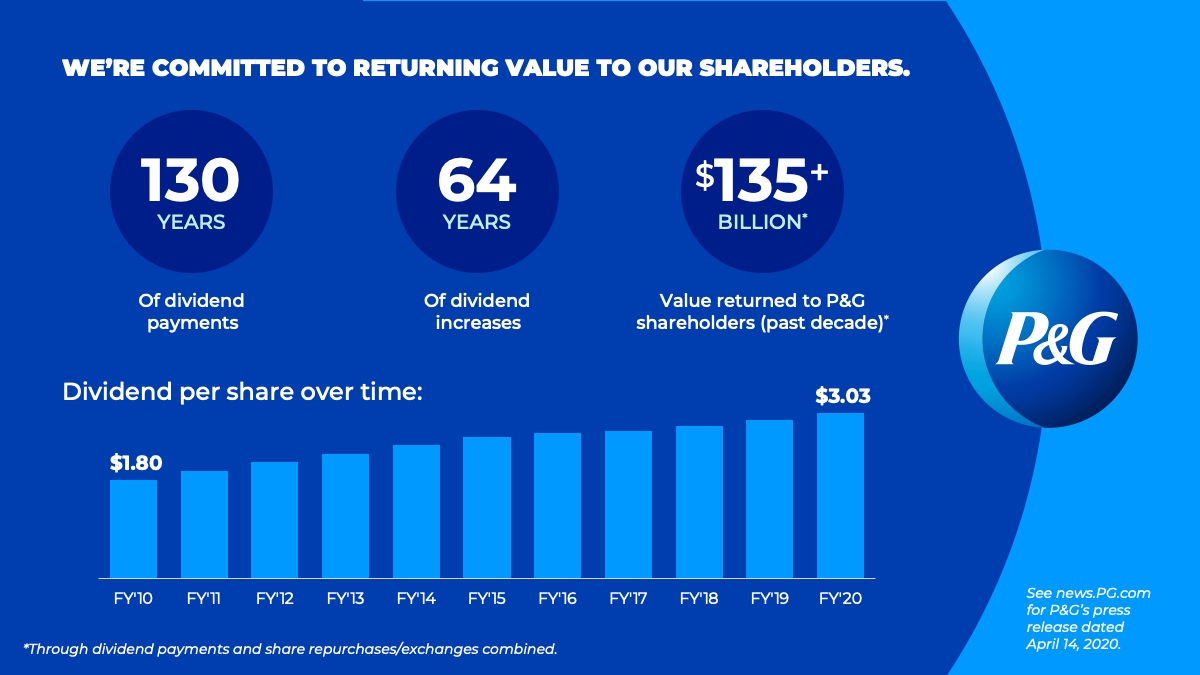
Source: Press Release
This is the second dividend increase for me today, after dividend king Johnson & Johnson (JNJ) hiked distributions by 6.30%. Both companies are dividend kings, and there are only 28 such companies in the US.
This is also the 130th consecutive year that P&G has paid a dividend since its incorporation in 1890. The dividend demonstrates the company's commitment to rewarding long-term shareholders with cash dividends. The track record is undeniably a testament to the resilience of the P&G's business model, and the fact that it is relatively immune from recessions.
Procter & Gamble also moved its earnings release to April 17th. The company is expected to generate $4.96/share in earnings in 2020, however this could be subject to a downward revision. That being said, the core business is very stable, which means that long-term earnings power should not be affected. Based on forward earnings, it appears that the forward dividend payout ratio is a little lower than 64%, which means that the dividend is sustainable.
While I applaud this dividend hike, I do not like the fact that earnings per share did not go anywhere since hitting a high of $4.26/share in 2009. This puts a limit to dividend growth. As a result, I have mostly been a holder of the stock, and haven't added to my position since perhaps the first half of the 2010s.
At the current price of $120.96/share, the stock seems overvalued at 24.40 times forward earnings. P&G may be worth a second look on dips below $99/share.
Relevant Articles:
- Dividend Kings List for 2020
- Johnson & Johnson (JNJ) Hikes Dividends By 6.30%
- Procter & Gamble Raises Dividends for 61st Consecutive Year in a Row
- Lindsay Corporation Hikes Dividends
The company increased its quarterly dividend by 6% to 79.07 cents/share. This dividend increase will mark the 64th consecutive year that this dividend king has increased its dividend. The new quarterly dividend of 79.07 cents/share is almost exactly 6% higher from the prior dividend of 74.59 cents/share. Fractions make it possible to get even dividend raises on a percentage basis.
During the past decade, the company has managed to increase dividends at an annualized rate of 5.60%.
Source: Press Release
This is the second dividend increase for me today, after dividend king Johnson & Johnson (JNJ) hiked distributions by 6.30%. Both companies are dividend kings, and there are only 28 such companies in the US.
This is also the 130th consecutive year that P&G has paid a dividend since its incorporation in 1890. The dividend demonstrates the company's commitment to rewarding long-term shareholders with cash dividends. The track record is undeniably a testament to the resilience of the P&G's business model, and the fact that it is relatively immune from recessions.
Procter & Gamble also moved its earnings release to April 17th. The company is expected to generate $4.96/share in earnings in 2020, however this could be subject to a downward revision. That being said, the core business is very stable, which means that long-term earnings power should not be affected. Based on forward earnings, it appears that the forward dividend payout ratio is a little lower than 64%, which means that the dividend is sustainable.
While I applaud this dividend hike, I do not like the fact that earnings per share did not go anywhere since hitting a high of $4.26/share in 2009. This puts a limit to dividend growth. As a result, I have mostly been a holder of the stock, and haven't added to my position since perhaps the first half of the 2010s.
At the current price of $120.96/share, the stock seems overvalued at 24.40 times forward earnings. P&G may be worth a second look on dips below $99/share.
Relevant Articles:
- Dividend Kings List for 2020
- Johnson & Johnson (JNJ) Hikes Dividends By 6.30%
- Procter & Gamble Raises Dividends for 61st Consecutive Year in a Row
- Lindsay Corporation Hikes Dividends
Tuesday, April 14, 2020
Johnson & Johnson (JNJ) Hikes Dividends By 6.30%
Johnson & Johnson (JNJ), together with its subsidiaries, is engaged in the research and development, manufacture, and sale of various products in the health care field worldwide. The company operates in three segments: Consumer, Pharmaceutical, and Medical Devices & Diagnostics. This dividend king has paid dividends since 1944. Dividend increases have been like clockwork every year for decades. Check my analysis of Johnson & Johnson (JNJ) for more information about the company.
I just read that Johnson & Johnson (JNJ) has hiked dividends by 6.30% to $1.01/share. This marked the 58th consecutive annual dividend increase for this dividend king. There are only 28 companies in the US which have managed to increase dividends annually for at least 50 years in a row.
Over the past decade, Johnson & Johnson has managed to grow dividends at an annualzied rate of 6.90%/year.
When reviewing press releases that discuss dividend increases, I always find it helpful to see the tone from top management. I especially liked what the CEO had to say (Source: Press Release):
"In recognition of our 2019 results, strong financial position and confidence in the future of Johnson & Johnson, the Board has voted to increase the quarterly dividend for the 58th consecutive year," said Alex Gorsky, Chairman and Chief Executive Officer of the company.
This dividend increase is a testament to the stability of the business model. In a period where other companies cite current conditions as unprecedented, Johnson & Johnson actually can provide guidance on revenues and earnings for 2020. It is reassuring to understand that long term fundamentals remain intact, even if 2020 guidance is lowered to reflect COVID-19 impact and related investments.
In fact, I used Johnson & Johnson a couple of weeks ago to illustrate that even if the shutdowns cause earnings to be zero for 2020 and 2021, long-term value of a business like this dividend king would not be impaired as much as it had been. Please check my post titled Dividend Investing and Covid-19 Disruptions.
The company lowered 2020 guidance to $7.50 - $7.90/share from $8.95 - $9.10/share. In terms of valuation, I would be interested in the stock at lower prices than today. Perhaps a starting yield of 3% would be a decent entry point, equivalent to a price of $134/share or lower.
There were a few more companies that I expect to increase dividends this month, which I discussed a couple of days ago. I have a high level of confidence that most of those would also hike dividends this month.
Relevant Articles:
Over the past decade, Johnson & Johnson has managed to grow dividends at an annualzied rate of 6.90%/year.
When reviewing press releases that discuss dividend increases, I always find it helpful to see the tone from top management. I especially liked what the CEO had to say (Source: Press Release):
"In recognition of our 2019 results, strong financial position and confidence in the future of Johnson & Johnson, the Board has voted to increase the quarterly dividend for the 58th consecutive year," said Alex Gorsky, Chairman and Chief Executive Officer of the company.
This dividend increase is a testament to the stability of the business model. In a period where other companies cite current conditions as unprecedented, Johnson & Johnson actually can provide guidance on revenues and earnings for 2020. It is reassuring to understand that long term fundamentals remain intact, even if 2020 guidance is lowered to reflect COVID-19 impact and related investments.
In fact, I used Johnson & Johnson a couple of weeks ago to illustrate that even if the shutdowns cause earnings to be zero for 2020 and 2021, long-term value of a business like this dividend king would not be impaired as much as it had been. Please check my post titled Dividend Investing and Covid-19 Disruptions.
The company lowered 2020 guidance to $7.50 - $7.90/share from $8.95 - $9.10/share. In terms of valuation, I would be interested in the stock at lower prices than today. Perhaps a starting yield of 3% would be a decent entry point, equivalent to a price of $134/share or lower.
There were a few more companies that I expect to increase dividends this month, which I discussed a couple of days ago. I have a high level of confidence that most of those would also hike dividends this month.
Relevant Articles:
Saturday, April 11, 2020
Lindsay Corporation Hikes Dividends
Last week, there was only one dividend increase from a company that has managed to grow dividends for a decade. The culprit was Lindsay Corporation (LNN).
Lindsay Corporation, (LNN) provides water management and road infrastructure products and services in the United States and internationally. The company operates through two segments, Irrigation and Infrastructure. Lindsay Corporation hiked its quarterly dividend by 3.20% to 32 cents/share. This marked the 18th consecutive annual dividend increase for this dividend achiever.
During the past decade, the company has managed to grow distributions at an annualized rate of 14.90%. The rate of dividend growth has slowed down to 3.20% over the past five years.
Earnings per share went from $1.98 in 2010 to an estimated $2.75 in 2020. That doesn't strike as a terribly exciting growth, particularly given the fact that earnings estimates are probably on the very optimistic side. Given the rapid deterioration in economic fundamentals, it is difficult to forecast anything today, let alone earnings per share.
Nevertheless, I find it fascinating that this company is selling for 36.80 times forward earnings, which is way too high. The stock yields 1.25%. I would not be interested in the stock at this time, given the slow rate of dividend growth and the high valuation.
While the past week has been slow on dividend increases, I would be watching out for dividend hikes on the following companies:
Procter & Gamble (PG) - PG hiked dividends by 6%.
Johnson & Johnson (JNJ) - JNJ hiked dividends by 6.30%
Exxon (XOM)
Ameriprise Financial (AMP)
Sonoco (SON) - kept dividends unchanged
W.W. Grainger (GWW)
Traveler's (TRV) - Traveler's hiked dividends by 4% to 85 cents/share.
Unilever (UL) - kept dividends unchanged
Costco (COST) - Costco hiked dividends by 7%
IBM (IBM)
Magellan Midstream Partners (MMP)
Relevant Articles:
- Four Dividend Increases From Last Week
- Two Companies Escaping the Quarantine on Dividend Hikes
- Dividend Investing and Covid-19 Disruptions
- Three REITs Delivering Fresh Dividend Growth To Shareholders
Lindsay Corporation, (LNN) provides water management and road infrastructure products and services in the United States and internationally. The company operates through two segments, Irrigation and Infrastructure. Lindsay Corporation hiked its quarterly dividend by 3.20% to 32 cents/share. This marked the 18th consecutive annual dividend increase for this dividend achiever.
During the past decade, the company has managed to grow distributions at an annualized rate of 14.90%. The rate of dividend growth has slowed down to 3.20% over the past five years.
Earnings per share went from $1.98 in 2010 to an estimated $2.75 in 2020. That doesn't strike as a terribly exciting growth, particularly given the fact that earnings estimates are probably on the very optimistic side. Given the rapid deterioration in economic fundamentals, it is difficult to forecast anything today, let alone earnings per share.
Nevertheless, I find it fascinating that this company is selling for 36.80 times forward earnings, which is way too high. The stock yields 1.25%. I would not be interested in the stock at this time, given the slow rate of dividend growth and the high valuation.
While the past week has been slow on dividend increases, I would be watching out for dividend hikes on the following companies:
Procter & Gamble (PG) - PG hiked dividends by 6%.
Johnson & Johnson (JNJ) - JNJ hiked dividends by 6.30%
Exxon (XOM)
Ameriprise Financial (AMP)
Sonoco (SON) - kept dividends unchanged
W.W. Grainger (GWW)
Traveler's (TRV) - Traveler's hiked dividends by 4% to 85 cents/share.
Unilever (UL) - kept dividends unchanged
Costco (COST) - Costco hiked dividends by 7%
IBM (IBM)
Magellan Midstream Partners (MMP)
Relevant Articles:
- Four Dividend Increases From Last Week
- Two Companies Escaping the Quarantine on Dividend Hikes
- Dividend Investing and Covid-19 Disruptions
- Three REITs Delivering Fresh Dividend Growth To Shareholders
Subscribe to:
Posts (Atom)
