Friday, October 31, 2014

Verizon (VZ): Another High Yield Telecom for Current Income

Verizon Communications Inc. (VZ) provides communications, information, and entertainment products and services to consumers, businesses, and governmental agencies worldwide. This dividend achiever has paid dividends since 1984 and increased them for 10 years in a row.

The most recent dividend increase was in September 2013, when the Board of Directors approved a 2.90% increase in the quarterly dividend to 53 cents/share.

The company’s competitors include AT&T (T), Sprint (S) and T-Mobile (TMUS).

Over the past decade this dividend growth stock has delivered an annualized total return of 9% to its shareholders. Future returns will be dependent on growth in earnings and dividend yields obtained by shareholders.


The company has managed to deliver a 12.10% average increase in annual EPS over the past decade. This high earnings growth is deceptive, since the company's annual earnings per share fluctuates wildly due to one-time accounting effects, such as pension adjustments for example. Verizon is expected to earn $3.57 per share in 2014 and $3.87 per share in 2015. In comparison, the company earned $4/share in 2013.


Verizon is one of the two dominant telecom players in the US, the other one being AT&T. Both companies have the scale in number of customers to compete successfully, invest in their business and market their products, while keeping costs of servicing customers low and therefore generating excess cash flows. Those excess cash flows are returned to shareholders through a generous dividend. In addition, the company has the reputation for America's best coverage for wireless, which provides it with a high market share and customer loyalty. This has resulted in low churn rates, which in essence makes it easier to make money, since acquiring new customers is expensive. In addition, Verizon has valuable spectrum, which is of limited quantity in the US. The company has been able to grow through acquisitions over the past years, which is another way that it can bolster its future earnings per share. The risk to Verizon is that the already cutthroat telecom market is shaken by a price war, which could be bad for margins and profitability.

I like the fact that Verizon was able to acquire the remaining 45% of Verizon Wireless it didn't already own from Vodafone (NASDAQ:VOD) by paying $130 billion in cash and stock. Approximately 1.275 billion shares were issued, bringing number of shares outstanding from 2.874 billion at end of 2013 to 4.153 billion by the end of Q2 2014. In addition, the company took on approximately $60 billion in debt, and also offered asset stakes to Vodafone to pay up for Verizon Wireless. This deal is expected to be accretive to Verizon over time, and is helpful to have been done at a time when interest rates are so low. It would be nice if the company takes on the challenge of repurchasing those dilutive shares over the next decade.

Since I owned shares of Vodafone at the time, I also received a few shares of Verizon. For those who own Verizon, they might be optimistic about the company, after Berkshire Hathaway disclosed a stake in the telecom giant. It is unclear at this point however, whether it was Warren Buffett who initiated the purchase, or one of his two trusted money managers - Ted Weschler or Todd Combs.

The annual dividend payment has increased by 3% per year over the past decade, which is lower than the growth in EPS. My expectations for future dividend growth are for them to be close to the rate of inflation over the next two decades.


A 3% growth in distributions translates into the dividend payment doubling every twenty four years on average. If we check the dividend history, going as far back as 1990, we could see that Verizon has last managed to double dividends every 23 years on average.

In the past decade, the dividend payout ratio has been all over the place. This was of course caused by the effect of one-time items on earnings per share. A lower payout is always a plus, since it leaves room for consistent dividend growth minimizing the impact of short-term fluctuations in earnings.


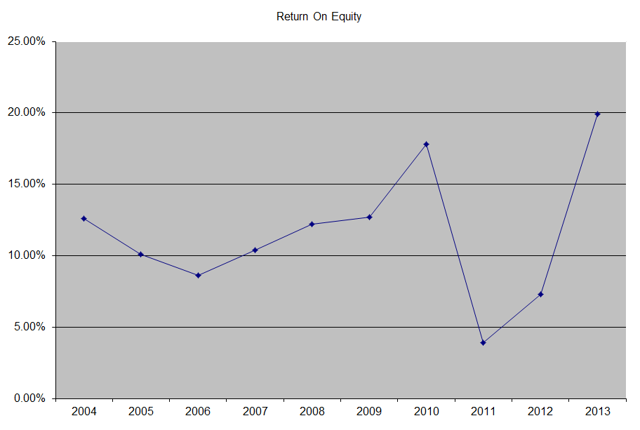
Verizon has been able to generate a decent average return on equity of 13.30% over the past decade. With the exception of a couple years where we had large one-time adjustments to earnings, this indicator has been relatively stable however. I generally like seeing a high return on equity, which is also relatively stable over time.

Currently, Verizon is attractively valued at 13.70 times forward earnings, and has a dividend yield of 4.20%. In comparison, rival AT&T is selling for 13.30 times forward earnings and yields 5.20%. Both companies have been preferred investment vehicles to retired investors, due to their above average yields. Unfortunately, the slow dividend growth can only be expected to keep pace with inflation at best. That being said, if one needs high current income today, and would not be opposed to potentially losing a small portion of purchasing power over the next decade or two, Verizon could be the type of company to buy and hold. For use of my capital however, I am reluctant to pull the trigger on the company. I believe there are other high yield companies, which offer better dividend growth in the future, which is why I would refrain from adding to Verizon or initiating a position in AT&T. On a side note, I hold Verizon as a result of my ownership of Vodafone . I plan on holding both, but would not add any additional shares. If all the rumors are true however, my Vodafone shares might turn into AT&T stock at some point in time.

Wednesday, October 29, 2014

Key Ingredients for Successful Dividend Investing

There are four key attributes that need to be considered, in order to be successful at dividend investing. These ingredients include focusing on quality, earnings growth, entry price and sustainable distributions. In this article, I would focus in more detail behind each of these four items.

Quality

I believe in purchasing quality dividend paying companies. This means that I try to focus on companies with strong competitive advantages, strong brand names and/or wide moats. Companies like that offer a product or service which customers desire, and are willing to pay a price which would deliver a fair profit. In addition, companies which offer products which are perceived to have quality characteristics, which typically translates into repeated purchases of the goods or services. In addition, companies that offer a unique product or service are able to compete based upon the added value they bring to the marketplace, and avoid costly price wars with competitors. Furthermore, the company would be able to have pricing power and pass on costs to customers, which will be much less likely to switch to another product. I understand that quality lies in the eyes of the beholder, but through experience, dividend investors should be able to uncover quality dividend paying gems.

Earnings growth

My strategy focuses on purchasing shares in companies which will grow dividends over time. In order to achieve that however in a sustainable manner, companies need to be able to grow earnings. Businesses that manage to grow earnings also tend to become more valuable over time. I also prefer to focus on earnings per share rather than total net income. Companies can grow earnings either by expanding in new markets, introducing new products, marketing existing products to new customers, acquiring competitors, cutting costs or raising prices. I like to read about companies which have specific earnings growth targets. Coca-Cola (KO) is anexample that immediately come to mind when I think about specific growth plans, as I outlined in an earlier article. I also like to see companies riding a long-term economic trend. Many of the companies I own in my portfolio for example will benefit from the increase in number of middle class customers in emerging markets such as China and India. Others like Eaton Vance (EV) or Ameriprise Financial (AMP) will benefit from the increased need for financial products that generate income in retirement by the millions of baby boomers that are expected to retire over the next two decades.

Entry price

The price at which shares are acquired matters a great deal to investors. Even if an investor has identified the best dividend growth stock in the world, with the widest moat, and excellent prospects for earnings and dividend growth, they could still end up losing money for extended periods of time. The reason is that even the best dividend stocks are not worth owning at any price. If you overpay for your stocks, you might end up with losses or not gains to show for your efforts for extended periods of time, even if the underlying fundamentals improve according to your initial plan. In an earlier article I argued that this was one of the main reasons behind the so called “lost decade for stocks” in the US in the early 2000s. Companies such as Coca-Cola (KO) and Wal-Mart (WMT) were grossly overvalued in 2000, which is the primary reason why the stocks didn’t generate much in total returns over the next decade, despite the fact that earnings and dividend increased substantially during the period. I am not proposing that investors time the market and only invest when stocks are super cheap. Instead, I focus on screening the dividend growth lists for attractively valued companies on a regular basis, and then analyze in detail the companies that are spitted out by my screen before adding money to them.

Sustainable distributions

The next key ingredient for successful dividend investing involves the sustainability of distributions. Investors who purchase dividend stocks for income should check whether the company is able to adequately support distributions from current earnings or cash flows for certain entities such as Master Limited Partnerships or Real Estate Investment Trusts. For most corporations, a dividend payout ratio below 60% is generally preferred. A higher ratio could jeopardize the dividend payment even if earnings dip temporarily. That being said, even if a company has a sustainable payout at the time of purchase, over time it could become unsustainable if it grow distributions faster than earnings or earnings decrease due to tectonic shifts in the business model. The best situation I like to observe is when earnings and dividends grow at similar rates. For new dividend payers I typically observe situations where dividend growth is higher than earnings growth up to a certain payout ratio, after which it closely trails growth in profitability.

While investors could argue that one cannot put success in a pre-packaged recipe for achieving it, I have found the four ingredients above to be essential for my income investing strategy.

Full Disclosure: I have a position in all companies listed above

Relevant Articles:

Seven Sleep Well at Night Dividend Stocks
Three Questions That Every Dividend Investor Should Ask Themselves
How to retire in 10 years with dividend stocks
The work required to have an opinion
Three Characteristics of Successful Dividend Investors

Monday, October 27, 2014

Dividends Make Investing Easier During Market Declines

The past two weeks have been characterized by declines in stock prices. Many were speculating whether this decline is the beginning of a new bear market, or whether it was a sign that the US economy is heading into a recession. As I discussed in a previous article, I choose to ignore that noise, and stick to my simple long-term investing. It is during turbulent times, that I realize how much easier it is to keep a simple investment strategy that produces steady ( and growing) cash flow that goes directly to my bottom line.

For example, I used the cash produced by my income portfolio over the preceding few weeks to buy more shares. I also bought some shares in ConocoPhillips (COP) last week and just purchased some shares of IBM (IBM) as well. The fact is, I receive my dividend checks whether the stock market falls by 10% or rises by 10%. I will still receive them even if they closed the stock market for 10 years. Since I am in the accumulation phase, I reinvest all dividends into more dividend paying stocks each month. In addition, I am also able to save money from my day job, and use it to further build up my Dividend Growth Machine. As a passive investor with a long-term holding period, I have found that having a demanding career is helpful to keep me engaged. This helps because it prevents me from hearing noise about stocks, which would create an urge to do something. As we discussed last week, to be successful in investing, you have to have a set it and forget type of mentality where you let compounding to the heavy lifting for you. Worrying about ticks in unemployment, economy, Dow Jones Industrial s average is usually a recipe to do something stupid, such as panicking and selling when everyone else is selling. The other positive part of having a career is that I receive cash to deploy and invest.

Building wealth is really simple – get a job, save money, and then invest savings wisely. I invest my funds as if I would never ever be able to earn another penny, which is why I try to be a conservative income investor. This is a boring, slow and steady way, but if I methodically invest and compound my dividends, I know I will do reasonably well in 10, 20, 30 years.

The fact that I receive cash from the companies I own to deploy on a periodic basis is the fundamental strength of dividend investing. During a dip in stock prices, I can put that to work at more attractive valuations. If I needed retirement income which is predictable in amount and timing, my dividend checks satisfy both needs.

The things are getting better of course, when companies I own decide they have earned so much money, that they can now afford to not only pay me a dividend, but also to increase it for another consecutive year. I typically look for companies with long histories of consecutive dividend increases, because I have found that this is usually an indicator of a strong business with strong fundamentals. I do analyze companies in detail however before deciding if I want to buy their shares. In addition, I also try to follow a few basic valuation guidelines, in order to determine if share prices are attractive or not.

In the past week, several companies which I own, announced their intent to reward me with higher dividend payments.

Abbvie (ABBV) discovers, develops, manufactures, and sells pharmaceutical products worldwide. The company raised its quarterly dividend by 17% to 49 cents/share. In addition, the company approved $5 billion share buyback, after it scrapped its acquisition plan of Shire (SHPG). This was the second dividend increase for the company, since the split of Abbott Laboratories (ABT) into two companies. Given the fact that the company is expected to earn $4.06/share for the year ending December 2015, this puts the payout ratio at an adequate 48.30% and valuation of a forward 15 times earnings and an yield of 3.30%. Abbvie generates a large portion of sales from the drug Humira, which is scheduled to go off patent later in the decade. At this time I do not plan on adding to my position there, although I would keep holding, and allocating those dividends elsewhere.

Visa (V) operates as a retail electronic payments network worldwide. The company raised its quarterly dividends by 20% to 48 cents/share. This is the sixth consecutive dividend increase for the company which went public in 2008. The new dividend payment is 4.5 times larger than the initial payment of $0.105/share. The new yield is 0.90%, and the forward P/E ratio is 20.60 times FY 2015 earnings. The only reason to invest in Visa is if you believe that the company can maintain growing earnings per share by at least 15% for the next five years, and then by at least 10% for the subsequent 5- 10 years after that. This could translate into high dividend per share growth, and potential yields on cost that double every five years and come with massive capital gains in the process. Check my analysis of Visa on Seeking Alpha.

ONEOK Inc (OKE), which is the general partner of ONEOK Partners (OKS), raised its quarterly dividend to 59 cents/share. The forward yield on new shares is 3.90%. At the same time, ONEOK Partners (OKS) increased its quarterly distribution to 77.50 cents/unit, which is an increase of 6.90% over the same period in 2013. The forward yield is 5.80%. I sold most of my partnership units last week and purchased shares of the general partner with the proceeds. Based on my analysis of the situation, it almost always makes sense for a long-term investor to hold the general partnership shares, than the limited partnership units. ONEOK Inc is a dividend achiever, which has managed to boost distributions for 12 years in a row. It has a ten year dividend growth rate of 15.70%/year. ONEOK Partners on the other hand has increased distributions for 9 years in a row, and has a ten year dividend growth rate of only 6%/year.  I believe that yields on cost on an investment in ONEOK Inc (OKE) today could surpass the yield on cost in ONEOK Partners (OKS) in approximately five years. In addition, those shares could deliver higher total returns than the limited partnership units. That being said, I am keeping a minor position in ONEOK Partners in my retirement account, because the amount allocated to it is so small, the commissions to buy and sell are high at $7.95, which makes it not worth making a change at this time.

In addition, two other dividend champions continued their streak of regular dividend increases as well. Those included:

V.F. Corporation (VFC) designs, manufactures, or sources from independent contractors various apparel and footwear products primarily in the United States and Europe. This dividend champion raised its quarterly distributions by 21.90% to 32 cents/share. This marked the 42nd consecutive annual dividend increase for V.F. Corporation. The company has managed to increase annual dividends by 13.70%/year in the past decade. The stock sells for 21.50 times forward earnings and yields 1.90%

Parker-Hannifin Corporation (PH) manufactures and sells motion and control technologies and systems for various mobile, industrial, and aerospace markets worldwide. This dividend king raised its quarterly distributions by 31.25% to 63 cents/share. This marked the 59th consecutive annual dividend increase for Parker-Hannifin. The company has managed to increase annual dividends by 13.40%/year in the past decade. The stock sells for 15.20 times forward earnings and yields 2.20%.

Full Disclosure Long COP, IBM, OKE, OKS, ABBV, ABT

Relevant Articles:

- Dividend Champions - The Best List for Dividend Investors
The importance of yield on cost
Dividend Investors Will Make Money Even if the Stock Market Closed for Ten Years
Time in the market is more important than timing the market
Top Dividend Growth Stocks of the past decade

Friday, October 24, 2014

AT&T: A High Yield Telecom for Current Income

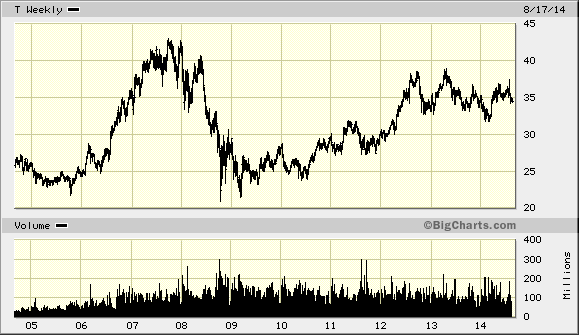
AT&T Inc. (T) provides telecommunications services to consumers and businesses in the United States and internationally. This dividend champion has paid dividends since 1984 and increased them for 30 years in a row. The most recent dividend increase was in December 2013, when the Board of Directors approved a 2.20% increase in the quarterly dividend to 46 cents/share.

The company’s competitors include Verizon (VZ), Sprint (S) and T-Mobile (TMUS).

Over the past decade this dividend growth stock has delivered an annualized total return of 9% to its shareholders. Future returns will be dependent on growth in earnings and dividend yields obtained by shareholders.

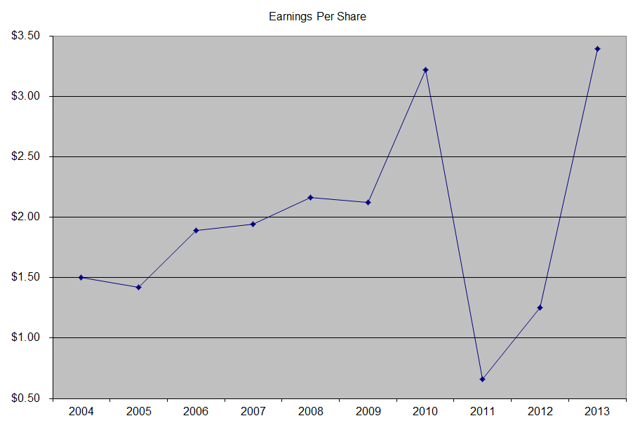
The company has managed to deliver a 6.50% average increase in annual EPS over the past decade. AT&T is expected to earn $2.60 per share in 2014 and $2.72 per share in 2015. In comparison, the company earned $3.39 per share in 2013.


AT&T has consistent history of share repurchases. The company has been able to reduce the number of shares outstanding from 6.17 billion in 2007 to 5.220 billion in 2014.

The competitive advantage for AT&T is the scale of its operations, as evidenced by the number of subscribers it has. In addition, the company owns valuable spectrum, which is of limited quantities and is a deterrent for entry into the telecom market. Both AT&T and Verizon have scale that is unmatched at present times from the next two competitors.

The wireless market in the US is close to a saturation point. However, a potential for growth includes data, and not just the type used by ordinary consumers, but machine-to-machine use. The drawback is the fact that telecom service is essentially a commodity, which is why differentiation from one carrier to another is difficult, if there was a price war. In addition, there is the need for constant capital expenditures to maintain the quality of the network and keep up with the times. Given the competitive nature of the telecom industry, and the constant need for technological upgrades merely to keep up with the next big wave, it is highly unlikely that companies like AT&T will provide outstanding stock performance. However, they should do okay for those who need a high dividend today and who do not mind having their income mostly keeping up with inflation.

The company could also grow through strategic acquisitions. It is an embodiment to acquisitions, since it was spun-out of the original AT&T in 1984 and named SBC. After a series of acquisitions, SBC acquired AT&T (ma-bell) in 2005, and then promptly changed its name to AT&T. The company has a track record of successfully integrating acquisitions, which is no small feat.

AT&T has recently announced that it would be acquiring DirectTV (DTV). This could help it offer bundled services to customers at a greater scale. It could also pave the way for international expansion beyond TV for AT&T. AT&T could generate synergies from the deal. AT&T expects cost synergies to exceed a $1.6 billion annual run-rate by three years after closing. These synergies include things like programming cost reductions, operational efficiencies and reductions in redundant broadcast infrastructure. Programming cost reductions are the most significant part of the expected cost synergies. The company also expects synergies from bundling services, advertising, etc. AT&T has grown through acquisitions in the past, which is why I believe integration risk to be low. I especially like that AT&T will be able to offer consumers a bundled service, which would be a differentiator in many key markets.

Plus, DIRECTV could easily increase earnings over the next five years. Average analyst estimates are for earnings to grow by 8.60%/year over the next five years. This could translate into earnings growing to $4.30 billion by 2019, from the current $2.86 billion in 2013. This would be driven by growth in Latin America, where fixed line access is limited, and where a large portion of customers are joining the ranks of the middle class.

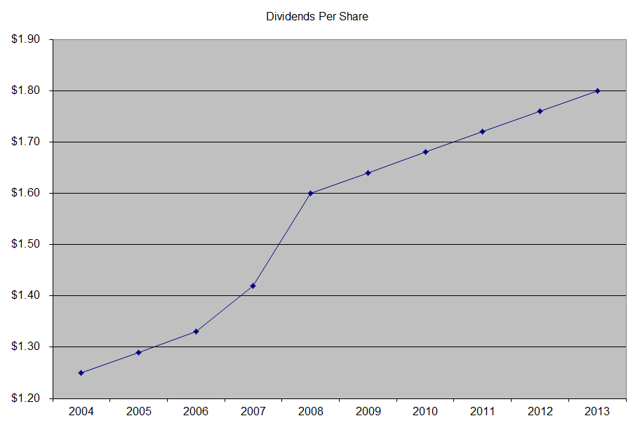
The annual dividend payment has increased by 4.80% per year over the past decade, which is lower than the growth in EPS. Since 2009, AT&T has managed to raise annual dividends by 4 cents/share, or about 2%/year. I would expect future dividend growth to be close or slightly exceed the rate of inflation over the next 10-15 years.


A 5% growth in distributions translates into the dividend payment doubling every fourteen and half years on average. If we check the dividend history going as far back as 1984, we could see that AT&T has indeed managed to double dividends every fourteen and a half years on average.

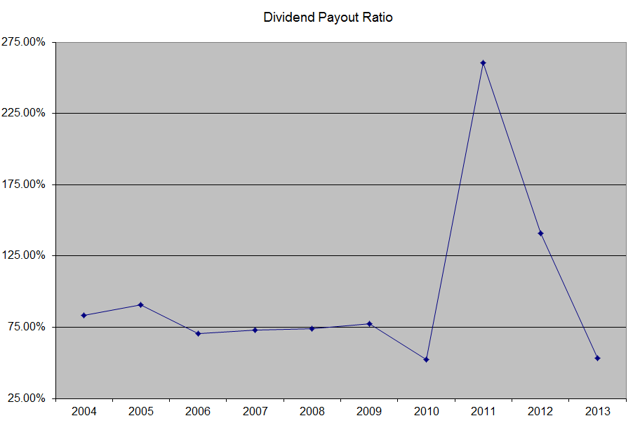
In the past decade, the dividend payout ratio has been all over the place, ranging from 52% in 2010 to 260% in 2011. Of course, this was caused by the effect of one-time items on earnings per share. A lower payout is always a plus, since it leaves room for consistent dividend growth, minimizing the impact of short-term fluctuations in earnings.


AT&T has been able to generate an unimpressive average return on equity of 11.55% over the past decade. With the exception of a couple years where we had large one-time adjustments to earnings, this indicator has been relatively stable, however. I generally like seeing a high return on equity, which is also relatively stable over time.


Currently, AT&T is attractively valued at 13.30 times forward earnings, and has a dividend yield of 5.20%. Investors who purchase AT&T today should not expect much in terms of dividend growth over the lifetime of their investment. The most likely scenario is that dividend income merely keeps up with inflation over time, which is not too bad of an outcome for some. Thus, AT&T has mostly been purchased by income-hungry retirees, who need the current income today, and are fine even if the income slowly loses purchasing power over time. Since I have a 15-20-year investment horizon, and because of the slow growth in earnings and dividends, AT&T is not a company I am currently considering.

Full Disclosure: Long VZ

Relevant Articles:

Two High Yield Companies Raising Dividends in the past month
Should I invest in AT&T and Verizon for high dividend income
Maintaining Moats in times of Technological Changes
Vodafone Group (VOD) Dividend Stock Analysis
Types of dividend growth stocks
Seven dividend companies bringing holiday joy to shareholders

Wednesday, October 22, 2014

Time in the market is more important than timing the market

There is so much mental energy spent by investors, media and gurus spent on “guessing” the market top, market bottom, and whether we are in a bull or bear market, it is exhausting for me to watch. Frankly, in order to be successful in investing, one needs to keep it simple, and follow common sense principles. You do not need to successfully pick tops or bottoms in order to be successful, but have goals, and patiently hold quality companies for the long term that shower you with rising dividend income every year. If you have goals you want to achieve, you only need to develop a strategy to achieve it, and then stick to your plan through thick and thin.

Time in an investment is more important than perfect timing based on following fluctuations in the stock price. This is because if you hold a quality company purchased at a fair price, and then let the power of compounding do its magic over a long stretch of time, you will do really well. Those who are always looking to buy at the bottom or sell at the top end up missing out on the compounding of their income and capital. This is because noone can correctly buy at the top or sell at the bottom, except for a lucky accident once in their lifetime. At the end of the day, even a broken clock is right twice per day. Those who can tell you they can consistently do it, are either liars, are trying to get famous by being right once, or are trying to sell you an expensive investment service.

I did a quick experiment using Yahoo Finance historical data, where we have two investors buying shares of Johnson & Johnson (JNJ) between 1/1/1980 and 12/31/1989. The first investor has $1,200 to put to work each year, and manages to buy Johnson & Johnson shares at the lowest monthly close for each year. They reinvest dividends into more Johnson & Johnson shares with each payment from the company. This investor manages to get this lucky for 10 years in a row. They then stop adding new money, reinvest their dividends automatically into Johnson & Johnson stock and hold on to the end of September 2014. The first investor thus ends up with a stake worth roughly $1,011,000 million, which generates approximately $26,600 in annual dividend income.

The second investor simply puts $100 per month, every month between 1/1/1980 and 12/31/1989. They also reinvest those dividends in more Johnson & Johnson stock in the accumulation phase. After that, no new money is added, although dividends keep getting reinvested automatically. By September 2014, the second investor has a portfolio worth roughly $875,000, which generates approximately $23,000 in annual dividend income. As you can see, while the second investor ends up with a little lower final portfolio values and annual dividend incomes, their returns are much more realistic and achievable by ordinary investors. Again, the goal is to try and keep a simple plan to stick to. It is highly UNLIKELY that someone will be able to allocate money at the lowest point in a company for 10 years in a row. Most keep trying, and as a result end up missing the big moves. The important thing in the case of Johnson & Johnson was to buy the shares, and then patiently reinvest dividends for decades, and let the power of compounding do the heavy lifting for you.

This example is where you have an edge in investing, that noone else on Wall Street has - you can hold patiently to your passive portfolio of quality dividend paying stocks, and collect those rising dividends through thick and thin. You do not care about high frequency traders, irrelevant relative performance bench-marking against some index over a meaningless time frame of a month or an year. If you have patience, you are very likely to successfully fund your long-term goals.

My goal is to reach a certain level in dividend income by 2018 – 2019. In order to reach this goal, I know that I need to save a certain portion of my paycheck, and then invest it every month in quality dividend paying stocks. As those dividend paying companies pay me more in dividend income, I then reinvest that income into more dividend paying companies. Life is much easier when you create a positive loop.

You can see that my strategy is only dependent on finding enough quality dividend paying companies to invest in each month. Therefore, it does not matter whether we are in a bull market, bear market or sideways market. As a dividend investor, I am a stock picker, not a market timer or prognosticator anyways. I focus on individual businesses available at attractive prices, which can earn more over time and thus afford to increase my dividends regularly. The only difference that a bear market makes to me is that there are more companies that are attractively prices. Since my timeframe for holding those companies and living off those dividends is approximately forever, my success is determined on letting those dividends compound over time into a meaningful stream of income to live off forever.

The toughest part of my plan is patience. As Munger Says, the most difficult thing a person can do is sit alone and do nothing. Given the fact that I am constantly bombarded by useless chatter from the media about the economy, shares, the FED, the world etc, I feel inclined to do something when in reality no action on my part is needed. I believe that investors should tune everything out, and just stick to their plan. At least that’s what I am doing. I know that the odds for success are very high for the investor who buys stakes in quality blue chip dividend payers every single month, reinvests dividends selectively, and then patiently sits on those companies for the next 20 – 30 years.

For example, did you know that if you started investing in in blue chip companies at the start of the great depression in 1929, and you reinvested dividends you broke even within 6 years. You did pretty well if you held on for 30 years. Even if you bought shares right at the top in 1972, and held on for 30 years, you made a lot money as well. The lesson is very clear – keep holding to quality dividend paying companies through thick and thin, keep adding money to dividend portfolios every single month and keep reinvesting those dividends. If you are unwilling to hold through a company through a 50% correction in the stock price, you should not be investing in stocks. 50% corrections would not bother me, as I see them as opportunities, since my dollars buy more shares when prices are lower. I also try to invest in companies, where I would not be afraid to hold, even if the stock market was closed for a decade.

The lesson to long-term investors is clear; it doesn't matter whether we are in a bull market or bear market. The goal is to dollar cost average each month in quality dividend growth stocks selling at attractive valuations, reinvest dividends, and hold patiently for the next 20 – 30 years. I cannot emphasize quality factor, since the quality companies are more likely to survive a deep recession unscatered, and continue paying and growing dividends, even during the hardest of times. If you are already retired, then you shouldn’t really care about stock prices anyways – just withdraw those growing dividends and enjoy life. Dividends are more stable than capital gains, they are always positive, which makes them an ideal way of living off a nest egg.

Full Disclosure: Long JNJ

Relevant Articles:

Dividend Investors Will Make Money Even if the Stock Market Closed for Ten Years
Let dividends do the heavy lifting for your retirement
How to retire in 10 years with dividend stocks
My Dividend Goals for 2014 and after
Dividend Investors Should Ignore Price Fluctuations

Popular Posts