Monday, January 23, 2023

Seven Dividend Growth Companies Rewarding Owners With Raises Last Week

As part of my monitoring process, I review the list of dividend increases every week. I use this exercise to review existing holdings, and to identify companies for further research. I tend to focus on the companies with a ten year history of annual dividend increases. That's in an effort to identify consistent dividend growth companies that could potentially reward me with higher dividends for many years.

Of course, that's just one step in the process for me. If I identify a company for review, I look at financials, such as the trends in dividends, earnings, payout ratios over the past decade. I try to understand the company, and determine if it is a suitable candidate for my portfolio. Last but not least, I also try to determine whether it is fairly valued today. If not, I set some mental entry points when the company may be worth re-visting at.

Over the past week, there were close to 40 dividend increases. I am including below the companies that raised dividends last week and also had a minimum 10 year streak of consecutive annual dividend increases:

Fastenal Company (FAST) engages in the wholesale distribution of industrial and construction supplies in the United States, Canada, Mexico, North America, and internationally. 

The company increased quarterly dividends by 12.90% to $0.35/share. This is the 25th consecutive annual dividend increase for this newly minted dividend champion. Over the past decade, the company has managed to grow dividends at an annualized rate of 12.90%. 

Earnings per share rose from $0.76 in 2013 to $1.89 in 2022. The company is expected to earn $1.94/share in 2023.

The stock is selling for 25.29 times forward earnings and yields 2.86%.


Franco-Nevada Corporation (FNV) operates as a gold-focused royalty and streaming company in Latin America, the United States, Canada, and internationally. It operates in two segments, Mining and Energy. 

The company increased quarterly dividends by 6.30% to $0.34/share. This marks the 16th consecutive annual increase for Franco-Nevada shareholders. Over the past decade, the company has managed to grow dividends at an annualized rate of 9%. 

Earnings per share rose from $0.72 in 2012 to $3.84 in 2021. The company is expected to earn $3.65/share in 2022.

The stock is selling for 39.47 times forward earnings and yields 0.92%.


Enterprise Bancorp, Inc. (EBTC) operates as the holding company of Enterprise Bank and Trust Company that provides commercial banking products and services. It offers commercial and retail deposit products, including checking accounts, limited-transactional savings and money market accounts, commercial sweep products, and term certificates of deposit. 

The company increased quarterly dividends by 12.20% to $0.23/share.  This marks the 31st consecutive annual dividend increase for this dividend champion. Over the past decade, the company has managed to grow annualized dividends at a rate of 6.40%.

Earnings per share rose from $1.29 in 2012 to $3.51 in 2021.

The stock is selling for 10.38 times trailing earnings and yields 2.59%.


J.B. Hunt Transport Services, Inc. (JBHT) provides surface transportation, delivery, and logistic services in North America. It operates through five segments: Intermodal (JBI), Dedicated Contract Services (DCS), Integrated Capacity Solutions (ICS), Final Mile Services (FMS), and Truckload (JBT). 

The company increased quarterly dividends by 5% to $0.42/share. This marks is the 19th year of consecutive annual dividend increases for this dividend achiever. Over the past decade, the company has managed to grow annualized dividends at a rate of 11.10%.

Earnings per share rose from $2.92 in 2013 to $9.21 in 2022.

The stock is selling for 20.11 times trailing earnings and yields 0.89%.


Consolidated Edison, Inc. (ED) engages in the regulated electric, gas, and steam delivery businesses in the United States. 

The company increased quarterly dividends by 2.50% to $0.81/share. This is the 49th consecutive annual dividend increase for this dividend aristocrat. Over the past decade, the company has managed to grow annualized dividends at a rate of 2.70%.

I like their comment in the press release: 

"The 49th consecutive annual increase for stockholders, the longest period of consecutive annual dividend increases of any utility in the S&P 500 index, reflects our continued emphasis on providing a return to our investors while meeting the needs of our customers during the clean energy transition," said Robert Hoglund, Con Edison's senior vice president and chief financial officer. The company continues to target a dividend payout ratio of between 60% and 70% of its adjusted earnings.

Earnings per share went from $3.89 in 2012 to $3.86 in 2021. Con Edison is expected to earn $4.54/share in 2022.

The stock is selling for 20.55 times forward earnings and yields 3.45%.


Union Bankshares, Inc. (UNB) operates as the bank holding company for Union Bank that provides retail, commercial, and municipal banking products and services in northern Vermont and New Hampshire. 

The company increased quarterly dividends by 2.90% to $0.36/share.  This marks the 11th consecutive annual dividend increase for this dividend achiever. Over the past decade, the company has managed to grow annualized dividends at a rate of 3.40%.

Earnings per share rose from $1.54 in 2012 to $2.94 in 2021.

The stock is selling for 8.74 times trailing earnings and yields 5.76%.


Mercantile Bank Corporation (MWBM) operates as the bank holding company for Mercantile Bank of Michigan that provides commercial and retail banking services to small- to medium-sized businesses and individuals in the United States.

The company increased quarterly dividends by 3.10% to $0.33/share.  This marks the 11th consecutive annual dividend increase for this dividend achiever. Over the past decade, the company has managed to grow annualized dividends at a rate of 30.20%. That high dividend growth is due to it cutting dividends in 2010 - 2011, and initiating a small dividend base in 2012.

Earnings per share rose from $1.96 in 2013 to $3.85 in 2022. The bank is expected to earn $4.49/share in 2023.

The stock is selling for 7.42 times forward earnings and yields 3.96%.


Relevant Articles:

- Twelve Companies Rewarding Shareholders With a Raise

- Three Dividend Achievers Rewarding Shareholders With Raises Last Week

- Two Dividend Achievers Rewarding Shareholders With Raises

- Dividend Increases for the Dividend Aristocrats in 2022


Thursday, January 19, 2023

Investing Lessons Learned From 15 Years of Writing

Today marks the 15th birthday of the Dividend Growth Investor blog. It is unreal that I have managed to keep this up for 15 years in a row. There have been more than 2,000 articles published during that time. I wanted to thank you all for reading along the way, through the ups and downs.

Today, I wanted to share nine lessons that I have learned about successful investing over the past decade and a half. Those were learned from personal experience, through my interactions with readers and through observations of other investors.

1) Diversification matters.

Diversification is the only free lunch out there. This means holding as little as 40 – 50 individual companies from as many sectors as possible. Diversifying over time helps build the discipline to allocate money in the best ideas every single month. By slowly building out a dividend machine over time, you will end up with a portfolio that is well diversified, since different companies and sectors are available at different points of each economic cycle. Having some allocation to fixed income in retirement could be helpful as well, though not as helpful in the accumulation phase.

2) Patience is important.

I believe that successful dividend investing requires patience. It helps you avoid paying excessive costs to brokers and taxes to governments. It allows you to enjoy the full power of compounding for your capital and dividend income. My review of the Corporate Leaders Trust fund offers a compelling case behind building a portfolio of solid blue chips, and then leaving it alone.

3) Stick to your strategy

The ability to have a strategy and stick to it through thick or thin is underrated. Switching to something else because someone has done better over an arbitrary period of time will be costly down the road. Make sure this strategy fits your personality. Staying put can deliver better results than jumping ship all the time. My review of this fund showed a perfect example about this. The best strategy is the one where you will hold tight, when things are tough, when everyone else seems to be (temporarily) making more money than you. When you want to switch, this is usually the time to double down.

4) Keeping investment costs low

You need to keep costs low. This includes taxes, brokerage fees etc. The less money you spend at your broker, or at Uncle Sam’s, the more money you will have working for you. It is a no-brainer. A patient dividend investor, who leaves their portfolio alone, will have a lower cost of investing than the lowest cost fund out there. Lower turnover has been shown to correlate with high returns for patient investors in solid blue chip dividend stocks. If you have a $100,000 portfolio consisting of 50 individual securities, and you have paid 50 brokerage commissions to buy and hold those companies forever, your costs will be low if you never sell.

5) Avoid micromanaging your investments

Investors should not micromanage their investments. Just because a company or an industry has had a bad quarter or an year, that doesn’t mean this problem will persist forever. You need to pick a diversified selection of businesses, and let them do the heavy lifting for you. Some will fail outright, while others will deliver miraculous things – it is impossible to know which ones will do what in advance however. This is why any time spent worrying may pressure you to sell something that is just about to turn the corner, and buy something else that is just about to falter. In 9 out of 10 situations where I sold for any “good reason”, I would have been better off simply doing nothing. The investors who do rebalancing are also guilty of too much micromanaging.

6) Avoid noise.

Too many people worry about the economy, jobs, the markets etc. This is useless information for you. No one can time the markets successfully. Therefore, do not try to pick tops or bottoms. Just have an investing strategy for the long-term, and ignore everything else that may prompt you to do anything. Time in the market beats timing the market.

7) Focus on things within your control.

You have more control over your savings rate, what you invest in, your holding period and your costs, than your investment results. But if you stick to it long enough, good things may happen to you.

This includes selecting and sticking to an investment strategy through the ups and downs. It also means holding patiently, in order to let the power of compounding do the heavy lifting for you. It also means keeping taxes low, by maxing out retirement accounts ( and getting employer matching dollars). If you hold patiently to investments, your commission costs will be low.

8) Avoid experts and their opinions.

I have found that the smartest sounding people are usually pretty bad investors. I have found that most experts out there are good at marketing themselves and sounding smart, rather than making money. It is much easier to make money talking about investments, rather than earning dollars by investing money. This is why you need to be skeptical about investment experts, because they usually have an agenda to sell you. You are the only one who truly cares about your money.

9) Try to improve all the time.

This means looking at strategies that are different than yours, and learning from people who share different opinions from you. I spent a decade looking at ticker tapes, reading books on different strategies before I decided on dividend growth investing. Buying companies with growing dividends is an idea taken from trend following and momentum. Buying and Holding diversified portfolios with low turnover is an idea taken from indexing. Buying companies at attractive valuations, while trying to avoid overpaying is an idea taken from value investing. My edge is in buying a diversified portfolio of quality dividend stocks at attractive valuations, and then holding on to them tightly for decades. In a world where everyone has a short attention span, and everyone is worried about losing a fraction of a penny to high frequency traders, it pays to invest for the long term. Trying to improve can pay off larger dividends and capital gains for you down the road.

Relevant Articles:

Use these tools within your control to get rich
Are you patient enough to become a successful dividend investor?
Dividend Portfolios – concentrate or diversify?
My Dividend Growth Plan - Diversification
Dividend Investing Knowledge Accumulates Like Compound Interest

Monday, January 16, 2023

Three Dividend Achievers Rewarding Shareholders With Raises Last Week

I review the list of dividend increases every week, as part of my monitoring process. This exercise helps me review existing holdings, and also potentially identify companies for further research.

I typically focus on companies with a ten year track record of annual dividend increases. I then review the latest dividend increase and compare it to the pace of increases over the last decade. I find it helpful to review dividend growth along with earnings growth and current valuation multiples such as P/E ratio and dividend yield. 

Over the past week, there were three companies that raised dividends. These companies have also managed to increase annual dividends to shareholders for at least ten years in a row. The companies include:


Apogee Enterprises, Inc. (APOG) designs and develops glass and metal products and services in the United States, Canada, and Brazil. The company operates in four segments: Architectural Framing Systems, Architectural Glass, Architectural Services, and Large-Scale Optical Technologies (LSO).

The company increased quarterly dividends by 9.10% to $0.24/share.  This marks Apogee’s tenth consecutive year with a dividend increase, during which time the quarterly dividend has grown by 167 percent, from $0.09 per share to $0.24 per share. 

“This dividend increase reflects our improved operational performance, strong financial position, and ability to generate consistent cash flow,” said Ty R. Silberhorn, Chief Executive Officer. “As we continue to execute our strategy, we’re committed to delivering value through investing in profitable growth and returning capital to our shareholders.”

The stock sells for 11.60 times forward earnings and yields 2.07%.


STAG Industrial, Inc. (STAG) is a real estate investment trust focused on the acquisition and operation of single-tenant, industrial properties throughout the United States. By targeting this type of property, STAG has developed an investment strategy that helps investors find a powerful balance of income plus growth.

The REIT hiked its monthly dividend by 0.70% to $0.1225/share. This marked the 12th consecutive annual dividend increases for this dividend achiever. Over the past decade, the company managed to boost dividends at an annualized rate of 3.20%. The pace of annualized dividend growth has been below 1% over the past 5 years however.

The stock sells for 15.80 times forward FFO and yields 4.20%.


Lakeland Financial Corporation (LKFN) operates as the bank holding company for Lake City Bank that provides various banking products and services. 

The company increased quarterly dividends by 15% to $0.46/share. This marked the 12th consecutive annual dividend increases for this dividend achiever. Over the past decade, the company managed to boost dividends at an annualized rate of 13.70%.

"We are pleased to announce another healthy increase to our dividend rate. Our consistent long-term operating performance and a strong capital foundation provide the capacity to comfortably increase dividends to shareholders," commented David M. Findlay, President and Chief Executive Officer.

The stock sells for 18.39 times forward earnings and yields 2.40%.


Relevant Articles:

- Two Dividend Achievers Rewarding Shareholders With Raises

- Twelve Companies Rewarding Shareholders With a Raise


Wednesday, January 11, 2023

2022 was a record year for US dividends

The year 2022 was a good one for dividends. 

"Dividend payments continue at record levels. The strength of the increases has declined, as concerns over interest rates, inflation and slowing consumer spending have made companies more measured and cautious in their commitment to dividend increases. At this point, 2023 appears set to increase, setting another record," said Howard Silverblatt, Senior Index Analyst at S&P Dow Jones Indices. "For 2023, the number of increases is expected to grow, with February being the most popular month for increases, even as the average increase is expected to be limited when measured against recent inflationary metrics."

"2023 appears set for another record payment, with the key question being by how much as the answer may depend on the state of the economy and corporate profits. The uncertain forecast for 2023 dividend payments is also driven by several factors including changes in inflation, interest rates, and consumer spending. Overall, it is clear that companies are currently protecting their dividends, even if it means reducing buybacks," Silverblatt concluded. (source)


Despite turbulence in global markets, wars, inflation and fears of recession, US companies paid a record amount in dividends. US dividend strategies delivered very good returns in 2022, when pretty much everyone else was losing money.

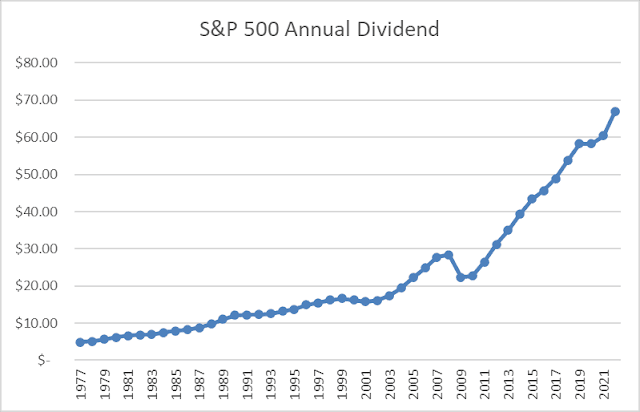
While S&P 500 price declined by 19.78% in 2022, S&P 500 dividends went up by 10.82% in 2022.  S&P 500 dividends increased from $60.40 in 2021 to $66.92 in 2022. That increase was higher than inflation.

S&P 500 dividend payments have increased for 13 consecutive years, and set a payment record for the last 11 consecutive years. S&P 500 is a dividend achiever.


Historically, US dividends have increased faster than the rate of inflation. They also rarely decrease. Over the past 80 years, US dividends have only decreased in a material way during the 2008 Global Financial Crisis. Prior to that, US dividends had decreased during the Great Depression of 1929 - 1932 and the following 1936 - 1937 mini-depression. 

In other words, dividends decrease very very rarely. Only when Capitalism is on its knees, do companies cut dividends en masse.

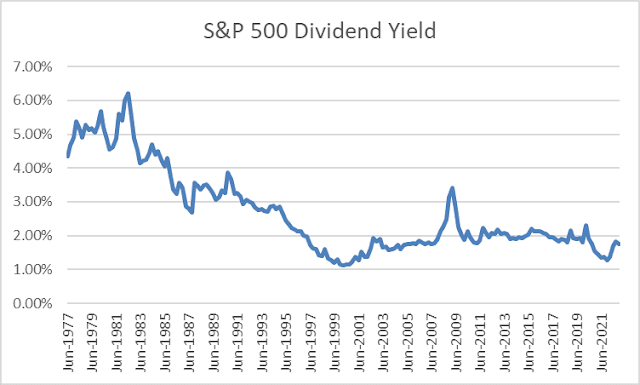
Due to declines in share prices in 2022, dividend yields on S&P 500 increased from the record low levels at the end of 2021. Dividend yields on S&P 500 went up from 1.27% to 1.74%.

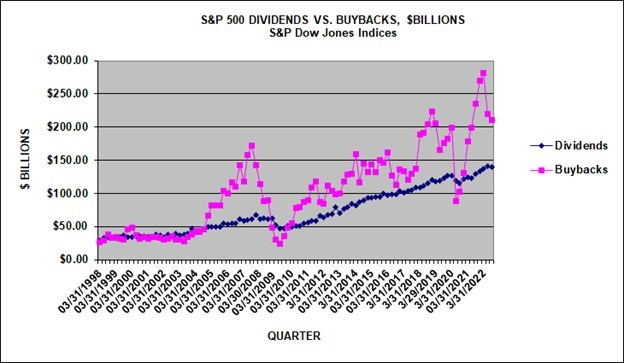
Share buybacks decreased slightly in 2022 as well, though they are still higher than S&P 500 dividends


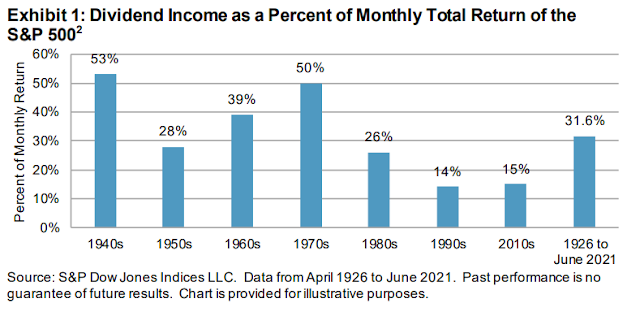
Since 1926 dividends have contributed approximately 32% of total return for the S&P 500, while capital appreciations have contributed 68%. ( through 2021)


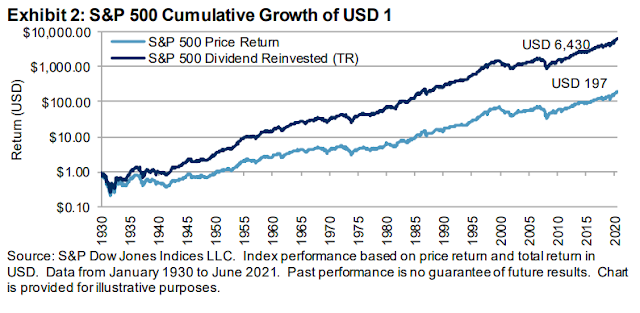
The power of reinvested dividends is even more pronounced over long periods of time.

A $1 investment made using the S&P 500 on Jan. 1, 1930, would have grown to $197 by the end of June 2021 if we focused on price return only

During the same period, a $ 1 investment with dividends reinvested would have yielded $6,430.


Of course, not all dividends are created equal. I prefer to invest in companies that regularly increase dividends. Requiring a consistent track record of regular dividend increases over at least 10 years narrows down my investment universe to a little over 300 companies. This helps me to focus on quality companies, with solid competitive advantages, which grow and distribute excess cashflows to shareholders.

Companies that grow dividends are best-of-breed. By paying a dividend, they focus on best projects with highest expected returns. Most companies cannot reinvest everything back at a high rate of return, hence they send dividends our way. In other words, paying a dividend actually ends up unlocking value, because otherwise that money would have sat on the balance sheet without earning much return or worse, it would have been wasted on some management pet project ( or corporate jets). But because managements of dividend growth companies focus on highest return projects when they reinvest money, they also have discipline, and ultimately end up growing earnings. Those growing earnings tend to help in growing dividends per share and intrinsic values over time. Reinvesting those growing dividends further turbo-charges income and shows the miracle of compounding.

My favorite lists include:


Relevant Articles:

- Dividend Increases for the Dividend Aristocrats in 2022

- There is no alternative (TINA)


Monday, January 9, 2023

Two Dividend Achievers Rewarding Shareholders With Raises

As part of my review process, I monitor the list of dividend increases every week. This exercise helps me monitor existing positions, but also identify newer companies for further research.

I tend to focus on the companies with a long history of annual dividend increases, like the achievers or aristocrats. That's because I am looking for companies that can potentially grow dividends over the course of a full economic cycle. I am also looking for companies that are riding long economic trends that last many years. I am not interested in short-term investments.

Monitoring dividend increases is just one part of my process of course. I monitor my watchlist, screen companies in my investment universe and try to scour the world for ideas. Once I get to an idea, I review its fundamentals, and determine the maximum entry price I am willing to buy it at.

Over the past week, there were two companies that increased dividends and managed to increase dividends annually for at least a decade.


Bank OZK (OZK) provides various retail and commercial banking services. 

The bank hiked quarterly dividends by 3% to $0.34/share. The new rate is 13.33% higher than the dividend paid during the same time last year.

This newly minted dividend champion has managed to increase dividends for 25 years in a row. Over the past decade, Bank OZK has managed to increase dividends at an annualized rate of 17.60%.

Between 2012 and 2021, Bank OZK managed to grow earnings from $1.11/share to $4.49/share. It's expected to earn $4.48/share in 2022 and $5.26/share in 2023.

The stock sells for 9 times forward earnings and yields 3.36%.


Enterprise Products Partners L.P. (EPD) provides midstream energy services to producers and consumers of natural gas, natural gas liquids (NGLs), crude oil, petrochemicals, and refined products. The company operates through four segments: NGL Pipelines & Services, Crude Oil Pipelines & Services, Natural Gas Pipelines & Services, and Petrochemical & Refined Products Services. 

This Master Limited Partnership hiked quarterly distributions to $0.49/unit. This distribution represents a 5.4 percent increase over the distribution paid during the same time last year.

This dividend achiever has managed to increase distributions every single year since going public in 1998.

Enterprise Products Partners is one of the best run MLPs in my opinion. Over the past decade, it has managed to grow distributions at an annualized rate of 4%.

The MLP yields 7.84% today.


Relevant Articles:

- Dividend Increases for the Dividend Aristocrats in 2022
- Twelve Companies Rewarding Shareholders With a Raise


Popular Posts