Monday, April 4, 2022

Four Dividend Growth Stocks Rewarding Shareholders With Raises

I review the list of dividend increases each week, as part of my monitoring process. This helps me monitor existing holdings. This step also helps me identify potential ideas for further research. 

For these reviews, I usually focus my attention on companies with at least a ten year track record of annual dividend increases. I ignore the rest, because I want companies with the ability to grow dividends throughout a normal economic cycle.

I also review trends in earnings per share, dividend growth, and valuation, before deciding if I want to spend more of my time researching the company in detail. I also like reviewing the press releases, in order to sense the tone and commitment of company management to furthering shareholder interests.

During the past week, there were four companies that raised dividends, and had an adequately long track record of annual dividend increases. The companies include:


Bank OZK (OZK) provides various retail and commercial banking services. 

The company raised its quarterly dividend by 3.30% to $0.31/share. Bank OZK has increased its quarterly cash dividend on its common stock in each of the last forty-seven quarters. For comparison purposes, the bank paid $0.28/share in April 2021. 

Bank OZK has raised dividends for 26 years in a row and has a ten year annualized dividend growth rate of 19.90%.

Between 2012 and 2021, the bank managed to grow earnings from $1.10/share to $4.47/share. It is expected to earn $3.94/share in 2022.

The stock is selling for 10.86 times forward earnings and yields 2.81%.

Glacier Bancorp, Inc. (GBCI) operates as the bank holding company for Glacier Bank that provides commercial banking services to individuals, small to medium-sized businesses, community organizations, and public entities in the United States.

The company increased its quarterly dividend by 3.10% to $0.33/share. The Company has declared 148 consecutive quarterly dividends and has increased the dividend 49 times. This is the eleventh year of consecutive annual dividend increases. Over the past decade, the company managed to grow dividends at an annualized rate of 9.30%.

Between 2012 and 2021, the bank managed to grow earnings from $1.05/share to $2.86/share. The company expects to earn $2.79/share in 2022.

The stock is selling for 18.05 times forward earnings and yields 2.63%.

The PNC Financial Services Group, Inc. (PNC) operates as a diversified financial services company in the United States. 

The company raised its quarterly dividend by 20% to $1.50/share. This is the twelfth consecutive year of annual dividend increases for this dividend achiever. Over the past decade, the bank has managed to boost dividends at an annualized rate of 16.30%. 

"The significant increase in our dividend is reflective of PNC's financial performance, strong capital levels and our board's confidence in our business model and strategies," said William S. Demchak, PNC chairman, president and chief executive officer.

PNC earned $5.28/share in 2012 and managed to grow earnings to $12.70/share in 2021. The bank is expected to earn $14.13/share in 2022.

The stock is selling at a forward P/E of 12.97 and yields 3.30%.

Watsco, Inc. (WSO) distributes air conditioning, heating, refrigeration equipment, and related parts and supplies. 

The company increased its quarterly dividend by 12.80% to $2.20/share. This is the ninth year of dividend increases for Watsco. They lost their track record in 2012, when they distributed a large special dividend, in anticipation of the increased taxes on dividends in 2013. That never happened, to they resumed growing the dividend from a lower base. 

Watsco has paid dividends to shareholders for 48 consecutive years. The Company’s philosophy is to share increasing amounts of cash flow through higher dividends while maintaining a conservative balance sheet with continued capacity to build its distribution network. Future changes in dividends are considered in light of investment opportunities, cash flow, general economic conditions and Watsco’s overall financial condition. 

Watsco grew earnings from $2.70/share in 2012 to $10.78/share in 2021. The company is expected to further grow earnings per share to $11.99 in 2022.

The stock is selling at 25.41 times forward earnings and yields 2.89%.

Relevant Articles:

- Thirteen Dividend Growth Stocks Rewarding Shareholders With A Raise

- Five Dividend Stocks Rewarding Shareholders With Raises


Friday, April 1, 2022

Help! I have a serious spending addiction

I have a serious spending addiction – any time I find myself with some extra cash on hand, I end up spending it. This is particularly troublesome, as I tend to salivate when I see an item that I really want.

Anytime there is a big sale, especially one with large markdowns, my spending problem comes out on the surface and I sometimes go through all of my cash on hand and sometimes even borrow money to spend. The exhilarating feeling of spending my cash is similar to probably what a drug addict feels when they get their daily dose. I look at the list of items I spent my money on, and it provides me with an internal sense of happiness and accomplishment. Sometimes, I even look for ways to save money from recurring expenses in order to have more money to spend. I am often scrambling to find enough cash, as I always have at least 15 – 20 deals on my radar, just waiting to be purchased.

I spend a large portion of my monthly income on dividend paying stocks. I willingly spend my money on dividend stocks because I know that I am contributing towards my retirement goals. I view every dollar that I can invest in a quality dividend stock at attractive valuation such as PepsiCo (PEP), Altria (MO) or Johnson & Johnson (JNJ), will work hard for me and produce several more dollars over their lifetime for me.

Over the past two months however, my spending addiction went out of control. There are a lot more bargains to be found. If we enter a bear market, we will have even more sales to take advantage of.  My fingers are itching on my trigger, as I see so many quality firms which are selling at promising entry prices.

Unfortunately, I would have to train myself to resist future sales in the future. This is because once I start living off our investments, I will have less money to invest every month. The month of April is usually a reminder of this future event for me. The reason why I will purchase a limited amount of stock in April is due to taxes. Once your income from non-salary sources becomes noticeable, you end up having to pay estimated quarterly taxes. Fortunately or unfortunately, my estimated payments were not sufficient to cover the remainder of taxes due. This is fortunate, because I had been able to deploy the funds at prices that were much lower than prices today. I would much rather invest the funds and get the chance of earning a return on them, rather than provide a zero interest loan to the government.

Luckily, by the end of April, I should be able to redirect my cash flows toward growing my dividend positions. Hopefully, the market is not going to increase too much by that time.

Relevant Articles:


Your future retirement income is on sale
Three stages of dividend growth
S&P 8000 – The power of reinvested dividends in action
Dividend Investors Should Focus on Valuation, not just Yield
39 Dividend Champions To Consider

Wednesday, March 30, 2022

Do not time the market

"Timing the market is a fool's game, whereas time in the market is your greatest natural advantage." 

- Nick Murray


I am a firm believer in the concept of buy and hold investing. I invest regularly every single month, in a group of attractively valued companies. I do not accumulate cash, waiting for a crash, nor do I get in and out of stocks based on moving averages or even valuation targets. Once I buy a company, I hold it, and reinvest dividends, for as long as it doesn't cut or eliminate the dividend. I simply follow my own strategy, through thick or thin.

Many investors seem to believe that they can score extra points by timing the market. In my opinion, they are needlessly complicating investing. 

In order to be successful with market timing, you need to make two correct decisions:


1. When to get out 

2. When to get back in


I believe that this is impossible to do. Hence, it's best to just buy and hold.

I've interacted with countless investors who missed most of the bull market of the past 14 - 15 years.


The story usually goes like this:

They sold after a decline in the stock market, and then stayed in cash for years.

The first question I always get is: "Do you think the market is too high"


It is a shame to get out of stocks because "they are too high". Or because you are afraid of stock market fluctuations. 

It's always sad to see this happen. I once spoke to a gentleman who sold in 2009, and never got back in. They locked in losses, and missed out on a lot of appreciation and dividends.

Of course, if you witnessed 2000-2010, you were trained that once S&P 500 reaches 1,500 points, we are due for a 50% decline. However, the issue is that over the long-run, US stocks tend to rise due to growth in earnings, revenues, dividends. Even if stocks stay flat, investors would generate returns through dividends and their reinvestment.

A good cure for market timing is to create your own investment system. It can help reduce guesswork, and keep you invested.

In my case, I invest every month in several quality companies with long streaks of annual dividend increases. I then stay invested for as long as these companies do not cut dividends. I reinvest those dividends, and hold these shares. It is best to avoid trading in and out of positions, and selling for some "reason", which usually happens to be fear, or exaggerating on a recent event. Other reasons could include greed, by selling a perfectly good companies because the valuation went a little too high, and reinvesting into a higher yielding stock that is a higher risk stock. I am very diversified, which helps me sleep well at night.

In other cases, folks tend to buy ETFs, which may cost a little in fees, but automates the investing process. The behavioral aspect is always the hard part with ETFs, because there are so many of them, which makes a lot of perfectionists out there tinker with their portfolios, until they try to find the perfect ETF ( Note: It doesn't exist)

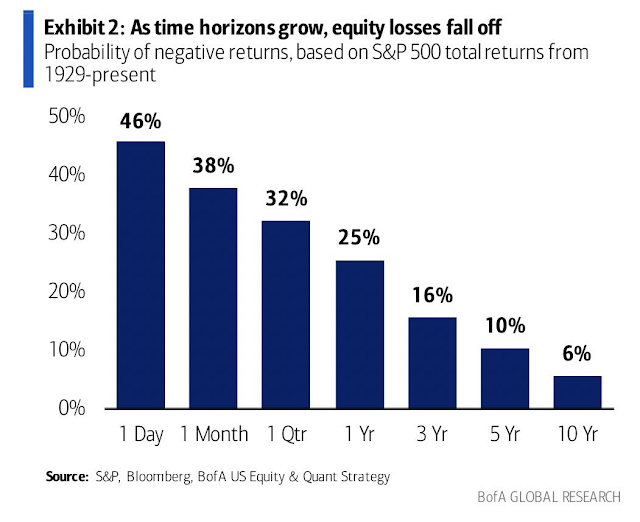
In general, investors make money by buying equities, and holding on to them. While share prices are volatile in the short-run and can result in unrealized losses in a given day, week, month or even year, it is unlikely that over the course of a decade or two there will be losses. This of course works for diversified portfolios of course.


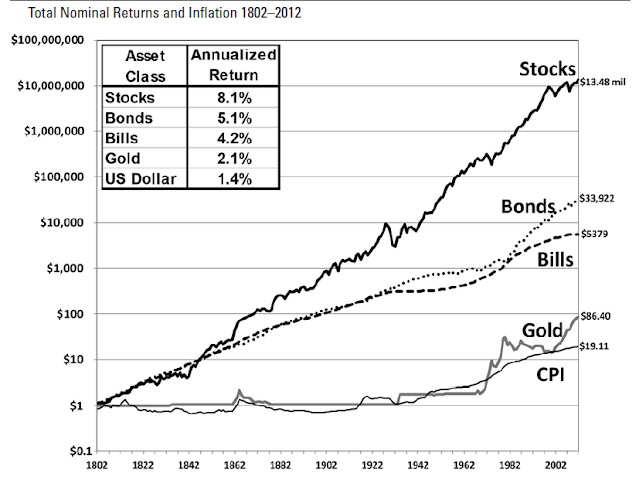
Stocks go up in the long run, because they are ownership pieces of real businesses. Over time, these businesses earn more money, and reinvest a portion to grow the business. They end up generating more than they know what to do with, on aggregate, and send those excess profits to shareholders. All of this tends to grow the values of those businesses as well. It is a true virtuous cycle, which lets the long-term investor take full advantage of the power of compounding. 

This is my favorite chart. In the long-run, US stocks have built a lot of wealth for patient long-term investors. It was never easy, and not always a straight line up. However, patience for US investors has been historically well rewarded. Market timing on the other hand has not been well rewarded.


Source: Stocks for the Long Run

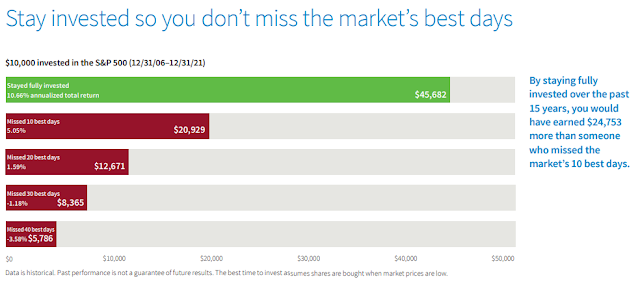
Another favorite statistic I have has to do with staying fully invested, versus missing the best days. If you try to time the short-term movement of security prices, you risk the chance of missing out on the best days. This reduces your future returns significantly.

Source: Putnam

The best and worst days are usually clustered together. If you jump in and out of stocks due to fear and greed that short-term fluctuations cause for you, you risk the chance of missing out on returns, compounding losses, and paying taxes, commissions and fees on top of that. You do not want to be compounding losses.

There’s no need to time the market when you have such a high chance of success through a long-term buy and hold. 


I also wanted to share this amazing video of Peter Lynch, on how to handle stock market volatility.


"Some event will come out of left field, and the market will go down, or the market will go up. Volatility will occur. Markets will continue to have these ups and downs. … Basic corporate profits have grown about 8% a year historically. So, corporate profits double about every nine years. The stock market ought to double about every nine years. So I think — the market is about 3,800 today, or 3,700 — I'm pretty convinced the next 3,800 points will be up; it won't be down. The next 500 points, the next 600 points — I don’t know which way they’ll go. So, the market ought to double in the next eight or nine years. They’ll double again in eight or nine years after that. Because profits go up 8% a year, and stocks will follow. That's all there is to it."


As my friend Chris D’Agnes says, "Don’t just do something, stand there."

This Buffett quote sums up my approach to just sitting there:


"Lethargy bordering on sloth remains the cornerstone of our investment style"

Thank you for reading!

Relevant Articles:


Monday, March 28, 2022

Warren Buffett's Investment in GEICO

Warren Buffett needs no introduction. If you have read "The Snowball", you would know that he was entrepreneurial and focused on investments and making money from an early age.

Back when he was 20, he set a goal to work for Ben Graham. He learned everything there is about him, and his investment style. He had noticed that Ben Graham sat on the board of GEICO, and had a significant ownership of the company.

This is why Buffett ended up taking a train to GEICO's headquarters on a weekend, in order to learn more about the company and its operations. He was only 21 years old at the time. He ended up knocking on the door, until the Janitor let him in and introduced him to the company's CEO. The CEO managed to explain the whole business model, the competitive advantages of the business. This conversation planted the seeds behind Buffett's future endeavors in Insurance, which ultimately led to his investment in Berkshire Hathaway, and transforming it to what it is today.

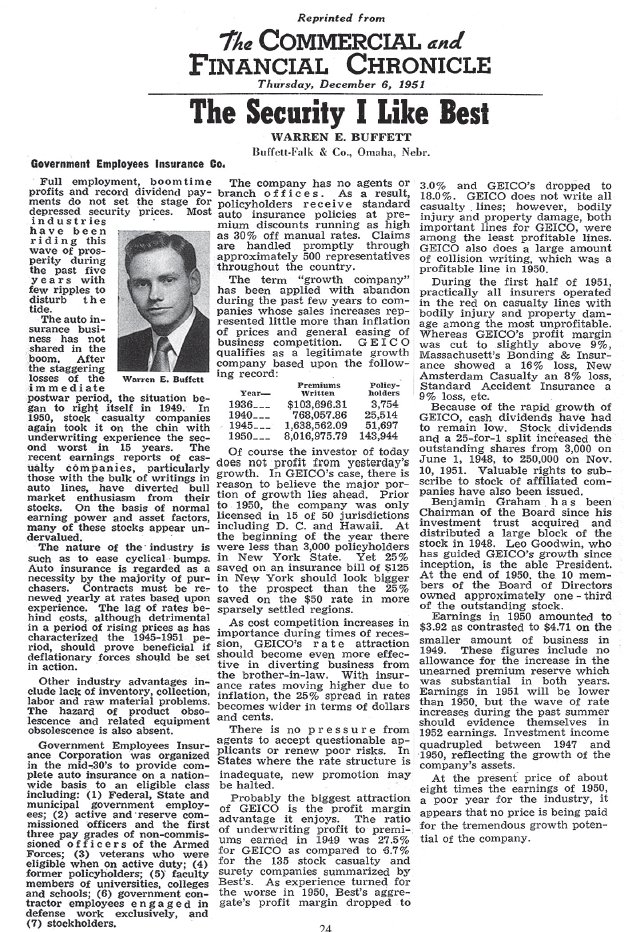
After the conversation, and reviewing filings and reports, Warren Buffett wrote this analysis of GEICO at the young age of 21. This is very impressive, given his young age. You can read it as PDF from here: The Security I Like Best


Source: The Security I Like Best


This is a good lesson in learning. When you write something down, this forces you to think hard about the topic at heart. By trying to distill your thoughts and teach others, you end up improving your communication skills and create a piece of research that is well supported with facts and strong arguments. This strengthens the research, because your thinking is clearer.

He invested $10,000 in the stock, and made a 50% profit in a single year. He did sell the stock however, and reinvested the proceeds elsewhere. That stock became a 130 bagger over the next 20 years. It would have turned that $10,000 into $1.30 million.

If Buffett had not sold the stock, it would have compounded to over $1.30million by 1972.

He was ultimately involved with saving GEICO in the 1970s, when the company had troubles. This investment led him to owning a big chunk of the car insurer. Berkshire invested $45.7 million in GEICO in 1976, and owned about a third of the stock.

The company ultimately rebounded its business, and returned to profitability. GEICO was a dividend achiever, which regularly raised dividends and repurchased shares. As a result of these share repurchases, Buffett's stake in the business increased at the expense of the remaining shareholders. He ultimately had a 50% ownership by 1995, which is when he decided to acquire the rest of GEICO.

Notice that GEICO was a member of the Dividend Achievers List, with a 16 year track record of annual dividend increases as of 1994. Berkshire was about to acquire it by 1995.


A few other Berkshire Hathaway acquisitions that were dividend achievers include General Re, Flight Safety & Wesco.

I find this article particularly fascinating, because it shows a few lessons. Notably, the importance of writing down your thesis, in order to improve investment methodology over time. This also helps in order to make sure you have done the work, in order to reach to a logical conclusion, and not wait for stock tips from others. Of course, it is fascinating to read something that a 21 year old Buffett has written up. It was obvious, in hindsight, that he had bright future ahead of him.

Relevant Articles:

Sunday, March 20, 2022

Five Dividend Stocks Rewarding Shareholders With Raises

I review the list of dividend increases weekly, as part of my portfolio monitoring process. I usually narrow the list down to companies with at least a ten year history of annual dividend increases.

The next involves reviewing each company in sufficient detail, in order to determine if dividend increases are based on solid fundamentals. This review includes looking at trends in earnings per share, dividends per share, payout ratios as good start. The goal is to determine the likelihood of future dividend increases.

The last review point includes valuation. In general, I try to avoid overpaying for companies. To me it used to mean not paying more than 20 times earnings for a stock. Valuation is more art than science however ( as is investing in general). This is why it is important to look at relative valuations and growth in the opportunity set, not just focus on absolute numbers.

These steps keep me in fighting shape, and help me monitor as many companies in the investable dividend growth universe in advance. This helps me to be prepared when the right opportunity at the right price comes along.

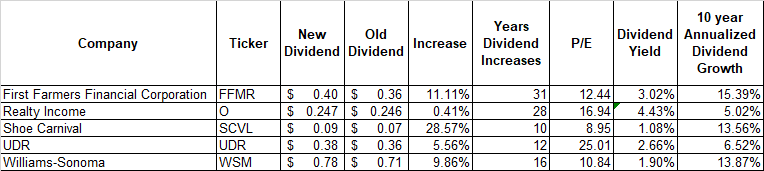
Over the past week, there were three companies which raised dividends to shareholders. Each company has a minimum ten year streak of annual dividend increases under its belt. The companies include:


This of course is just a list, not a recommendation.

When I review companies, I look at ten year trends in:

1) Earnings per share
2) Dividend payout ratio
3) Dividends per share
4) Valuation


Since I have some experience evaluating dividend companies, I also modify my criteria based on the environment we are in and the availability of quality companies. If I see a company with a strong business model and certain characteristics that I like, I may require a dividend streak that is lower than a decade. I have also found success in looking beyond screening criteria by purchasing stocks a little above the borders contained in a screen.

It is important to be flexible, without being too lenient.

You may like this analysis of Realty Income (O) as an example of how I review companies.

Relevant Articles:


Popular Posts