Monday, August 2, 2021

Nine Companies Delivering Solid Dividend Growth

As part of my monitoring process, I review the list of dividend increases every week. I usually focus my attention on the list of companies that have managed to boost distributions for at least a decade.

I have compiled the list of companies that have raised dividends for at least a decade, which also managed to boost dividends last week. The one exception was Mondelez, which I wanted to highlight since I own it. 

The companies for this weeks report include:

Cintas Corporation (CTAS) provides corporate identity uniforms and related business services primarily in North America, Latin America, Europe, and Asia. It operates through Uniform Rental and Facility Services and First Aid and Safety Services segments.

Cintas raised its quarterly dividend by 26.70% to 95 cents/share. This marks the 38th consecutive year of annual dividend increases for this dividend aristocrat. The company switched from making annual payments in 2020 to paying dividends quarterly.

Over the past decade, Cintas has managed to grow dividends at an annualized rate of 19.30%.

Cintas has managed to grow earnings from $2.27/share in 2012 to $10.24/share in 2021.

Cintas is expected to earn $10.64/share in 2022.

The stock is selling for 36.70 times forward earnings and yields 0.97%.

Mondelez International, Inc. (MDLZ) manufactures, markets, and sells snack food and beverage products worldwide.

The company raised its quarterly dividend by 11.10% to 35 cents/share. The company has hiked its quarterly dividend every single year since it split from Kraft Foods in 2012. Mondelez has managed to grow dividends at an annualized rate of 12.80% over the past 5 years.

Mondelez has managed to grow earnings from $2.01/share in 2011 to $2.69/share in 2020.

Mondelez is expected to earn $2.92/share in 2021.

The stock is selling for 21.69 times forward earnings and yields 2.21%.

McKesson Corporation (MCK) provides healthcare supply chain management, retail pharmacy, community oncology and specialty care, and healthcare information solutions in the United States and internationally. It operates through four segments: U.S. Pharmaceutical, International, Medical-Surgical Solutions, and Prescription Technology Solutions (RxTS)

The company raised its quarterly dividend by 11.90% to 47 cents/share. This dividend achiever has managed to increase annual dividends for 14 years in a row. McKesson has managed to grow dividends at an annualized rate of 9.60% during the past decade.

McKesson is expected to earn $19.08/share in 2022. For comparison purposes, the company’s earnings per share went from $5.59 in 2012 to $4.95/share in 2020. The company lost $28.26/share in 2021.

The stock is selling for 10.70 times forward earnings and yields

UMB Financial Corporation (UMBF) operates as the bank holding company for the UMB Bank that provides various banking and other financial services.

The company raised its quarterly dividend by 15.60% to 37 cents/share. This was the 30th year of consecutive annual dividend increases for this dividend champion.

Over the past decade, the company has been able to grow dividends at an annualized rate of 5.30%.

UMB Financial managed to grow earnings from $2.64/share in 2011 to $5.93/share in 2020. The company is expected to earn $7.16/share in 2021.

The stock is selling for 13.08 times forward earnings and yields 1.58%.

Republic Services, Inc. (RSG) provides non-hazardous solid waste collection, transfer, disposal, recycling, and environmental services in the United States.

The company raised its quarterly dividend by 8.20% to 46 cents/share. This is the seventeenth consecutive year of increasing the dividend for Republic Services. Over the past decade, the company has been able to grow dividends at an annualized rate of 7.90%.

Between 2011 and 2020, this dividend achiever has managed to grow earnings from $1.56/share to $3.02/share.

Republic Services is expected to earn $3.85/share in 2021.

The stock is selling for 29.95 times forward earnings and yields 1.47%.

The Hershey Company (HSY) manufactures and sells confectionery products and pantry items. The company operates in two segments, North America; and International and Other.

The company raised its quarterly dividend by 12% to 90.10 cents/share. This marked the 12th year of consecutive annual dividend increases for this dividend achiever. Over the past decade, the company has been able to grow dividends at an annualized rate of 9.40%.

Between 2011 and 2020, Hershey managed to increase earnings from $2.74/share to $6.11/share.

Hershey is expected to earn $6.89/share in 2021.

The stock is selling for 25.62 times forward earnings and yields 1.82%.

KLA Corporation (KLAC) designs, manufactures, and markets process control and yield management solutions for the semiconductor and related nanoelectronics industries worldwide.

The company raised its quarterly dividend by 17% to $1.05/share.

This is the twelfth consecutive dividend level increase for this dividend achiever.

Between 2011 and 2020, the company managed to grow earnings from $4.66/share to $7.70/share.

The company is expected to earn $14.12/share in 2021.

The stock is selling for 22.34 times forward earnings and yields 1.14%.

American States Water Company (AWR) provides water and electric services to residential, commercial, industrial, and other customers in the United States. It operates through three segments: Water, Electric, and Contracted Services.

The company raised its quarterly dividend by 9% to 36.50 cents/share. This dividend king has paid dividends every year since 1931, increasing the dividends received by shareholders each calendar year for 67 consecutive years.

Between 2011 and 2020, the company managed to increase earnings from $1.21/share to $2.33/share.

American States Water Company is expected to earn $2.43/share in 2021.

The stock is selling for 36.35 times forward earnings and yields 1.65%.

Diageo plc (DEO) produces, markets, and sells alcoholic beverages. 

The company increased its Final Dividend by 5% to 44.59 British Pence/share. Diageo had raised its interim dividend by only 2% in the Spring. The total annual dividend in 2021 is 3.82% higher than the total annual dividend paid in 2020.

Diageo has managed to increase dividends annually since at least 1998.

The stock sells for 27.45 times forward earnings and yields 2%.

Relevant Articles:


Wednesday, July 28, 2021

How dividends protect income from inflation

Since 1960s, dividends have increased at a steady pace. Perhaps due to inflation, perhaps due to the end of the Gold Standard, perhaps due to changes in the types of industries.


As an investor, I buy shares in companies that sell goods and services to consumers, and earn a profit in the process. Many of these companies have competitive advantages, which would allow them to pass on any sustainable cost increases to the final customers by raising prices. 

This means that equities could turn out to deliver a good inflation protection. If companies grow earnings, they can distribute more to shareholders in the form of dividends. In other words, dividends tend to produce a stream of income that protects against inflation.

I looked at the data for S&P 500 dividends since 1960 in order to test this hypothesis. (Source)

I also obtained data on annual inflation in the US. (source)

It does seem that dividends have managed to exceed inflation in each decade since 1960. The exception is in the 1970s, when dividends trailed slightly behind inflation. However, stock prices lost a lot more ground to inflation.


I tried to look at it by breaking it down by years. The period of high inflation in the US was between 1966 – 1981. During that time, inflation was just slightly above dividend growth. But if you spent dividends you largely maintained standard of living.


It looks like there were a few years where dividend income was lower at an inflation adjusted rate than 10 years earlier (1975). In other words, the purchasing power decreased by 25% through 1975, compared to 1965. But then it rebounded from there.

If we looked at real stock prices between 1965 and 1981 however, the picture is much worse. The inflation adjusted stock price, as indicated by S&P 500, decreased by 50% between 1965 and 1975 and stayed there till 1981. This means that if you held stock that could purchase $100,000 worth of goods in 1965, by 1975 that same basket of stocks could buy half of what you could buy before.


I do not have the data on Bonds, but interest income definitely lost purchasing power even more rapidly.

Overall, dividends have managed to provide a good protection against inflation. That being said, while dividends provide good inflation protection over time, that may not hold true in every single year. The period from 1965 - 1975 clearly indicates this.

The question for me is how would this affect me if I were retired and living off dividends between 1965 - 1975. I would probably have to look for ways to cut expenses in some areas, but not in others. The nice thing is that my personal basket of goods and services used will be different than the basket measured using CPI. 

I can always try to adjust my spending and my budget. For example, if travel was a big expense, I may spend less time travelling to expensive destinations like Paris, France and go to cheaper locations. I may go for switching brands or I may go for stocking up on certain items earlier in the year. Of course, certain expenses like healthcare are more difficult to manage and forecast too. 

In addition, while I used S&P 500 dividends as a proxy for dividend incomes in general, this is just a proxy. The portfolio of companies I would have invested in may have generate a dividend income stream that provides a better protection against inflation ( though it could be worse too if I chose poorly). Not all S&P 500 companies are dividend growth type however. The index includes a lot of cyclical names like U.S. Steel or General Motors, which tend to cut dividends during recessions, and are not dividend growth stocks. I tend to focus my attention on the companies that grow dividends annually, and have a track record for doing so. It also helps to analyze these companies, in order to understand if they can keep growing earnings and dividends. Having a competitive advantage, a strong brand name and a leadership position are big pluses in my book.

If I focus my attention on companies that grow dividends each year, I stand a better chance of growing my dividend income and protecting it against the ravages of inflation.

I obtained the historical dividends for three dividend growth stocks I thought about at the top of my head. I would argue that these are prominent large cap companies that have been prominent large and established companies for many decades, so it is reasonable to conclude that an investor would have had a chance of selecting them 55 years ago.

For example, Johnson & Johnson (JNJ) managed to grow real dividend income by a factor of 5 during the 1965 - 1981 period


Procter & Gamble shareholders also saw a gradual increase in their inflation-adjusted dividend income, albeit at a much slower pace than Johnson & Johnson. 


Coca-Cola shareholders also saw a gradual increase in their inflation-adjusted dividend income, albeit at a much slower pace than Johnson & Johnson, but faster than Procter & Gamble.


It looks like it has paid to be selective, when looking for dividend growth stocks that can grow dividends at or above the rate of inflation.

Thank you for reading. Please let me know what you think in the comments below.

Relevant Articles:

- A Look Under the Hood For Inflation

- Dividend Growth Stocks Protect Investors from Inflation


Monday, July 19, 2021

Seven Dividend Growth Stocks Rewarding Shareholders With Raises

As part of my monitoring process, I review the list of dividend increases every week This activity helps me to monitor the business performance of any companies I am invested in. It also helps me to identify any hidden dividend gems, and place them on my list for further research.

My reviews are an example of the quick way I use to evaluate companies, before deciding if they are worth a second look later or not.

The companies in today’s article have managed to grow dividends for at least ten years in a row. These companies also announced a dividend increase during the past week. The companies include:

Walgreens Boots Alliance, Inc. (WBA) operates as a pharmacy-led health and beauty retail company. It operates through three segments: Retail Pharmacy USA, Retail Pharmacy International, and Pharmaceutical Wholesale. 

Walgreens Boots Alliance hiked its quarterly dividend by 2.1 percent to 47.75 cents/share. This marked the 46th consecutive annual dividend increase for this dividend aristocrat. Over the past decade, it has managed to increase dividends by 11.50%/year. Lately, the rate of dividend increases has declined to about 2%/year.

Walgreen’s earned $2.94/share in 2011 and is expected to earn $4.80/share in 2021. It looks like Walgreen’s has been unable to grow earnings per share for about 3 – 4 years now.

The stock is selling for 9.59 times forward earnings and yields 4.15%.

Marsh & McLennan Companies, Inc. (MMC) is a professional services company which provides advice and solutions to clients in the areas of risk, strategy, and people worldwide. It operates in two segments, Risk and Insurance Services, and Consulting.  

Marsh & McLennan Companies hiked its quarterly dividend by 15.10% to 53.50 cents/share. This marked the 12th consecutive year of annual dividend increases for this dividend achiever. Over the past decade, the company managed to grow dividends at an annualized rate of 8.60%/year.

Earnings increased from $1.55/share in 2010 to $3.94/share in 2020.

The company is expected to generate $5.65/share in 2021.

The stock sells at 25 times forward earnings and yields 1.51%.

PPG Industries, Inc. (PPG) manufactures and distributes paints, coatings, and specialty materials worldwide. The company raised its quarterly dividend by 9.30% to 59 cents/share. This marked the 50th consecutive year of annual increases in the company’s dividend for this newly minted dividend king.

Between 2011 and 2020, the company managed to grow earnings from $3.44/share to $4.45/share. PPG Industries is expected to earn $8.03/share in 2021.

The stock sells for 21.21 times forward earnings and yields 1.39%.

National Retail Properties (NNN) invests primarily in high-quality retail properties subject generally to long-term, net leases.

The company raised its quarterly dividend by 1.90% to 53 cents/share. The increase in the quarterly dividend marks the 32nd consecutive annual dividend increase for this dividend champion. Over the past decade, the company has managed to grow annual dividends at a rate of 3.20%.

The REIT is expected to generate $2.76/share in FFO in 2021. It earned $1.70/share in FFO in 2011 and grew it to $2.51//share in 2020.

The REIT is selling for 17.50 times forward FFO and yields 4.38%.

Computer Services, Inc. (CSVI) provides core processing, digital banking, managed services, payments processing, print and electronic distribution, and regulatory compliance solutions to financial institutions and corporate entities in the United States.

Computer Services, Inc. hiked its dividend by 8 percent to 27 cents/share. This marked the 50th consecutive year of increased cash dividends paid to shareholders, according to the company.  

I have been unable to verify this claim however, as the company has only been public since 1995, and old annual reports only go back to 2004.

If you go to their 2006 annual report however, and flip to page 20, it states that “The fiscal 2006 cash dividend marks the 17th consecutive year with a dividend increase”.  https://backend.otcmarkets.com/otcapi/company/financial-report/10039/content

They started claiming a 42 year history of annual dividend increases in 2014’s annual report. On the 2013s annual report the claim was for a 24th consecutive year of annual dividend increases.

Between 2012 and 2021, the company has managed to grow earnings from 87 cents/share to $2.10/share.  The company has managed to grow dividends at an annualized rate of 16.20% over the past decade.

The stock is selling for 28.18 times earnings and yields 1.90%.

Duke Energy Corporation (DUK) operates as an energy company in the United States. It operates through three segments: Electric Utilities and Infrastructure, Gas Utilities and Infrastructure, and Commercial Renewables.

Duke Energy Corporation hiked quarterly dividends by 2.1 percent to 98.50 cents/share. This marked the 17th year of consecutive annual dividend increases for this dividend achiever. Over the past decade, Duke has managed to boost dividends at an annualized rate of 2.80%.

The company earned $3.83/share in 2011 and is projected to generate $5.18/share in 2021.

The stock is selling for 20.21 times forward earnings and yields 3.76%.

Cummins Inc. (CMI) designs, manufactures, distributes, and services diesel and natural gas engines, electric and hybrid powertrains, and related components worldwide. It operates through five segments: Engine, Distribution, Components, Power Systems, and New Power.

Cummins increased its quarterly dividend by 7.4 percent to $1.45/share.  This dividend achiever has managed to increase annual dividends for 16 years in a row. Over the past decade, Cummins has managed to grow dividends at an annualized rate of 19.70%.

The company managed to grow earnings from $9.55/share in 2011 to $12.01 in 2020.

Cummins is expected to earn $16.11/share in 2021.

The stock sells for 14.81 times forward earnings and yields 2.43%.

Ryder System, Inc. (R ) operates as a logistics and transportation company worldwide. The company operates through three segments: Fleet Management Solutions (FMS), Supply Chain Solutions (SCS), and Dedicated Transportation Solutions (DTS).

Ryder System raised its quarterly dividends by 3.60% to 58 cents/share. This marked the 17th year of consecutive annual dividends for this dividend achiever.

The company is expected to earn $5.92/share in 2021. For comparison, the company earned $3.28/share in 2011, but lost money in 2019 and 2020.

The stock is selling for 11.98 times forward  earnings and yields 3.27%.

Relevant Articles:


Sunday, July 11, 2021

J. M. Smucker (SJM) Dividend Stock Analysis

The J. M. Smucker Company (SJM) engages in manufacturing and marketing branded food products primarily in the United States, Canada, and internationally. 

The company is a member of the dividend achievers index, and has boosted distributions for 24 years in a row.

The company’s last dividend increase occurred last week, when the Board of Directors approved a 10% increase to 99 cents/share. 

Over the past decade this dividend growth stock has delivered an annualized total return of 8.33% to its shareholders.


J.M. Smucker Company has managed to increase earnings from $4.05/share in 2011 to $7.79/share in 2021. 

The EPS figures are not adjusted for amortization charges, which are related to intangible assets which are generated when acquisitions occur. These amortizations depress earnings per share artificially by $2.08/share in 2021, $2.07 in 2020, $2.11 in 2019 and $1.82 in 2018. The company is expected to generate adjusted earnings of $8.70 to $9.10/share in 2022. For comparison, adjusted earnings per share for 2021 were $9.12/share.


2021

2020

2019

2018

2017

2016

2015

Amortization/ share

$2.08

$2.07

$2.11

$1.82

$1.79

$1.74

$1.06


Future increases in earnings would likely be generated by acquisitions and some by cost restructuring. The company has a track record of making acquisitions that work. The company has taken the initiative to improve operations and production efficiencies and improving its cost base. The demand for products in Smucker’s end markets is stable and would grow slowly over time.

The demand for coffee, peanut butter, jelly, and cooking oils is pretty stable, and results in repeatable sales to consumers, once you establish that relationship. However, the industry is fiercely competitive, which is why the company needs to constantly spend on marketing, and is also exposed to rising costs and potentially being unable to pass them onto consumers.

International sales account for less than a quarter of revenues, which is an opportunity for growth. Product innovation could also provide opportunities for growth.

One risk factor to look at is that sales to Wal-Mart account for over a quarter of revenues. This is a high reliance on the world’s largest retailer, which is known for its stance to keep costs low. On the other hand, this is a mutually beneficial relationship, as customers looking for a particular brand may be turned off a retailer if they do not find it.

The number of shares outstanding has been largely flat. While it went down between 2009 and 2015, a strategic acquisition increased the number of shares in 2016. They have repurchased only a negligible amount of stock back.


The annual dividend payment has increased by 8.70% per year over the past decade, which higher than the growth in EPS. This was achieved mainly through the expansion in the dividend payout ratio.


An 8.70% growth in distributions translates into the dividend payment doubling almost every eight years. If we look at historical data, going as far back as 1978 we see that J. M. Smucker has actually managed to double its dividend every seven years on average.

The dividend payout ratio has increased from 39.10% in 2007 to 46% in 2016. A lower payout is always a plus, since it leaves room for consistent dividend growth minimizing the impact of short-term fluctuations in earnings.


Thursday, July 8, 2021

Understanding Compounding and Getting Rich Late in Life

I once shared the story of Ronald Read, who died at the age of 92 in 2014 with a dividend portfolio worth $8 million. That story shows that Ronald Read earned close to $20,000 in monthly dividend income from this diversified portfolio of 95 blue chip securities. It looked like Mr Read invested solely for dividend income, and his portfolio was well put together.

I was confused by some of the feedback, mostly judging him for his frugal lifestyle. A lot of folks asked me if he really enjoyed his life.

I think that these folks do not understand the powerful force of compounding. It is likely that they do not understand frugality, and the fact that you need to save something, in order to find money to invest.

But what they really failed to understand the power of investing small amounts on a consistent basis, and then letting that money compound for long periods of time. This is how wealth is built in the stock market.

The problem with long term investing is that the investment balances and dividend incomes will be largest at the end of our journeys. If you compound money for a long period of time, most of the gains will be visible after 40 - 50 - 60 years. That would be the case even if your savings rate was around 10% - 20%, which is not extreme in any case shape or form.

Let’s start with the basics

$1 invested today at 10% turns into $1.10 in one year, and $1.21 in two years. The extra cent in year 2 is due to the power of compounding. If you never compounded that $1, you would be simply stacking 10 cents per year. When you reinvest, you end up earning profits on top of profits, which creates a virtuous cycle of wealth.

Compounding is a powerful force, especially when you have a good return and you let the snowball roll for a long period of time. Most of the results will be visible at the end of the journey however.

The initial grind is always the hardest, because right away the fruits of compounding are very small. That same dollar invested at 10%/year won’t double until year 7. And still, the mind will trick you into believing that it was not worth it to wait for 7 long year for one measly dollar. A lot of folks lose hope in the initial stages of compounding. This is further compounded by the fact that returns do not arrive at a steady and predictable 10%/year. To earn 10%/year in equities, you would have to endure long drawdowns, recessions, unemployment, and only those patient enough to stick to their plan and to persevere get to enjoy the power of compounding to their advantage.

If that $1 is invested for 50 years at 10% compounded annually, it turns int o$117.39 after half a century.

Therefore, if you are a 30-year-old with $70,000 invested, and you can compound the money for 50 years at 10%/year, you could be worth close to $8 million when you are an 80-year-old.
If you manage to compound money for 60 years, you only need to put $26,275 to work for you, in order to reach $8M in net worth.

It is even more interesting to observe the interaction between savings rates, equity returns and reaching out your goals and objectives. Having the perspective of running the numbers and alooking at different scenarios definitely helps us see things clearly.

Imagine that you earn $5,000/month.

1) If you save and invest $1,000/month and earn 10%/year, you will become a millionaire in 22 years. It would take you approximately 42 years in total to reach a net worth of $8 million. This is a savings rate of 20%, which is high for US standards but nothing extreme.

At this level of savings, our investor spends $4,000/month. If our portfolio has an average dividend yield of 3%, we would need close to $1.60 million to generate $48,000 in annual dividend income. It would take close to 27 years to reach financial independence at this rate of savings.

2) If you save and invest $2,000/month and earn 10%/year, you will become a millionaire in 16 years. It would take a little over 35 years at this savings rate to reach a net worth of $8 million.

At this level of savings, our investor spends $3,000/month. If our portfolio has an average dividend yield of 3%, we would need close to $1.20 million to generate $36,000 in annual dividend income. It would take close to 18 years to reach financial independence at this rate of savings.

3) If you save and invest $4,000/month, but earn 10%/year, you will become a millionaire in 11 years. It would take almost 29 years to reach a net worth of $8 million at this rate of return and this very high rate of savings. It would be very hard to save 80% of income for 3 decades.

At this level of savings, our investor spends $1,000/month. If our portfolio has an average dividend yield of 3%, we would need close to $400,000 to generate $12,000 in annual dividend income. It would take close to 6 years to reach financial independence at this rate of savings.

As you can see, if you want to get rich quickly you need to play a game of strong offense and strong defense. The strong offense is earning a high income, and a strong defense is keeping costs low and trying to avoid lifestyle inflation.


Why am I telling you all of this common sense?

That’s because any time I share a story of someone that ended up with a lot of money at an old age, people always say “I hope he/she enjoyed their money”.

When most folks think about having $1M, they imagine how they will spend it all. These are the folks that live paycheck to paycheck, and seldom advance financially. Another problem with these questions is assigning what's important to someone else as a benchmark of what should be important to him. This is very arbitrary measure of "success".

These comments show that the person making them is not understanding the power of compounding, and the fact that most of the visible gains are seen at the end of someone’s lifetime.

For example, Ronald Read died at the age of 90 in 2014 with an estate worth $8m. That same estate could have been worth $4M in 2007 or $2M in 2000. Most of the gains on this portfolio probably occurred after he retired with an adequate amount. It is very likely that he didn’t even become a millionaire before the age of 70 in the early 1990s.

I extrapolated that data through a review if the total return performance of the proxy for US stocks - a fund based on S&P 500 since 1990. It shows that a $100 investment in S&P 500 in early 1990 would have turned into $900 by 2014 and $2,350 by 2021.


Let's assume that Ronald Read had $8 million in his stock portfolio in 2014, and he just reinvested dividends for the past 25 years and didn't add a single dollar. This means that its value was close to $900,000 in 1990. While this is still an above average amount, it is not as mind-boggling as $8 million. Given the fact that he probably kept adding money to his portfolio, his net worth may have been even lower in 1990.

If he had simply invested $7,812.50 at the age of 22 or $15,625 at the age of 29, and never added a single cent, he would have been worth $8 million by the age of 92. That's merely due to the power of compounding, and assuming 10% annualized returns.

Using the rule of 72, if I generate 10% annualized returns, my money would double roughly every 7 years. The table below illustrates this simple concept:


Because of the nature of compounding, Ronald Read most probably generated 90% of his net worth after the age of 70.

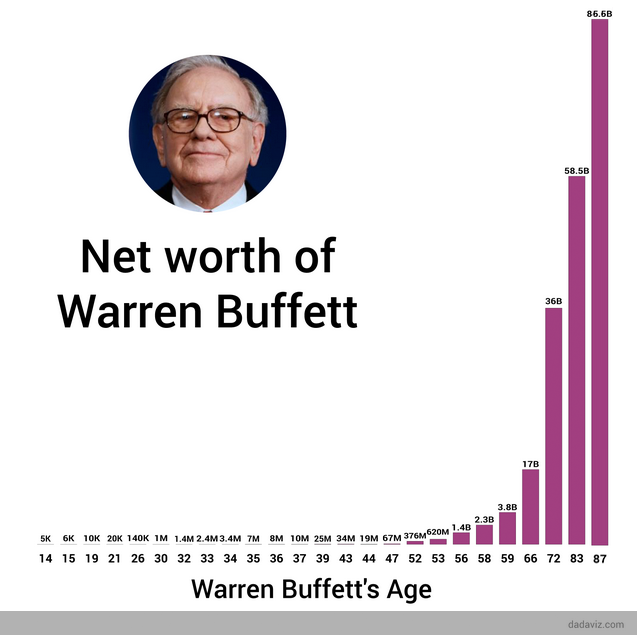
The power of compounding is truly visible with Warren Buffett. He first became a billionaire at the age of 56 in 1986. Today, his net worth is over $100 billion at the age of 91. And that’s after he donated tens of billions of stock to charity. You can see that due to compounding, over 99% of his net worth was built after the age of 56.

Image for post

I like researching different stories and viewpoints, and then trying to take the best lessons that apply in my situation. Ultimately, you are successful if you do something you enjoy.

Thank you for reading!

Relevant Articles:

The Most Successful Dividend Investors of all time
The importance of investing for retirement as early as possible
Dow 370,000
Warren Buffett’s Eight Billion Dollar Mistake

Popular Posts